A nilpotent group has a finite central seriesEquivalently the upper central series, defined by , reaches .
We first prove the normalizer condition for nilpotent groups. If , choose the least with . Then , and an element satisfies . Thus normalizes , giving .
Let be a Sylow subgroup of a finite nilpotent , and write . If , the normalizer condition gives some . The subgroups and are both Sylow subgroups of , so Sylow theorem supplies with . But then , forcing , a contradiction. Therefore every Sylow subgroup is a normal subgroup of .
For normal Sylow subgroups at different primes, . They commute, have coprime orders, and their product has order . Multiplication consequently gives an isomorphism from their external direct product of groups onto .
Conversely, a nontrivial finite p-group has nontrivial center of a group: its class equation has every noncentral conjugacy-class size divisible by , so is a positive multiple of . Induction on order, applied to , gives a central series for . Finite direct products of these central series give a central series for the product, padding shorter series by the full factor. Thus the finite nilpotent group decomposition is
For a finite group, define the Frattini subgroup bythe intersection is when there are no maximal subgroups, which for a finite group happens only for . A second definition is the set of non-generators: an element such that always implies .
If and , put in a maximal subgroup . Then , so . Conversely, if , some maximal subgroup omits it; maximality gives , although . This proves equivalence.
Every group automorphism permutes maximal subgroups, so is a characteristic subgroup, in particular a normal subgroup. Alsoa proper would lie in a maximal subgroup containing both factors.
Set and take a Sylow subgroup of . For , normality of makes a Sylow subgroup of . Conjugating inside therefore gives the Frattini argument factorization . The preceding generating property forces . Thus every Sylow subgroup of is normal, and part (i) shows that is a nilpotent group.
Now suppose is a finite p-group. The normalizer condition makes every maximal subgroup normal: and maximality force . The quotient has no proper nontrivial subgroup, hence is cyclic of prime order; its p-power order makes that prime . Consequently every such containswhere the two factors are the commutator subgroup and the subgroup generated by pth powers. Thus .
The quotient is an elementary abelian group, hence a vector space over . If , extend the nonzero vector to a basis and choose a linear functional nonzero on it. Its kernel pulls back to a subgroup of index , a maximal subgroup omitting . Therefore , provingThe two factors in the last formula are multiplied; the superscripted expression in the TeX aid is not the formula printed in the PDF.
For a subset of a finite p-group, its images span the Frattini quotient precisely when . By the generating property proved in part (ii), this is equivalent to .
If is a minimal generating set of a group, its images must be an irredundant spanning set in the vector space . A linear dependence would express one image using the others; those other images would still span, so the other elements would still generate , a contradiction. Thus the images form a basis. Conversely lifts of a basis generate , and deleting a lift destroys spanning and hence generation.
This proves the Burnside basis theorem, including equality of sizes for every inclusion-minimal generating set of a group:Inclusion-minimal generating sets of a group need not have equal sizes in arbitrary finite groups; the elementary-abelian Frattini quotient is the essential p-group feature.
Use rightmost-first composition of permutations, and letFor , direct evaluation gives . Conjugating this transposition by powers of yields the transpositions between consecutive letters around the cycle, including .
Put . For ,Thus the adjacent transpositions generate every transposition, and permutation cycle decomposition shows that transpositions generate the symmetric group. Therefore .
For the final lower bound, associate a graph to a family of transpositions: its vertices are the letters and its edges are the swapped pairs. Every generator preserves every connected component, so generation of requires that graph to be connected. A connected graph on vertices needs at least edges: adding an edge can reduce the number of components by at most one, starting from isolated vertices. The adjacent transpositions supply exactly edges. Equivalently, transpositions on a connected graph generate the symmetric group. Hence
We prove the primitive three-cycle criterion through supports. First, suppose a subgroup contains , the alternating group on a set of at least three letters, and a three-cycle with support meeting .
If adds one letter, it has two letters in . The group is transitive on unordered pairs of : for three letters its cyclic action permutes the three pairs, and for at least four letters one can adjust the parity of a permutation sending one pair to another while preserving its target pair. Conjugating the new cycle, and using inverses, supplies every three-cycle on two old letters and the new letter. Together with , these generate .
If adds two letters, write its cycle as with . Choose and conjugate within to obtain . ThenThe preceding case first adds ; applying it again to adds . This proves connected triple supports generate an alternating group, by successively merging the intersecting triples of a connected support hypergraph. We used that three-cycles generate alternating groups: pairs of transpositions with a common letter are three-cycles, while a pair of disjoint transpositions is a product of two three-cycles.
Now take all conjugates in of the given three-cycle. Their support hypergraph is -invariant, and its connected components form a block system. Transitivity makes their union the whole set. There is an edge, so a component has more than one vertex. A primitive group action forces a single component. The preceding merging argument proves
For the first family of counterexamples, letIts elements are Möbius transformations , modulo nonzero scalar matrices. Any ordered triple of distinct projective points is the image of under exactly one such transformation: representatives of the first two target lines form a basis, and scaling the two columns sends their sum to the third target line. Thus the action is sharply three-transitive, hence two-transitive and primitive. Its degree is and order . It is divisible by , butso it cannot contain .
For the second example takeThe same projective-line construction over is sharply three-transitive. Its order is divisible by 7 and is less than , so it does not contain . For a concrete field one can use .
Use the displayed formula as a right group action: applying and then gives . It is transitive since sends the identity to . An element fixing every must have by evaluating at the identity, and then for every . Its kernel is therefore , which is trivial by the center of a group hypothesis.
The identity stabilizer subgroup is . For every subgroup containing , setConjugation by diagonal elements makes normal in . Multiplying by shows , soConversely each normal subgroup gives such an . Thus the subgroups strictly between and correspond exactly to proper nontrivial normal subgroups of .
For a transitive action, blocks containing a chosen point correspond to subgroups containing its stabilizer subgroup: a block is the orbit of that point under its setwise stabilizer subgroup, and conversely the orbit under an intermediate subgroup gives a block. Therefore the diagonal action on a centerless group is primitive exactly when is simple. A nontrivial centerless simple group cannot be abelian, because an abelian group's center of a group is the whole group. HenceThis uses the usual nontrivial degree convention. If one allows a one-point action to count as primitive, is the additional degenerate exception.
For the requested order example use . Its simplicity follows from its conjugacy-class sizes : a normal subgroup is a union of classes containing the identity, and no proper nontrivial such sum divides 60. Set , a prime. The primitive diagonal action has
Work in the finite-group setting. If is maximal in a nonabelian simple , then : otherwise every nonidentity element would generate , forcing a cyclic group of prime order. Choose a minimal normal subgroup of . Every characteristic subgroup of is normal in , so minimality makes a characteristically simple group. Its normalizer contains . By maximality it is or , and the latter would make a nontrivial normal subgroup of the simple group , impossible because . This proves the maximal subgroup normalizer criterion:
For , stabilizer subgroups have order 12. Stabilizer subgroups of a two-element subset have order , and are isomorphic to ; for example . The normalizer of a Sylow 5-subgroup has order 10: its normalizer in has order , and exactly half its permutations are even, since a multiplier of order four on is an odd four-cycle. This gives a dihedral group of order 10.
To prove completeness, an intransitive subgroup either fixes a point, or its orbits on five letters have sizes two and three. It therefore lies in one of the first two types. A transitive proper subgroup has order divisible by 5. Its number of Sylow 5-subgroups is one or six, since has six and the count is modulo 5. A count of six would make , forcing an index-two subgroup and contradicting Simplicity of the alternating group A5. Therefore normalizes its unique Sylow 5-subgroup and lies in the order-ten normalizer.
Stabilizer subgroups are maximal because their index is prime. The order-ten group is transitive and cannot have a larger proper transitive overgroup by the preceding argument. The order-six group has no fixed point, cannot lie in a stabilizer subgroup, and cannot lie in the order-ten type because 3 does not divide 10. Thus all three types are maximal. is transitive on points and on unordered pairs, while Sylow conjugacy handles the normalizers. Consequently
Now let . Choosing independent columns gives . Its simplicity follows from the elementary projective-transvection proof in part 4(i), which does not use this subgroup classification.
A stabilizer subgroup and a plane stabilizer subgroup each have index seven and order 24. To construct the remaining type, identify with and take the Singer cycle of multiplications by nonzero field elements, of order seven. Any linear map commuting with a primitive multiplication commutes with all of , so its centralizer is precisely . A normalizer sends a primitive element to another root of its minimum polynomial, namely . The Frobenius map realizes those three choices. Hence
If for a proper , its Sylow count is one or eight. Eight would make , hence . Its index-three coset action would inject the simple group into : the kernel is normal and cannot be all of . This is impossible. Thus normalizes a unique Sylow 7-subgroup and lies in the order-21 normalizer.
If , its order divides 24. In its action on seven nonzero vectors, an odd orbit has size one or three. A one-point orbit gives a fixed point. If a three-point orbit is collinear, it is the set of nonzero vectors of an invariant plane. If its three vectors are independent, their nonzero sum is fixed by . Thus lies in a point or plane stabilizer subgroup.
The index-seven stabilizer subgroups are maximal, and any proper overgroup of the order-21 normalizer would again have a unique Sylow 7-subgroup and normalize that same subgroup, so the normalizer is maximal too. The point and plane stabilizer subgroups are not conjugate: a stabilizer subgroup fixes a point, whereas a plane stabilizer subgroup is transitive on its three internal points and its four external points, so fixes no point. Each type is one conjugacy class. We have proved maximal subgroups of GL3 over F2:
The Fano plane has as points the seven nonzero vectors of , because every one-dimensional vector subspace has just one nonzero vector. Its lines are the seven two-dimensional vector subspaces. Every line has three points, every point lies on three lines, two points determine the line , and two lines meet in one point.
The two order-24 classes are therefore stabilizer subgroups of points and of lines. Each is isomorphic to : fixing a vector gives the block group , the full affine group on four points; inverse transpose gives the dual line stabilizer subgroup. Their distinct fixed-point behavior in part (i) distinguishes the two conjugacy classes.
For a point and line , stabilizes the ordered pair . There are incident pairs and nonincident pairs. A change of basis takes any pair to a fixed model of its type, so each type is a single orbit. Orbit-stabilizer theorem gives the Fano point-line stabilizer intersection:Both occur: take and choose or .
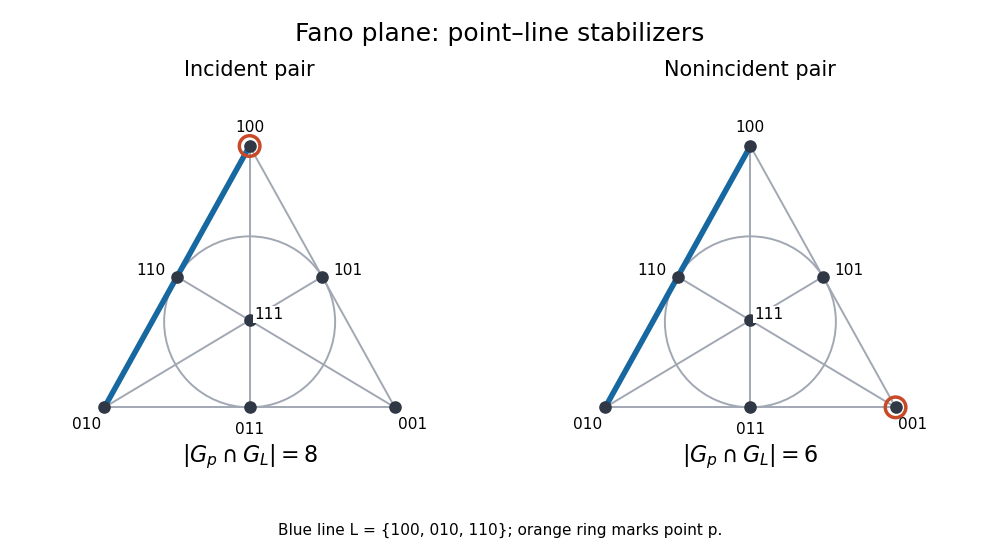
Fano plane with incident and nonincident point-line pairs
. Details. 
For the extension, identify vectors and covectors by the standard pairing. The inverse-transpose automorphism exchanges a point with its orthogonal plane and exchanges the two order-24 classes. Thus it is outer. The Fano plane duality group has order 336 and acts on points and lines, preserving incidence while allowing their types to be swapped.
The stabilizer subgroup of an unordered point-line pair has twice the corresponding ordered-pair stabilizer subgroup: some element outside swaps the pair, since duality produces a pair of the same incidence type and is transitive on such pairs. Hence these stabilizer subgroups have orders 16 and 12. Also every outside conjugate of a Sylow 7-subgroup can be moved back by an element of , giving
We prove these exhaust the maximal subgroups other than . Let be such a maximal subgroup and . Since is not contained in , is normal in and . If , part (i) gives a unique Sylow 7-subgroup of . It is characteristic in , hence normalized by . Therefore maximality forces .
Suppose and . The classification argument in part (i) says fixes a point or a line. Because is normal in , an element outside swaps its fixed-point and fixed-line sets, so it fixes at least one of each. WriteFixed lines are kernels of fixed nonzero covectors, since the only nonzero scalar is one. Duality gives , hence .
If , there is a unique fixed point and unique fixed line; preserves their unordered pair. If , put and . For every , contains the plane and lies in the line . Over there is only one nonzero linear map , so has order two. Invertibility forces : for one needs . Thus and are its unique image point and kernel line. These are canonically swapped by duality, so again preserves their unordered incident pair.
If , then has order two, generated by an involutory duality . For any point , the pair is preserved by . Hence lies in an order-12 or order-16 pair stabilizer subgroup and is not maximal. We have exhausted all cases.
The pair stabilizer subgroups are themselves maximal: a proper maximal overgroup is one of the just-listed types, and divisibility excludes orders 12 inside 16 or 42, and 16 inside 12 or 42. The order-42 normalizer is maximal by the unique-Sylow argument. Incidence types give one conjugacy class each; Sylow conjugacy gives one normalizer class. Thus, apart from the normal index-two subgroup ,
Let . The general linear group over a finite field consists of all invertible linear maps , and the special linear group over a finite field is its determinant-one subgroup. Counting the ordered bases givesThe determinant map is onto , since has determinant . Its kernel is , so
For , commuting with all the elementary transvection matrices forces a matrix to be scalar. Therefore the center of a group of consists of with . The multiplicative group of a finite field is cyclic, so this center of a group has size . The projective special linear group over a finite field consequently has order
Here is a proof of simplicity which isolates all the required ingredients. First we prove the Iwasawa simplicity lemma in the form needed. Suppose a group acts faithfully and primitively, is a perfect group, and has an abelian subgroup normal in a stabilizer subgroup , whose conjugates generate . For a nontrivial normal subgroup , its orbits form a block system. Faithfulness prevents all these orbits from being singletons, so primitivity makes transitive. Thus . Modulo , each conjugate of has exactly the same image as , because we may write its conjugating element as with and . The quotient is generated by this one abelian image and hence is abelian. Since is a perfect group, . Thus every nontrivial normal subgroup is .
Apply this to the action on projective points, that is, one-dimensional vector subspaces of . Any ordered pair of distinct lines can be sent to any other by a linear map obtained by extending representatives to bases. Multiplying one target basis vector by a suitable nonzero scalar adjusts the determinant to one without changing either target line. Thus is two-transitive on these points. A linear map fixing every line is scalar: it is diagonal on a fixed basis, and fixing the lines spanned by makes all diagonal entries equal. The projective quotient therefore acts faithfully, two-transitively, and primitively.
For the line , useThese matrices multiply by addition of , so is abelian. Conjugating by a matrix preserving preserves , so it is normal in that stabilizer subgroup. Its conjugates include every elementary transvection matrix .
These elementary transvection matrices generate by row elimination. For completeness, row addition is elementary, signed row interchange is elementary, and compensating diagonal scalings are elementary because, in a two-dimensional coordinate block,Elimination using these operations reduces a determinant-one matrix to the identity.
It remains to show that these groups are perfect groups. In the following matrix identities use ; the alternative group commutator convention generates the same commutator subgroup. If , distinct indices give the group commutator identityEvery elementary generator is therefore a group commutator. For and , choose with , and let . ThenAs varies this supplies all upper elementary transvection matrices, and conjugation supplies the lower ones. Thus , and its projective quotient, are perfect in the asserted cases. The preceding simplicity argument now applies.
The two exceptions are genuine: the projective actions identify with and with , of orders 6 and 12 respectively. The first contains its normal subgroup of order 3; the second contains the normal Klein four group. We have proved
Replace the determinant condition by preservation of a nondegenerate alternating bilinear form on . In a symplectic basis the symplectic group over a finite field isTo count symplectic bases, choose the first vector in ways, then choose with in ways. Their span is nondegenerate; its symplectic orthogonal complement has dimension and supplies the rest of the basis. The resulting recurrence gives the finite symplectic group order
The elementary replacements are symplectic transvectionsExpanding shows that the two cross terms cancel and the last term vanishes because . Thus these maps preserve ; their inverses are .
We need both generation and primitivity to use the argument from part (i). For nonzero vectors with , the symplectic transvection with direction and parameter sends to . When , choose nonorthogonal to both and use two such steps. Such exists because two proper hyperplanes cannot cover a vector space: if the two linear forms are independent prescribe both values to be one, and if dependent prescribe either a nonzero value. Hence symplectic transvections act transitively on nonzero vectors.
They generate the whole symplectic group over a finite field. Indeed first use them to make a given symplectic transformation fix . Its image of still satisfies . A symplectic transvection with direction fixes and sends to if the pairing is nonzero. If that pairing is zero, pass through for any : it has nonzero pairing with both partners, and both required directions lie in . We have now fixed the first hyperbolic pair, and induction applies in its nondegenerate orthogonal complement. The final two-dimensional case is exactly the elementary generation of proved in part (i).
For a fixed projective point , the symplectic transvections form an abelian subgroup normal in its stabilizer subgroup; conjugation scales by the square of the scalar multiplying . Their conjugates supply all symplectic transvections. A central element commutes with every symplectic transvection, so it preserves every direction line and must be scalar. Conversely scalars commute with the whole group. The kernel of the projective action consists of scalar matrices, and preservation of restricts the scalar to . Thus the center of a group has size and the projective symplectic group over a finite field acts faithfully.
For the stabilizer subgroup has precisely three orbits: its fixed point, the other points in , and the points outside . Transitivity on each follows by extending, respectively, an independent isotropic pair or a hyperbolic pair to a symplectic basis. WriteA nontrivial proper block through the fixed point would be a union of these stabilizer subgroup orbits, hence would have size either or . A block size divides . But , so cannot divide , and , excluding the other size. This proves primitivity. For the projective action is the two-transitive action of .
Here is a direct check of perfectness of finite symplectic groups, including the small fields where the diagonal group commutator needs replacement. If , every symplectic transvection lies in an embedded on a hyperbolic plane containing its direction, and that subgroup is perfect by part (i). Since the symplectic transvections generate, the whole symplectic group over a finite field is perfect.
For and , all are conjugate, so their common image generates the abelianization and satisfies . Choose independent perpendicular vectors . The four commuting symplectic transvections with directions and parameter one multiply to the identity: the sum of their rank-one matrices is zero in characteristic 3. Thus also , giving .
For and , use the seven nonzero vectors of a three-dimensional isotropic subspace of a symplectic vector space. Their symplectic transvections commute, and their product is the identity. To see this explicitly, write a vector in three isotropic basis coordinates: in the sum of the outer products each diagonal coefficient occurs four times and each off-diagonal coefficient twice, all zero in characteristic 2. The common abelianization image therefore satisfies . Again the group is perfect.
The simplicity argument from part (i) now applies to the projective symplectic group over a finite field. The remaining exceptional group besides and is . It is not simple: it is isomorphic to . One can verify this identification without assuming it. On setThese are all 16 quadratic forms with polar form ; the Arf invariant of a quadratic form gives . There are six with invariant one. The symplectic group over a finite field permutes these six forms. Differences of their parameter vectors span : writing for the symplectic basis, the six parameters areTheir pairwise differences include each of . An element fixing all six forms therefore fixes all linear forms , hence is the identity. This gives a faithful action on six objects; the group order is 720, so its image is all of . Consequently
Choose a complement to the fixed -dimensional vector subspace . With column vectors and the decomposition , its parabolic stabilizer of a subspace isThe arbitrary upper-right block forms a normal elementary abelian group. The block-diagonal matrices form a complement, acting on it by . ThusWith row vectors the off-diagonal block is transposed; the subgroup description is the same after the convention change.
The rank of a transitive permutation group is the number of orbits of a stabilizer subgroup, not the rank of a matrix. For , the invariant of its -orbit is . This invariant is complete. Choose a basis of , extend it to a basis of , then add a basis of a complement of in , and extend the resulting independent vectors to a basis of . For with the same intersection dimension , do the same. The map between these adapted bases preserves and sends to .
The Grassmann graph is connected, and its distance can be determined directly. Put , , and . Choose vectors so thatThe vectors of a basis of , followed by all the and , are independent: a relation would identify a vector in the two chosen complements modulo , contradicting . For defineEach successive pair has an intersection of dimension . Thus and are joined by a path of length .
For the lower bound, if two vertices are adjacent, their common vector subspace has codimension one in each. Both and lie between and . Thus one edge can change the dimension of the intersection with by at most one. It must change from to along a path from to , requiring at least edges. Therefore
If two ordered pairs have equal distance, their intersections have equal dimension. Construct adapted bases for each pair as above and extend both to bases of the ambient vector space. The invertible linear map between them sends the first ordered pair to the second. It preserves intersection dimensions, so it is a graph automorphism. This proves that the Grassmann graph is distance-transitive, with the required simultaneous images. Its diameter is , because permits two disjoint -dimensional vector subspaces.
A finite two-transitive group action is transitive on ordered pairs of distinct points. Equivalently, the action is transitive and a point stabilizer subgroup is transitive on the remaining points. Its rank of a transitive permutation group is two, and the orbit-stabilizer theorem gives for degree . Such an action is primitive: a block containing a point and another point must, by the transitivity of the stabilizer subgroup, contain every point.
These groups illustrate two quite different sources of symmetry. The structural theorem for finite two-transitive groups says that they have either a regular elementary-abelian normal subgroup, giving the affine case, or a nonabelian simple normal subgroup, giving the almost simple case. The full classification of the second case depends on the classification of finite simple groups; the useful point here is to describe the constructions, actions, and representative families rather than treat two-transitivity as an abstract property of a group without a specified action.
In the affine case let be a finite vector space over and let act transitively on . The affine two-transitive groupis transitive by translations, and the stabilizer subgroup of zero is exactly , so it is two-transitive. Conversely, if a two-transitive group has an abelian minimal normal subgroup , normal-subgroup orbits and primitivity make transitive. An abelian transitive faithful permutation subgroup is regular: an element fixing one point commutes with every element moving that point and hence fixes them all. Minimal normality makes elementary abelian, since its prime-primary subgroups and its subgroup of pth powers are characteristic. Conjugation by the stabilizer subgroup acts faithfully as linear automorphisms of , and regularity gives . This recovers precisely the construction above.
Many examples follow at once. The group acts on the vectors of ; sends any nonzero vector to any other by a basis map. For , the subgroup also gives a two-transitive action, since the determinant of a basis map can be adjusted on a second basis vector while retaining the prescribed first vector. The affine group with linear part gives another family: the nonzero-vector transitivity was proved using symplectic transvections in part 4(ii). Here the additive group of , for , is an elementary abelian p-group of rank .
In particular consists of with . Given distinct and distinct , the equations , have the unique solution , . Thus this action is sharply two-transitive, of degree and order . Adding field automorphisms gives , still two-transitive, with elements .
An almost simple group lies between a nonabelian simple group and its automorphism group. One must still specify an action: a group can have several permutation representations with different degrees or different transitivity properties. The natural actions of for and for are the most familiar examples of a two-transitive group action. For , the simple group , a normal subgroup, places these groups in the almost simple case; the smaller two-transitive examples belong to the affine case. The symmetric group sends any ordered distinct pair to any other; for the alternating group one can adjust an odd map by swapping two letters outside the target pair. Thus both are two-transitive in the indicated ranges.
The projective linear examples are just as concrete. The groups and act two-transitively onpoints, by the basis and determinant adjustment argument of part 4(i). Their field-automorphism extensions are also two-transitive. On the projective line, is sharply three-transitive: three distinct points determine a unique Möbius transformation. Its degree is and its order is . For even , ; for odd the special projective group has half that order and remains two-transitive, but cannot be three-transitive. In projective dimension at least two, triples of distinct points may be collinear or noncollinear, so the natural action is not three-transitive.
The projective special unitary group over a finite field , for , acts on the isotropic points of a space with a nondegenerate Hermitian form of dimension three over . Its degree and order areFor two distinct isotropic lines the Hermitian form pairing is nonzero, since a three-dimensional nondegenerate Hermitian space has maximal totally isotropic dimension one. Scale their representatives to form a hyperbolic pair and extend to a basis adapted to the Hermitian form. The corresponding isometry sends one ordered pair to another, and a norm-one scalar on the orthogonal one-dimensional complement adjusts its determinant without moving the two lines. Thus the special projective unitary action is two-transitive.
Two further families of simple groups have analogous rank-two actions:The Suzuki group of Lie type and the Ree group of type G2 have stabilizer subgroups containing subgroups acting regularly on all the other points in these actions; this gives two-transitivity. For example has degree 65 and order 29120. These are exceptional Lie-type families, distinct from the preceding linear and unitary constructions.
The symplectic group over a finite field in characteristic two has a particularly illuminating pair of two-transitive actions which are not their projective-vector actions. For , acts on the two classes of quadratic forms whose polar form is the given alternating bilinear form, distinguished by the Arf invariant of a quadratic form. Their degrees areTransitivity on each class follows by choosing symplectic bases giving the standard quadratic-form normal forms. Fix a form . Every other form with the same polar form is , and has the same Arf invariant of a quadratic form exactly when . The stabilizer subgroup of , an orthogonal group over a finite field, is transitive on its nonzero isotropic vectors: extend such a vector to a hyperbolic pair and map adapted quadratic-form bases. It is therefore transitive on the other forms of the same type. This proves two-transitivity of both actions. In particular has actions of degrees 28 and 36. The degree-six action of in part 4(ii) is the smaller-dimensional precursor.
Finally the Mathieu groups supply exceptional examples with even higher transitivity:In particular all five natural actions are two-transitive. Together these examples exhibit affine spaces, projective and Hermitian geometries, symplectic quadratic forms, and exceptional finite simple groups as different sources of the same pair symmetry.
The organizing distinction is affine versus almost simple; the action, its degree, and its stabilizer subgroup are essential data. The explicitly verified affine, symmetric, alternating, projective, unitary, and symplectic actions already give many infinite families, while the exceptional families show why no single matrix construction covers every example.
Articles by others on the same topic
There are currently no matching articles.