Efficient convection makes the interior follow a nearly adiabatic process and maintains uniform specific entropy. For the fully ionized monatomic ideal gas, the specific-heat ratio is , so the adiabatic temperature gradient gives . Integrating at a fixed time givesThe coefficient is spatially constant because the composition and specific entropy are uniform. It can change as the star loses energy. Equivalently the gas is an adiabatic stellar polytrope with and polytropic index ; and the pressure-temperature coefficient are different quantities.
This fixes the dimensionless Lane-Emden equation profile throughout a stellar homology sequence. Writing in the mass integral gives , with a fixed positive shape constant . Integrating the stellar hydrostatic equation through the same profile, with negligible surface pressure compared with central pressure, gives . HenceThese are homology scalings of central stellar pressure. Substituting the central quantities into yieldsThus is constant for the fixed stellar polytrope family.
At the approximate photosphere, take and use the ideal gas relation . The prescribed opacity givesThe stellar surface boundary condition and surface gravity of a star therefore implyThis is the temperature-four special case of convective contraction with power-law opacity.
Using the Stefan–Boltzmann law, the luminosity isFor , the supplied gravitational-energy formula is . The stellar virial theorem for a monatomic gas gives , so the total energy is . During Kelvin-Helmholtz contraction, with constant mass and no significant nuclear source, . ThusMultiplying by and integrating givesThe sign makes the radius decrease as time increases.
When the accumulated contraction term dominates the initial-radius term, this yields . Combining it with the central ideal gas temperature gives the late-time central-temperature scalingReplacing by gives the stated late-time form. The asymptotic step also requires a time long enough to forget the initial radius, not merely a choice of zero for the age.
The helium mass fraction is . For the two compositions, and . The mean molecular weight is thereforeAt fixed mass and with the same prescribed opacity coefficient, part (a) gives and . Eliminating radius givesThis is the composition shift of a convective pre-main-sequence track. The higher-helium mass fraction case is hotter at a given luminosity, lying to the left of the case in a Hertzsprung-Russell diagram. Its fixed-luminosity temperature ratio is .
Both stars contract, so both and decrease in this particular opacity model. Their nearly vertical Hayashi tracks therefore run downward and slightly to the right, with arrows in that direction: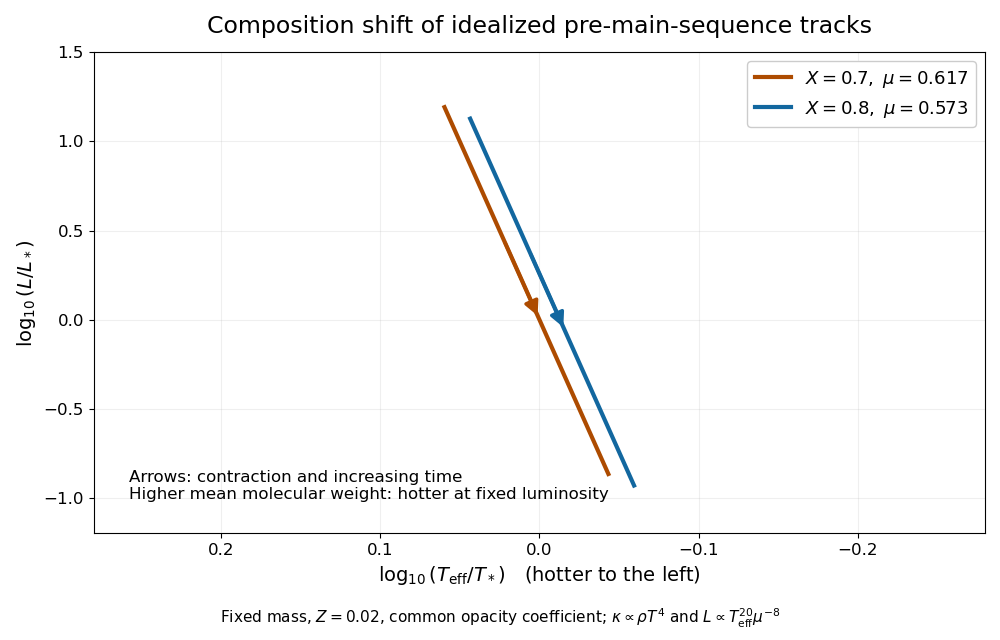
Figure 1.
Composition-dependent pre-main-sequence tracks with contraction arrows
. Details. 
The plotted luminosity and effective temperature are normalized to arbitrary common references; no opacity normalization or absolute age was specified. The comparison holds the given opacity coefficient fixed.
These paths cease to apply when their assumptions fail. Deuterium-burning energy-generation rate can temporarily slow contraction; sustained hydrogen burning ends the purely gravitational phase. Formation of a radiative core breaks the fully convective adiabat and can lead to a Henyey track toward hotter effective temperature. Partial ionization, a changing atmospheric opacity, and electron degeneracy pressure alter the equation of state or boundary relation. Accretion luminosity, changing mass, and magnetic inhibition of convection can also modify a young star's path.
Keep the fixed stellar homology profile, so that and . Solving the partially degenerate equation of state for the central temperature giveswhere and are positive constants. The ion mean molecular weight is distinct from the total-particle mean molecular weight used in part (a).
Set . The expression in parentheses is a concave quadratic in . Its maximum occurs atSubstitution gives the contraction-limited central temperatureAt this point electron degeneracy pressure supplies half the required central pressure. Further contraction increasingly goes into the density-dependent degeneracy term rather than heating the ions. The formula applies along the positive-temperature part of the idealized homologous sequence; a negative value beyond it is not a physical temperature.
For sufficiently small mass, this maximum never reaches the temperature needed for sustained hydrogen burning. Such an object stays below the hydrogen-burning minimum mass and becomes a cooling brown dwarf, rather than an ordinary main sequence star. Some such objects burn their initial deuterium, but that finite reservoir does not provide lasting hydrogen burning.
Articles by others on the same topic
There are currently no matching articles.