Efficient convection makes the interior follow a nearly adiabatic process and maintains uniform specific entropy. For the fully ionized monatomic ideal gas, the specific-heat ratio is , so the adiabatic temperature gradient gives . Integrating at a fixed time givesThe coefficient is spatially constant because the composition and specific entropy are uniform. It can change as the star loses energy. Equivalently the gas is an adiabatic stellar polytrope with and polytropic index ; and the pressure-temperature coefficient are different quantities.
This fixes the dimensionless Lane-Emden equation profile throughout a stellar homology sequence. Writing in the mass integral gives , with a fixed positive shape constant . Integrating the stellar hydrostatic equation through the same profile, with negligible surface pressure compared with central pressure, gives . HenceThese are homology scalings of central stellar pressure. Substituting the central quantities into yieldsThus is constant for the fixed stellar polytrope family.
At the approximate photosphere, take and use the ideal gas relation . The prescribed opacity givesThe stellar surface boundary condition and surface gravity of a star therefore implyThis is the temperature-four special case of convective contraction with power-law opacity.
Using the Stefan–Boltzmann law, the luminosity isFor , the supplied gravitational-energy formula is . The stellar virial theorem for a monatomic gas gives , so the total energy is . During Kelvin-Helmholtz contraction, with constant mass and no significant nuclear source, . ThusMultiplying by and integrating givesThe sign makes the radius decrease as time increases.
When the accumulated contraction term dominates the initial-radius term, this yields . Combining it with the central ideal gas temperature gives the late-time central-temperature scalingReplacing by gives the stated late-time form. The asymptotic step also requires a time long enough to forget the initial radius, not merely a choice of zero for the age.
The helium mass fraction is . For the two compositions, and . The mean molecular weight is thereforeAt fixed mass and with the same prescribed opacity coefficient, part (a) gives and . Eliminating radius givesThis is the composition shift of a convective pre-main-sequence track. The higher-helium mass fraction case is hotter at a given luminosity, lying to the left of the case in a Hertzsprung-Russell diagram. Its fixed-luminosity temperature ratio is .
Both stars contract, so both and decrease in this particular opacity model. Their nearly vertical Hayashi tracks therefore run downward and slightly to the right, with arrows in that direction: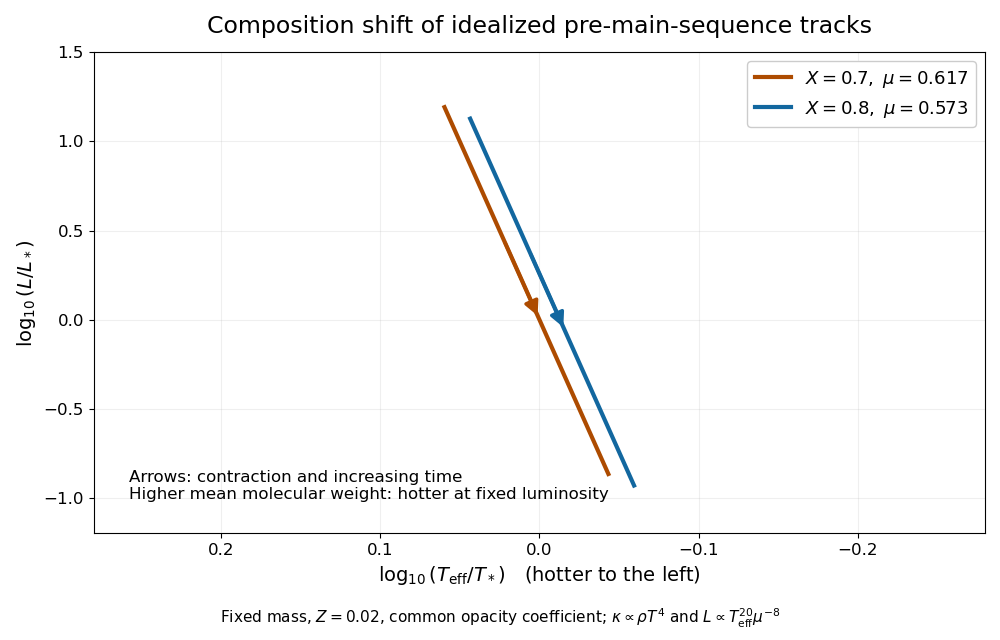
Figure 1.
Composition-dependent pre-main-sequence tracks with contraction arrows
. Details. The plotted luminosity and effective temperature are normalized to arbitrary common references; no opacity normalization or absolute age was specified. The comparison holds the given opacity coefficient fixed.
These paths cease to apply when their assumptions fail. Deuterium-burning energy-generation rate can temporarily slow contraction; sustained hydrogen burning ends the purely gravitational phase. Formation of a radiative core breaks the fully convective adiabat and can lead to a Henyey track toward hotter effective temperature. Partial ionization, a changing atmospheric opacity, and electron degeneracy pressure alter the equation of state or boundary relation. Accretion luminosity, changing mass, and magnetic inhibition of convection can also modify a young star's path.
Keep the fixed stellar homology profile, so that and . Solving the partially degenerate equation of state for the central temperature giveswhere and are positive constants. The ion mean molecular weight is distinct from the total-particle mean molecular weight used in part (a).
Set . The expression in parentheses is a concave quadratic in . Its maximum occurs atSubstitution gives the contraction-limited central temperatureAt this point electron degeneracy pressure supplies half the required central pressure. Further contraction increasingly goes into the density-dependent degeneracy term rather than heating the ions. The formula applies along the positive-temperature part of the idealized homologous sequence; a negative value beyond it is not a physical temperature.
For sufficiently small mass, this maximum never reaches the temperature needed for sustained hydrogen burning. Such an object stays below the hydrogen-burning minimum mass and becomes a cooling brown dwarf, rather than an ordinary main sequence star. Some such objects burn their initial deuterium, but that finite reservoir does not provide lasting hydrogen burning.
Write , and use axial symmetry. The radiative flux is . Integrating the radiative transfer equation over directions givesThere are no energy sources in the atmosphere, so radiative equilibrium makes constant. Consequently
For the linear angular approximation , the radiation-field moments areThus it satisfies the Eddington closure approximation, andSince is constant, . Substitution in the radiative transfer equation, using , gives , hence .
In this moment approximation, the inward hemispheric flux at the surface isSetting this boundary moment to zero gives . ThereforeCombining it with the thermal source function and gives the grey atmosphere temperature law:
The surface condition is an approximate angular-moment condition. If the affine intensity were interpreted as an exact nonnegative boundary radiation field, no incident radiation would require for every ; a linear polynomial vanishing on that interval would have and no outward flux either. The derived formal profile indeed has . This positivity limitation of a linear Eddington intensity is why one uses the Eddington surface boundary condition as a moment closure, not the affine ansatz as an exact emergent angular intensity. An outward direction-independent intensity with no inward intensity gives the same boundary moments.
For the gas-pressure-dominated atmosphere, combine with . Thus the hydrostatic equilibrium in optical depth is . Let . The grey atmosphere law implies . With the specified power-law opacity,At the outer vacuum limit take and . Since , integration givesThis is the grey-atmosphere pressure with power-law opacity relation.
At the matching radius the local radiative flux is . In the thin plane-parallel atmosphere approximation this equals , so and . Multiplying the pressure relation by yields the required surface pressure-opacity relationHere is a product, not a pressure subscript.
Let be the gravitational potential, with , and let measure distance from the rotation axis. Uniform solid-body rotation contributes the centrifugal potential . In the corotating frame, static force balance therefore gives the uniformly rotating stellar hydrostatic equilibrium equationsThe final coefficient follows because .
A tangent displacement along a regular connected equipotential surface has zero dot product with , and hence with . Thus locally. Taking the curl of the hydrostatic equilibrium equation gives , so on such surfaces as well. The Poisson equation then shows that is constant on each equipotential surface.
The magnitude need not be constant. For instance , with positive , has constant Laplacian but different pole and equator gradient magnitudes on an ellipsoidal equipotential. In a rotating star, flattening and centrifugal acceleration likewise make the effective gravity latitude dependent.
With uniform composition, an equation of state determines from and ; for the supplied ideal gas plus radiation pressure law its right side increases monotonically with . Hence , and the radiative conductivity is also constant on an equipotential surface. Put . Then . On the stellar surface, below mass shedding, the outward normal is , soThis is the radiative gravity-darkening law. The effective temperature measures emergent flux; it is not the same quantity as the interior material temperature that was constant on an equipotential.
A rapidly rotating star is oblate, with reduced effective gravity and cooler effective temperature around the equator. The poles are hottest. The original sketch uses a Roche model of a uniformly rotating star only to illustrate the shape and surface-flux variation:
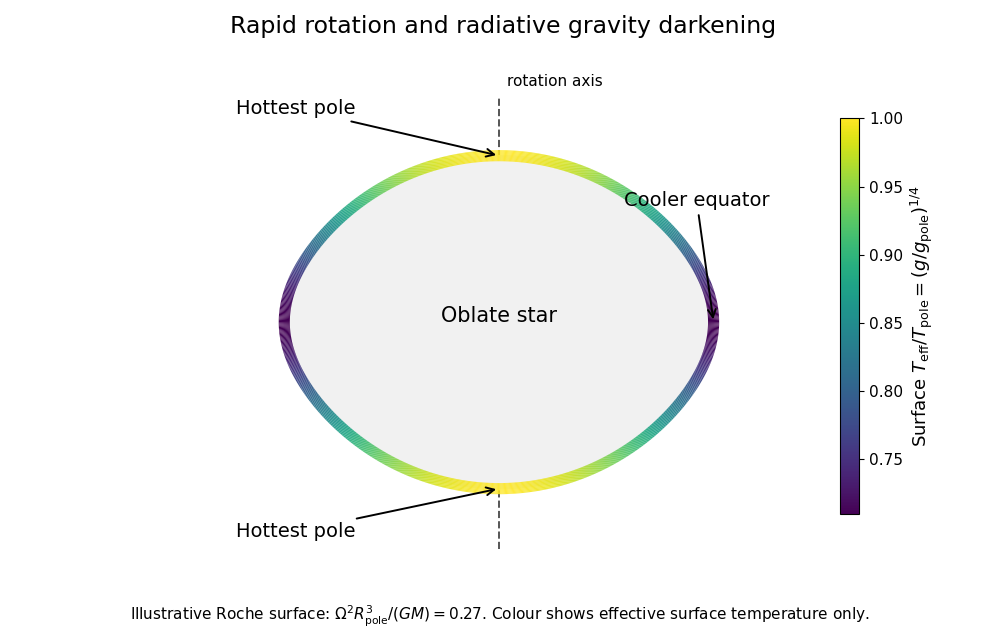


The obstruction to purely local radiative equilibrium is visible by taking the divergence:On an equipotential surface, , , and the second term are constant, but generally varies. Unless or another special circumstance removes the mismatch, cannot hold at every latitude. This is the radiative-equilibrium obstruction in a rotating barotropic star; heat advection by stellar meridional circulation resolves the missing energy transport in the leading hydrostatic treatment.
For the steady circulation, mass conservation gives . The specific enthalpy identity and hydrostatic equilibrium giveConsequentlyBoth and are constant on the bounding equipotential surface. By the divergence theorem and steady continuity equation,Integrating the given thermal energy equation therefore gives equipotential luminosity conservation with stellar circulation:Individual circulation streams can cross the surface; only their net steady mass flux has to vanish.
Since is constant on that surface, integrating the Poisson equation givesThus , while . Dividing these derivatives and inserting yields the radiative gradient in a uniformly rotating star:The bracket must be positive for the regular outward-gravity configuration being used.
For an interior equipotential, both mass factors must be the enclosed mass . The printed final bracket uses , but its derivation gives ; at the outer surface and the printed bracket is recovered. For a direct check, a uniform-density model has , so the true correction is independent of the chosen enclosed volume. Replacing by a fixed total mass would incorrectly make it volume dependent.
Stellar nucleosynthesis and the subsequent return of matter explain most elements heavier than the primordial hydrogen and helium. Big Bang nucleosynthesis supplied predominantly those two elements, with small light-isotope abundances; stars do not make every element from an initially metal-free mixture. Different stellar masses reach different central temperatures and leave different remnants. The mass comparisons below describe representative isolated, near-solar-composition stars; mass loss and binary interaction can alter the final core. A nucleus contributes to later generations only if it is eventually expelled into the interstellar medium, rather than remaining locked in a remnant.
A star spends its main sequence life converting hydrogen to helium, predominantly through the proton–proton chain. After core hydrogen burning ends, a hydrogen-burning shell supplies an expanding red giant envelope and builds an electron-degenerate helium core. First dredge-up exposes material whose CNO cycle has redistributed the original carbon and nitrogen abundances. The helium flash starts core helium burning: the Triple-alpha process makes carbon, and carbon-12 alpha capture makes oxygen. Once core helium is exhausted, the Asymptotic giant branch has a carbon-oxygen core with helium-burning shell and hydrogen-burning shell. Shell instability causes AGB thermal pulses; subsequent third dredge-up, where efficient enough, can bring carbon and neutron-capture products into the envelope. Its efficiency at such low mass depends on composition and mixing. The star does not ordinarily ignite core carbon burning. Stellar winds remove the envelope, a hot remnant may illuminate a planetary nebula, and a carbon-oxygen white dwarf retains much of the core's synthesized matter.
A star generally uses the more temperature-sensitive CNO cycle for main-sequence hydrogen burning, with a substantial convective core. Its hotter helium core ignites core helium burning without the low-mass degeneracy-driven helium flash, producing carbon and oxygen. After core helium exhaustion it develops double-shell Asymptotic giant branch burning and a degenerate carbon-oxygen core. Second dredge-up and repeated third dredge-up alter the envelope composition. In sufficiently hot models, hot-bottom burning at the base of the convective envelope converts dredged-up carbon into nitrogen through the CNO cycle; consequently a carbon-producing shell need not produce a carbon-rich final envelope. Hot helium-shell pulses can activate the neutron source. Strong stellar winds expel these processed layers. A conventional isolated five-solar-mass model ends as a carbon-oxygen white dwarf, below the mass range that normally develops sustained core carbon burning; mass loss and mixing govern the exact boundaries between outcomes.
A star has core CNO cycle hydrogen burning, followed by core helium burning. The core then contracts through carbon burning, neon burning, oxygen burning and silicon burning, with active shells outside the successive exhausted cores. Carbon burning produces chiefly nuclei such as neon and magnesium. Neon burning combines photodisintegration and alpha capture; oxygen burning makes silicon-group nuclei. Silicon burning is a network of captures and photodisintegration approaching nuclear statistical equilibrium, rather than simply fusion of pairs of silicon nuclei. It produces an iron-group mixture governed by temperature, density and weak reactions. The maximum in nuclear binding energy per nucleon near the iron group prevents continued exothermic fusion from supplying ordinary hydrostatic support. Stellar neutrino energy loss accelerates the advanced stages; electron capture and photodisintegration help remove support during iron-core collapse.
The massive star can return products both before and during collapse. Radiation-driven stellar winds may expose and expel layers enriched in helium, nitrogen, carbon and oxygen. A successful core-collapse supernova ejects additional hydrostatic products and creates further nuclei by shock-driven explosive burning, including alpha-rich and iron-group products. The nickel-56 decay chain converts radioactive nickel into iron through cobalt. Initial mass alone does not fix the explosion or remnant: substantial fallback or a failed supernova can leave a black hole and retain much of the core material. Thus the possible core-collapse supernova contribution is not a guarantee that a thirty-two-solar-mass star ejects every element it made.
For nuclei well beyond the iron group, neutron capture is a principal assembly mechanism, avoiding the large Coulomb barrier for charged-particle fusion. Beta-minus decay converts captured neutrons into protons and raises the atomic number. In the s-process, captures are slower than relevant beta decays, so the sequence usually follows nuclei near stability. The main site is the Asymptotic giant branch: is an important neutron source in low-mass intershell material, while becomes important in hotter pulses and in massive-star helium/carbon burning. Third dredge-up and stellar winds make these products available to the interstellar medium. Barium and lead illustrate heavy products; the detailed yield depends on seed abundance, neutron exposure and branching at unstable nuclei.
In the r-process, neutron captures outrun beta decays, building very neutron-rich nuclei before they decay toward stable heavy isotopes. This needs much larger neutron densities than the s-process and can produce very heavy nuclei, including uranium. Neutron-rich ejecta from neutron star mergers provide an established site: observed kilonova emission and spectroscopy support heavy-element synthesis in such ejecta. Rare magnetically driven stellar-collapse outflows are additional candidate sites. An ordinary core-collapse supernova cannot automatically be assumed to supply a complete heavy r-process pattern.
Not every heavy isotope belongs to the two capture sequences. Gamma-process nucleosynthesis in hot supernova material uses photodisintegration on pre-existing heavy seed nuclei through neutron, proton and alpha-emission channels, helping produce proton-rich isotopes bypassed by the main capture paths. This is distinct from simply using charged-particle fusion to build every element beyond the iron group.
Finally, binary stars change both production and delivery. Roche-lobe overflow and wind mass transfer in a binary star strip envelopes, change subsequent core growth, and expose processed layers. Mass transfer from an Asymptotic giant branch donor can enrich a surviving companion in carbon and s-process products, as in a barium star; this redistributes existing yields rather than creating them in the recipient. Accretion onto a white dwarf can trigger a classical nova with explosive hydrogen-burning products. Thermonuclear disruption of a carbon-oxygen white dwarf in a Type Ia supernova, through suitable accretion or the Double-degenerate Type Ia supernova scenario, supplies a major delayed iron-group contribution, including iron; it is not the same event as collapse of a massive iron core. Compact binaries containing two neutron stars can later merge and eject r-process material. Thus binaries affect stellar mass histories, enrich companions, open thermonuclear explosion channels, and create heavy-element-producing compact-remnant mergers.
Articles by others on the same topic
There are currently no matching articles.