For the reaction , chemical equilibrium requires because thermal photons have zero chemical potential. Insert the nonrelativistic Maxwell-Boltzmann distribution number densities and use :For ground-state hydrogen, including its spin states, , ; hence the degeneracy factor is one. Since , the right side is .
Charge neutrality gives , while baryon conservation gives . Consequently and . Inverting the preceding ratio and inserting the photon number density with gives the hydrogen-only Saha equationWriting , its coefficient is , consistent with the rounded . The negligible mass-ratio correction and ground-state approximation are the assumptions behind this form.
At , the left side of the Saha equation is two. With its rounded coefficient, the recombination temperature therefore satisfiesNeglecting the logarithmic prefactor gives andThis is the requested rough scale. Retaining the prefactor and the unrounded logarithm gives and eV; the displayed eV is not a high-accuracy numerical root of the Saha equation.
The small baryon-to-photon ratio means that radiation and the entropy of the free charged particles strongly favor ionization. A low mean photon energy does not eliminate the energetic tail, and ionized particles have a large phase-space advantage. The exponential binding factor must become very large before neutral atoms dominate this dilute gas. Accordingly is of order forty rather than order one, so recombination occurs well below the hydrogen binding energy.
Photon decoupling is a dynamical loss of frequent scattering, distinct from the chemical conversion of charged particles into neutral atoms. Before recombination, Thomson scattering on free electrons keeps photons coupled to the baryon plasma. The physical scattering rate isin units with . Define the approximate decoupling temperature byEquivalently the photon mean scattering time becomes comparable to an expansion time. A refined last-scattering definition uses the optical depth and the maximum of the visibility function; it need not coincide exactly with the local rate criterion. As falls, scattering becomes inefficient, ordinarily after the half-ionized recombination stage, so .
Residual electron freeze-out concerns the remaining ionized fraction. The Saha equation presumes sufficiently rapid forward and reverse reactions to maintain chemical equilibrium. Real recombination is slowed by radiative bottlenecks and expansion; the free-electron fraction can therefore exceed its equilibrium value. Eventually the effective recombination rate per free electron, roughly , falls below . The remaining electrons cannot all find and recombine with protons within an expansion time. A small nonzero residual fraction survives while the Saha prediction decreases exponentially toward zero.
The sketch shows this lag and residual floor. Its kinetic curve and the position of the decoupling marker are schematic: the data supplied determine the equilibrium curve, but not a quantitative recombination history or an exact . Determining those needs the expansion history and atomic transition rates. The horizontal axis decreases toward the right to follow cosmological cooling.
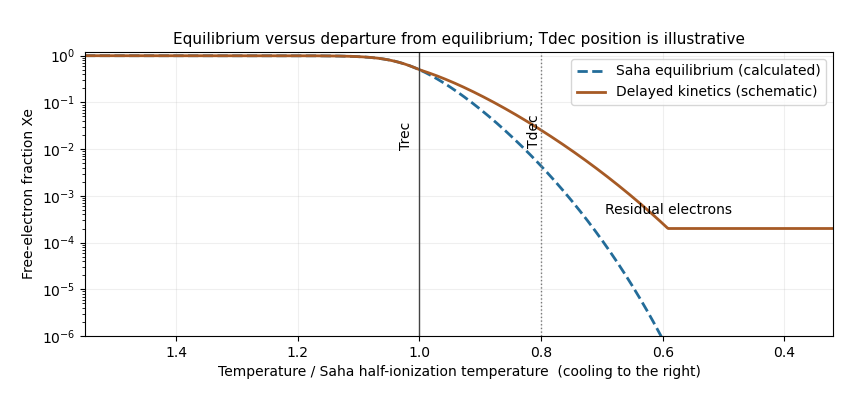
Saha equilibrium and a schematic delayed recombination curve, with recombination and photon-decoupling temperatures marked during cooling
. Details. 
Articles by others on the same topic
There are currently no matching articles.