Assume positive fluid density, , and write . A perfect fluid with constant equation of state obeys the cosmological perfect-fluid continuity equation, givingIn the stated units the Friedmann equation is . Multiplication by yields the Friedmann effective potential for a constant-equation-of-state fluid,The allowed region has . The Friedmann acceleration equation is equivalently , including turning points by continuity. Thus a zero-energy mechanical trajectory reproduces the cosmological evolution, with .
For , , the potential increases strictly from negative infinity to positive infinity. Its unique zero givesExpansion from the Big Bang stops there, with negative acceleration, then reverses into a Big Crunch. Both the turning point and the final singularity occur in finite proper time: is integrable near a simple turning point and behaves as a constant times near zero.
For , , increases from negative infinity to and crosses zero atThis is again expansion followed by finite-time recollapse. For , the same increasing curve has asymptote and never meets zero. Expansion continues without a finite maximum; asymptotically and , as spatial curvature dominates the diluted fluid.
For , , tends to negative infinity at both ends. It has a maximum atThere is no turning point. Expansion initially decelerates, then accelerates once , and approaches de Sitter spacetime expansion . Thus positive flat dark-energy expansion is unbounded; negative flat dark energy and positive curvature without dark energy recollapse.
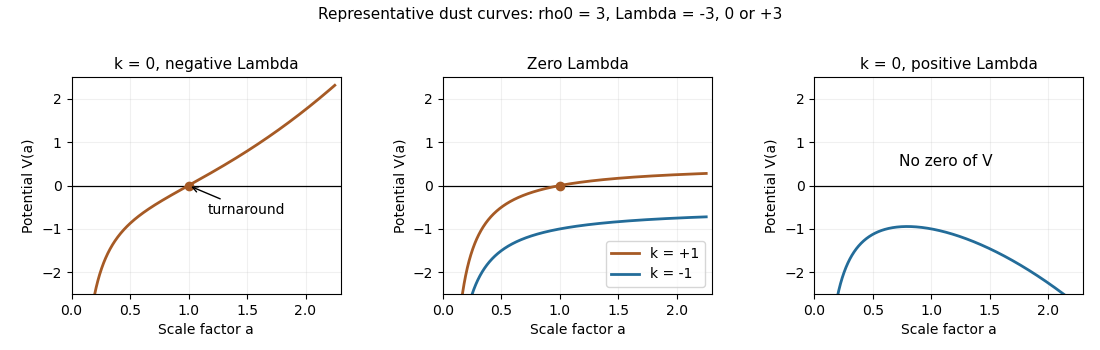
Zero-energy Friedmann potentials showing recollapse, curvature-dominated expansion and positive-cosmological-constant expansion
. Details. 
Use conformal time, , and let primes mean . Then and . For , , the Friedmann equation and acceleration equation giveSubstitution yieldsUse the supplied solution without deriving it. Its first maximum has sine equal to one, so its amplitude must equal the physical turnaround scale in part (a):Choose the expanding branch with and the first zero at .
For pressureless matter, , the closed matter-dominated Friedmann solution isThe Big Crunch is at , or proper time , measured from the Big Bang.
A radial null geodesic in FLRW spacetime obeys . The spatial slice is a unit three-sphere times , so a great circle has comoving circumference . The dust lifetime supplies conformal distance : one circumference, with the return occurring only in the crunch limit. Strictly before the singular endpoint no full return is completed. The radiation lifetime supplies conformal distance : the photon reaches the antipode, half a great circle, in the crunch limit. These are limiting null rays from near the initial singularity, not photons at a regular event on the singular surface.
For the reaction , chemical equilibrium requires because thermal photons have zero chemical potential. Insert the nonrelativistic Maxwell-Boltzmann distribution number densities and use :For ground-state hydrogen, including its spin states, , ; hence the degeneracy factor is one. Since , the right side is .
Charge neutrality gives , while baryon conservation gives . Consequently and . Inverting the preceding ratio and inserting the photon number density with gives the hydrogen-only Saha equationWriting , its coefficient is , consistent with the rounded . The negligible mass-ratio correction and ground-state approximation are the assumptions behind this form.
At , the left side of the Saha equation is two. With its rounded coefficient, the recombination temperature therefore satisfiesNeglecting the logarithmic prefactor gives andThis is the requested rough scale. Retaining the prefactor and the unrounded logarithm gives and eV; the displayed eV is not a high-accuracy numerical root of the Saha equation.
The small baryon-to-photon ratio means that radiation and the entropy of the free charged particles strongly favor ionization. A low mean photon energy does not eliminate the energetic tail, and ionized particles have a large phase-space advantage. The exponential binding factor must become very large before neutral atoms dominate this dilute gas. Accordingly is of order forty rather than order one, so recombination occurs well below the hydrogen binding energy.
Photon decoupling is a dynamical loss of frequent scattering, distinct from the chemical conversion of charged particles into neutral atoms. Before recombination, Thomson scattering on free electrons keeps photons coupled to the baryon plasma. The physical scattering rate isin units with . Define the approximate decoupling temperature byEquivalently the photon mean scattering time becomes comparable to an expansion time. A refined last-scattering definition uses the optical depth and the maximum of the visibility function; it need not coincide exactly with the local rate criterion. As falls, scattering becomes inefficient, ordinarily after the half-ionized recombination stage, so .
Residual electron freeze-out concerns the remaining ionized fraction. The Saha equation presumes sufficiently rapid forward and reverse reactions to maintain chemical equilibrium. Real recombination is slowed by radiative bottlenecks and expansion; the free-electron fraction can therefore exceed its equilibrium value. Eventually the effective recombination rate per free electron, roughly , falls below . The remaining electrons cannot all find and recombine with protons within an expansion time. A small nonzero residual fraction survives while the Saha prediction decreases exponentially toward zero.
The sketch shows this lag and residual floor. Its kinetic curve and the position of the decoupling marker are schematic: the data supplied determine the equilibrium curve, but not a quantitative recombination history or an exact . Determining those needs the expansion history and atomic transition rates. The horizontal axis decreases toward the right to follow cosmological cooling.
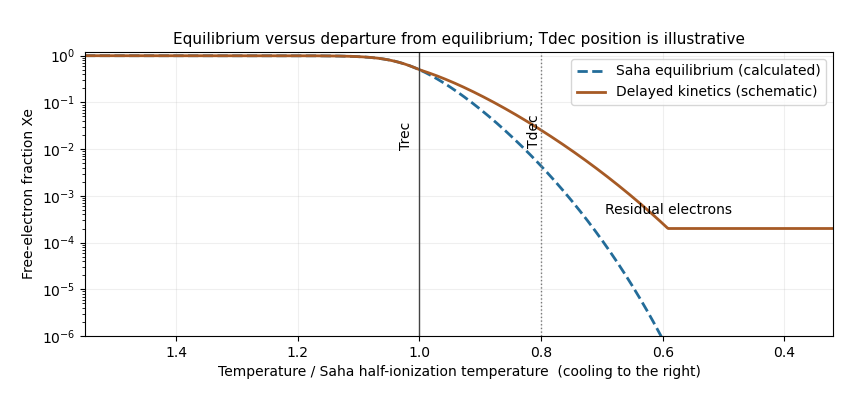
Saha equilibrium and a schematic delayed recombination curve, with recombination and photon-decoupling temperatures marked during cooling
. Details. 
Differentiate the linearized cosmological continuity equation, remembering the derivative of :Insert the linear cosmological Euler equation for the peculiar velocity, givingThus the linear matter perturbation growth equation isThe factor includes one expansion term from continuity and one from momentum dilution. This equation uses sub-Hubble, pressureless linear perturbations and the stated matter-only source for the gravitational potential.
Change independent variable from proper time to the scale factor. Then and . Under radiation domination, and . Since , the linear matter perturbation growth equation becomesPutting givesThis keeps the matter self-gravity term in a radiation-dominated background. It is not an exact background equation through radiation-matter equality.
At , neglecting that small term gives . Integration yieldsThus matter has at most logarithmic growth during this leading radiation approximation, together with a constant independent mode. The constant is non-growing, not a mode that literally falls as ; that power belongs to rather than .
For an increasing/decreasing basis of the displayed equation with matter self-gravity retained, put . Its equation becomes . HenceThe Modified Bessel function of the first kind gives , which increases slowly. The Modified Bessel function of the second kind gives , where is Euler's constant; this mode decreases as increases. Their leading span is precisely the constant/logarithmic pair above. Mode labels depend on the chosen basis and normalization; no rapid matter-era growth occurs here. Neglected background corrections can change subleading terms, so the Bessel basis should not be extrapolated through equality.
Let . The supplied equation has integrating factor :Consequently the integral linear growth factor in a matter-Lambda universe gives the two independent solutionsThe first is the conventional matter-era decaying mode. A finite lower limit in the second fixes a decaying admixture; adding a multiple of can choose a pure growing normalization.
During matter domination, write . The integral solution isRemoving the second term by the independent solution gives the matter-era linear growth factorFor positive cosmological constant at sufficiently late times, . The integrand approaches , whose tail is integrable. ThereforeIts remaining approach has leading behavior for the usual matter-plus-Lambda background. Growth of structure freezes rather than continuing as . The basis function also approaches a constant; subtracting a suitable multiple of it isolates a genuinely decaying late-time solution . The name “decaying mode” for refers to its matter-era behavior.
Use primes for conformal-time derivatives in this question, reserving for a potential derivative. The inflaton background obeys , so the linear variation of its action vanishes up to boundary terms. With , the conformal-time quadratic action for an inflaton perturbation is initiallyThe cross term integrates to . Since , this becomesVarying gives . The symmetric Fourier transform convention used in the question turns into . Dropping the small mass term under the stated slow-roll inflation assumption yieldsFor de Sitter spacetime, with , so . The rescaled field has a canonical kinetic term; rather than is therefore the convenient oscillator variable.
Promote the canonical field and momentum to operators satisfying the canonical commutation relation, . A real field has Fourier reality condition . Its oscillator expansion isThe creation and annihilation operators add or remove excitations in the selected mode basis, withCanonical normalization requires the Wronskian .
For the Bunch-Davies vacuum, choose the positive-frequency short-wavelength behavior as . For the proposed solution, direct differentiation givesSubstitution cancels every term in . Its Wronskian is , and its large- limit is the required flat-spacetime positive-frequency mode. ThusA term with the conjugate frequency is another allowed classical solution, but would describe a different quantum state, through a Bogoliubov transformation. Its coefficient is set to zero by the early-time vacuum condition, not by absence of a second solution to the differential equation.
The annihilation operators kill the vacuum, and their commutator givesTherefore the scale-invariant inflationary power spectrum has the superhorizon limitThe canonical mode grows as outside the Hubble radius, while the physical field perturbation freezes. A slowly varying produces an almost scale-invariant spectrum rather than exact scale invariance.
For a slowly rolling single field, fluctuations in the inflaton clock become the comoving curvature perturbation, up to sign convention. Restoring the reduced Planck mass and using givesThis conversion presumes nonzero background roll; a strictly constant test scalar in exact de Sitter spacetime does not by itself define a finite comoving curvature perturbation through this formula. The curvature perturbations seed the later density fluctuations.
When metric fluctuations and their Einstein-gravity normalization are restored, the two graviton polarizations have the same massless mode equation. The usual total primordial tensor power spectrum is , so the single-field leading ratio is . Tensor amplitudes therefore probe the inflationary energy scale, whereas scalar amplitudes also depend on the roll rate. These tensor statements explain the relevance of the mode result; they are not derived from a scalar action with metric perturbations omitted.
Articles by others on the same topic
There are currently no matching articles.