Let . In the Zurek spin-bath model, , so unitary time evolution with is . The bath Hamiltonian terms commute, and device states have eigenvalues . Hencewhere the two normalized conditional bath states areTake each bath factor normalized, , and . This entails no restriction: if only the product is initially normalized, divide each nonzero factor by its norm; the product of these norms is one.
Taking the partial trace over the bath gives the reduced density matrixThe orientation of this conditional environment overlap fixes the sign of the phase in the upper-right entry. Factorizing the overlap yields the decoherence factorThe populations are conserved because . Only phase coherence can be reduced. In particular,Quantum decoherence here results from distinguishable conditional bath states, although the complete system remains in a pure state under unitary time evolution.
With every bath spin up, the two conditional bath states in the Zurek spin-bath model differ only by global phases. The decoherence factor isThere is no quantum decoherence, even for a very large bath. The device evolves as the pure state , while the bath stays in its original product eigenstate up to phase. Since no device information is imprinted in distinguishable bath states, the conditional environment overlap has unit modulus. The phase rotation must not be mistaken for decay of off-diagonal magnitude.
A pure spin-one-half state on the equator of the Bloch sphere has , so . Its azimuthal phase does not enter the conditional environment overlap, because the interaction is diagonal in . Substitution in the decoherence factor givesThe Zurek spin-bath model now has a real coherence factor: positive and negative values correspond to opposite relative phases, while suppression of coherence depends on .
For these three couplings, the decoherence factor becomesIt is periodic with period . To locate its extrema, put ; then . Its maximum is at , and its minimum is where , namely . The zeros on the displayed interval are . The half-integer zeros are crossings; the zeros at and are double zeros, where the curve touches zero from below.
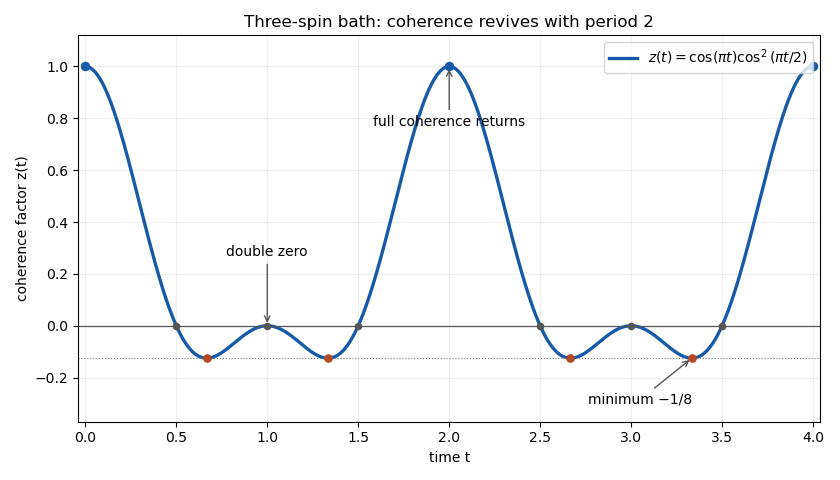

The finite spin-bath coherence recurrence returns the device to full coherence every two time units. Negative indicates a relative phase change and is not a negative probability. When , the device reduced density matrix becomes diagonal at each zero, but quantum decoherence is not irreversible in this finite bath. The sketch explicitly displays both loss of coherence and its revival.
Write for the upper endpoint called in the question, to distinguish it from the device amplitude. For a single realization of a finite bath,The literal claim of convergence to zero as time tends to infinity is false for every fixed finite . Random-coupling spin-bath decoherence must distinguish individual realizations, ensemble averages and the large-bath limit.
First establish finite spin-bath coherence recurrence without assuming commensurate couplings. Fix a reference time and consider points with coordinates modulo , for . Partition the unit cube into smaller cubes of side . Two points share a cube, so their difference provides an integer withAt time every cosine is arbitrarily close to . As increases, either these have an unbounded subsequence, or a bounded subsequence supplies a fixed with all distances exactly zero; its arbitrarily large multiples are then exact recurrences. In both cases there are unbounded times such that . This is the simultaneous Dirichlet approximation theorem argument; it applies equally to typical irrational random couplings. Part (i) supplies a particularly simple exact periodic counterexample.
The intended suppression is valid after ensemble averaging. Independence and the uniform density give the ensemble spin-bath coherenceThe continuous value at is . For its magnitude is strictly below to the power , and for fixed it has an envelope of order as . Thus the ensemble mean tends to zero with time.
The mean square distinguishes actual loss of coherence from cancellation of signs in that mean:At long times this tends to , exponentially small for , rather than exactly zero for a finite bath. At any fixed , the bracket is strictly less than , since on a set of positive measure. The Markov inequality then givesThis proves small coherence for typical large baths at a fixed nonzero time. An even stronger fixed-time formulation uses the strong law of large numbers:The logarithmic singularities at isolated cosine zeros are integrable, and an exact zero has probability zero, so the law applies. Typical coherence consequently decreases exponentially with bath size.
The initial time scale is also explicit. When , , so the short-time Gaussian spin-bath decoherence approximation isHere ; on the scale the displayed remainder tends to zero. The coherence is therefore rapidly suppressed for a large bath and is usually tiny at later fixed times, while rare recurrences still prevent a finite-realization long-time zero limit. Ensemble decay or a specified large- limit is the correct qualification of the printed assertion, consistent with reversible global unitary time evolution.
Articles by others on the same topic
There are currently no matching articles.