Use the dimensionless quantum phase , so that with . Work locally away from wavefunction nodes, where and are differentiable. Differentiating the wavefunction for substitution in the Time-dependent Schrödinger equation gives:Cancel in the time-dependent equation and equate real and imaginary parts. The resulting Madelung equations areThe second equation is a Hamilton-Jacobi equation for the action , with an additional quantum potential. To see the meaning of the first, multiply it by and set . It becomes the probability continuity equationThus the probability density is transported by the velocity field . The Madelung equations are a local rewriting of the linear wave equation; their apparent nonlinearity comes from expressing a complex wavefunction in modulus and phase variables.
In Bohmian mechanics the particle has a definite position at every time. Its wavefunction obeys the usual autonomous wave equation, while its actual position follows the guidance equationHere is the probability current. The Born rule is the quantum-equilibrium choice of initial position distribution ; quantum equilibrium equivariance ensures that this distribution persists because it obeys the same probability continuity equation as the wave amplitude. The guidance equation fixes the initial velocity as well as subsequent velocities: the second-order equation below does not permit an independent arbitrary initial velocity.
Define the quantum potentialTaking the gradient of the real Madelung equations givesOn any smooth phase patch , so . Along the actual path, differentiation is the material derivative . ThereforeThis is the Bohmian mechanics Newton form: the classical force is supplemented by the amplitude-dependent quantum potential. Neither division by nor a smooth phase is justified at a wavefunction node, so the derivation applies on nonzero-amplitude regions. A nonzero circulation around a node is compatible with the locally curl-free guidance equation.
The rotational invariance of a central-potential Hamiltonian allows a simultaneous eigenstate of energy and the two-dimensional orbital angular momentum . For a separated wavefunction , the Laplacian in polar coordinates givesThe term must be a constant; write . The angular eigenfunctions can be chosen as . Single-valuedness under imposes , hence . The radial equation in the separation of a two-dimensional central-potential eigenstate isFor a real central potential and the usual real self-adjoint radial boundary conditions, the radial equation admits a basis of real solutions: real and imaginary parts of a complex solution obey the same equation and boundary conditions. Choose a real normalized radial eigenfunction. Since the plane area element in plane polar coordinates is , the normalization isThis establishes the intended separated simultaneous eigenstate form. It is not the form of every stationary state. The radial equation depends on , so the and sectors have the same energy. For , their normalized superpositionis a single-valued stationary state with that energy but is not a single angular exponential. Quantum degeneracy is precisely why separation of variables selects a convenient eigenstate basis rather than all vectors in an energy eigenspace. The printed assertion needs this qualification. The printed polar-coordinate aid also labels a gradient component tuple as a divergence; the gradient used below is the two-dimensional vector .
For the separated stationary state, restore its time factor . Away from radial nodes, the quantum phase is , up to a constant or where the real radial function has fixed sign. The guidance equation in plane polar coordinates therefore gives the Bohmian circulation of an angular-momentum eigenstateThe direction is for and for ; the velocity is zero for . Each admissible trajectory is a circle:The orbital angular momentum along the trajectory is . The origin or any zero-amplitude circle is excluded from this local formula. For the real degenerate superposition constructed above, the spatial quantum phase is constant on each nodal sector, so its Bohmian mechanics velocity is instead zero. Thus the circular motion is a conclusion about the separated angular-momentum eigenstate, not an arbitrary energy eigenstate.
The EPR criterion of reality says that a physical quantity has an element of reality if its value can be predicted with certainty without physically disturbing the system. The proposed criterion distinguishes what the system possesses from what one happens to measure.
A local hidden-variable theory supplements the preparation by a variable , drawn from a distribution independent of the later measurement settings. Its locality assumption is conditional factorization:Alice's local response does not depend on Bob's setting , and Bob's does not depend on Alice's . Correlations can arise from the shared past variable . In a deterministic local hidden-variable model, the response probabilities are point masses at functions and . In particular, all possible local settings have definite values for a fixed , even when only one setting is used in a trial.
The setting-independence assumption is needed for comparing these predetermined values across different experiments. Conditional factorization is stronger than quantum no-signalling: no-signalling constrains observed marginal probabilities, whereas local hidden-variable theory constrains their decomposition at fixed . This distinction is what Bell theorem tests.
Fix a hidden variable in the deterministic local hidden-variable model, so that every is an integer. Let be the representative of modulo in . The terms in the chained modular Bell inequality alternate between the two parties. Before reduction their sum telescopes:After reduction, the sum is a nonnegative integer congruent to modulo . For , the smallest possible such integer is . Thus for each hidden variable separately. Averaging over the setting-independent distribution givesHere each expectation is the expectation value of the reduced random variable, not the residue of its expectation. Each term can be measured using one setting at each site. The proof uses their common deterministic assignments rather than any joint quantum measurement of incompatible local settings. Stochastic local hidden-variable theories satisfy the same bound: include their local random seeds in and average the resulting deterministic assignments.
The printed final coefficient in the definition of the average is typographically incomplete. The expectation used here is the usual , with final coefficient .
Take and label the first vector of each measurement basis by outcome . Assign the Pauli measurement value to outcome and to outcome . The four observables areHere and are the Pauli X gate and Pauli Z gate matrices. These follow by subtracting the two rank-one basis projectors; a real basis rotated through has observable .
The Schmidt-basis Pauli correlation tensor of the state givesConsequently , and , where . For binary outcomes, , whereas the final offset term has . The chained modular Bell inequality left side is thereforeThe local bound is , so the exact violation condition isEquality saturates the bound. The maximal violation for these fixed measurements occurs at or their common negative, giving . Opposite signs do not violate this particular inequality with these fixed bases, although other measurement choices can reveal the state's entanglement. If unnormalized real amplitudes are used, replace throughout by .
Write the system's basis as , and use a separate pair of meter qubits in the Bell state . Alice applies a CNOT gate from system to her meter qubit; Bob simultaneously applies a CNOT gate from to his meter qubit. Flipping neither or both meter qubits preserves , while flipping exactly one gives . Hence the entanglement-assisted nondemolition parity measurement interaction produceswhere and . Each party now measures only their meter qubit in the basis. If their binary records are , the system Kraus operator isUnequal records verify zero total spin, since vanishes precisely on the odd sector. The probability of success is , and the successful conditional state is . Every zero-total--spin state is left unchanged, including any coherent superposition of and . Similarly the even-sector coherence is preserved. This is a quantum nondemolition measurement of the parity, rather than separate measurements of both system spins.
All quantum operations and local meter measurements can finish within the spacelike time window. Nevertheless each local meter record is individually uniform: . The verification result is obtained only by comparing the records using local operations and classical communication. Thus “instantaneous” refers to the local completion of the joint measurement instrument, not instant access to its nonlocal outcome; quantum no-signalling remains intact.
Apply the modulo operation to the eigenvalues of . The product eigenstates have ordinary eigenvalues , respectively, and residues modulo . The resulting observable isUse the entanglement-assisted nondemolition parity measurement from part (a). Equal local meter records give ; unequal records give . Its conditional quantum measurement maps are and , with normalization by their probabilities. The quantum nondemolition measurement preserves every vector within each degenerate eigenspace, including superpositions of and . Measuring the two system spins separately would destroy that even-sector coherence and would therefore not realize the same Lüders rule instrument. The nonlocal eigenvalue again becomes known only after local operations and classical communication compares the local records.
Assume the proposed device distinguishes the four displayed eigenstates, as an ideal rank-one projective measurement. This assumption matters: if all four had the same eigenvalue, the identity observable would admit that eigenbasis but its Lüders rule measurement would do nothing and could not signal. The printed eigenvectors alone do not exclude this degeneracy.
For the complete resolving measurement, let , , and be the four rank-one projectors. If the nonlocal outcome is ignored, the nonselective projective measurement channel is . Each listed state's local reduced density matrix is diagonal in , with expectation for either plus state and for either minus state. ConsequentlyCompute in its even and odd two-dimensional blocks: both have diagonal entries and off-diagonal entries . ThusandTo signal, prepare Alice in and Bob initially in . Bob encodes a bit by either doing nothing or applying a local Pauli Z gate, which changes his state to . Alice's input reduced density matrix is identical in both cases, but after the hypothetical instantaneous measurement her local expectation isThe two probabilities for Alice's outcome are , so their difference is . It is strictly positive for . Repeated trials let Alice infer Bob's bit while their operations are still spacelike, violating quantum no-signalling and relativistic causality. The relativistic causality constraint on an ideal nonlocal measurement therefore permits onlywithin the specified interval. The argument requires no rapid communication of the hypothetical nonlocal outcome: Alice reads her own changed local statistics. It rules out the full ideal instrument, not merely the later classical comparison of locally obtained records.
At the four eigenstates are the computational product basis, with irrelevant signs on two vectors. Alice and Bob measure their own system qubits in . These local projective measurements preserve each product eigenstate; their pair of records identifies the global outcome after local operations and classical communication.
At the four states are the Bell states. They are simultaneous eigenstates of the commuting Pauli operators and : have respective pairs . Their nonlocal parity measurements can be performed without directly distinguishing the local system spins.
Use the first shared Bell state pair to perform the entanglement-assisted nondemolition parity measurement of . Use the second shared pair for : both parties apply a local Hadamard gate to their system qubit, execute the same local system-to-meter CNOT gates and -meter measurements, then undo the Hadamard gates. This measures because . The two system parity projectors commute, since anticommutation at both sites cancels:Each is the corresponding rank-one Bell state projector. Every complete tuple of four local meter records has system Kraus operator for its two parities. Summing the four record tuples compatible with gives the ideal outcome map . The protocol is a Bell-state nondemolition measurement: an input Bell state is preserved, while an arbitrary input is projected onto the reported Bell state with the Born rule probability.
The local circuits need no adaptive communication between the laboratories, so both parties can finish inside the specified time window. Global identification of still requires later local operations and classical communication. This endpoint protocol respects quantum no-signalling, unlike the hypothetical intermediate-angle instrument in part (i).
Let . In the Zurek spin-bath model, , so unitary time evolution with is . The bath Hamiltonian terms commute, and device states have eigenvalues . Hencewhere the two normalized conditional bath states areTake each bath factor normalized, , and . This entails no restriction: if only the product is initially normalized, divide each nonzero factor by its norm; the product of these norms is one.
Taking the partial trace over the bath gives the reduced density matrixThe orientation of this conditional environment overlap fixes the sign of the phase in the upper-right entry. Factorizing the overlap yields the decoherence factorThe populations are conserved because . Only phase coherence can be reduced. In particular,Quantum decoherence here results from distinguishable conditional bath states, although the complete system remains in a pure state under unitary time evolution.
With every bath spin up, the two conditional bath states in the Zurek spin-bath model differ only by global phases. The decoherence factor isThere is no quantum decoherence, even for a very large bath. The device evolves as the pure state , while the bath stays in its original product eigenstate up to phase. Since no device information is imprinted in distinguishable bath states, the conditional environment overlap has unit modulus. The phase rotation must not be mistaken for decay of off-diagonal magnitude.
A pure spin-one-half state on the equator of the Bloch sphere has , so . Its azimuthal phase does not enter the conditional environment overlap, because the interaction is diagonal in . Substitution in the decoherence factor givesThe Zurek spin-bath model now has a real coherence factor: positive and negative values correspond to opposite relative phases, while suppression of coherence depends on .
For these three couplings, the decoherence factor becomesIt is periodic with period . To locate its extrema, put ; then . Its maximum is at , and its minimum is where , namely . The zeros on the displayed interval are . The half-integer zeros are crossings; the zeros at and are double zeros, where the curve touches zero from below.
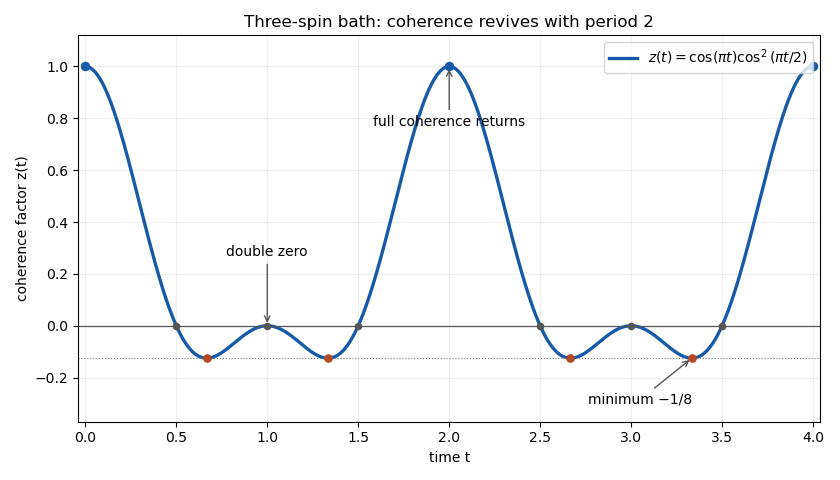

The finite spin-bath coherence recurrence returns the device to full coherence every two time units. Negative indicates a relative phase change and is not a negative probability. When , the device reduced density matrix becomes diagonal at each zero, but quantum decoherence is not irreversible in this finite bath. The sketch explicitly displays both loss of coherence and its revival.
Write for the upper endpoint called in the question, to distinguish it from the device amplitude. For a single realization of a finite bath,The literal claim of convergence to zero as time tends to infinity is false for every fixed finite . Random-coupling spin-bath decoherence must distinguish individual realizations, ensemble averages and the large-bath limit.
First establish finite spin-bath coherence recurrence without assuming commensurate couplings. Fix a reference time and consider points with coordinates modulo , for . Partition the unit cube into smaller cubes of side . Two points share a cube, so their difference provides an integer withAt time every cosine is arbitrarily close to . As increases, either these have an unbounded subsequence, or a bounded subsequence supplies a fixed with all distances exactly zero; its arbitrarily large multiples are then exact recurrences. In both cases there are unbounded times such that . This is the simultaneous Dirichlet approximation theorem argument; it applies equally to typical irrational random couplings. Part (i) supplies a particularly simple exact periodic counterexample.
The intended suppression is valid after ensemble averaging. Independence and the uniform density give the ensemble spin-bath coherenceThe continuous value at is . For its magnitude is strictly below to the power , and for fixed it has an envelope of order as . Thus the ensemble mean tends to zero with time.
The mean square distinguishes actual loss of coherence from cancellation of signs in that mean:At long times this tends to , exponentially small for , rather than exactly zero for a finite bath. At any fixed , the bracket is strictly less than , since on a set of positive measure. The Markov inequality then givesThis proves small coherence for typical large baths at a fixed nonzero time. An even stronger fixed-time formulation uses the strong law of large numbers:The logarithmic singularities at isolated cosine zeros are integrable, and an exact zero has probability zero, so the law applies. Typical coherence consequently decreases exponentially with bath size.
The initial time scale is also explicit. When , , so the short-time Gaussian spin-bath decoherence approximation isHere ; on the scale the displayed remainder tends to zero. The coherence is therefore rapidly suppressed for a large bath and is usually tiny at later fixed times, while rare recurrences still prevent a finite-realization long-time zero limit. Ensemble decay or a specified large- limit is the correct qualification of the printed assertion, consistent with reversible global unitary time evolution.
Articles by others on the same topic
There are currently no matching articles.