For the negative-flux Inviscid Burgers equation, the method of characteristics givesThe characteristic curve starting at therefore has , and henceFor smooth data this describes a single-valued classical solution as long as the characteristic flow map is invertible. Its Jacobian is ; after characteristic crossing, one must instead select a weak solution with the appropriate entropy solution condition.
The conservation form is , with conservation law flux . Integrating this scalar conservation law across a moving discontinuity, or differentiating its Heaviside representation as a distribution, yields the Rankine-Hugoniot conditionFor distinct one-sided limits it simplifies toThis jump-speed relation is exact for the Burgers conservation law; an additional entropy condition is needed to distinguish a physical compressive shock wave from an expansion discontinuity.
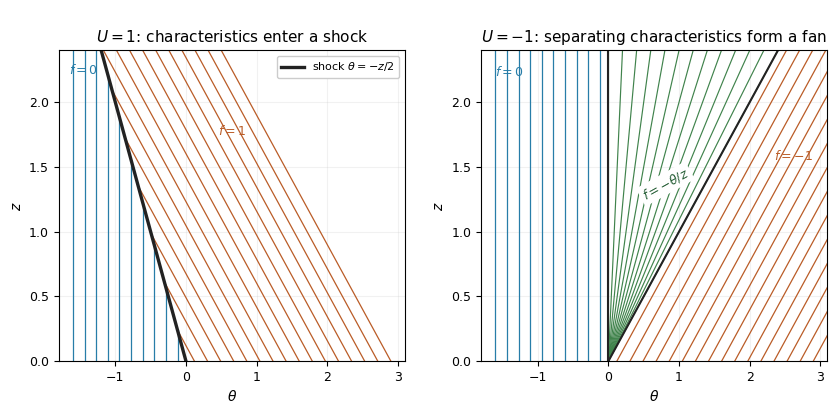
The step gives the Burgers Riemann problem with negative flux. If , characteristic curves from the left have speed zero, while those from the right have speed : they converge. The entropy shock wave has speed and thusCharacteristics enter this shock from both sides, since .
If , the right-hand speed is positive and the two families separate. A smooth steep approximation to the initial step spreads into a rarefaction wave. In the fan, the self-similar characteristic curve relation is , givingThe endpoint values match continuously. The discontinuity moving at would satisfy the jump condition even for , but its characteristic curves leave the discontinuity and it fails entropy admissibility. For the solution is identically zero.

Articles by others on the same topic
There are currently no matching articles.