For the negative-flux Inviscid Burgers equation, the method of characteristics givesThe characteristic curve starting at therefore has , and henceFor smooth data this describes a single-valued classical solution as long as the characteristic flow map is invertible. Its Jacobian is ; after characteristic crossing, one must instead select a weak solution with the appropriate entropy solution condition.
The conservation form is , with conservation law flux . Integrating this scalar conservation law across a moving discontinuity, or differentiating its Heaviside representation as a distribution, yields the Rankine-Hugoniot conditionFor distinct one-sided limits it simplifies toThis jump-speed relation is exact for the Burgers conservation law; an additional entropy condition is needed to distinguish a physical compressive shock wave from an expansion discontinuity.
The step gives the Burgers Riemann problem with negative flux. If , characteristic curves from the left have speed zero, while those from the right have speed : they converge. The entropy shock wave has speed and thusCharacteristics enter this shock from both sides, since .
If , the right-hand speed is positive and the two families separate. A smooth steep approximation to the initial step spreads into a rarefaction wave. In the fan, the self-similar characteristic curve relation is , givingThe endpoint values match continuously. The discontinuity moving at would satisfy the jump condition even for , but its characteristic curves leave the discontinuity and it fails entropy admissibility. For the solution is identically zero.
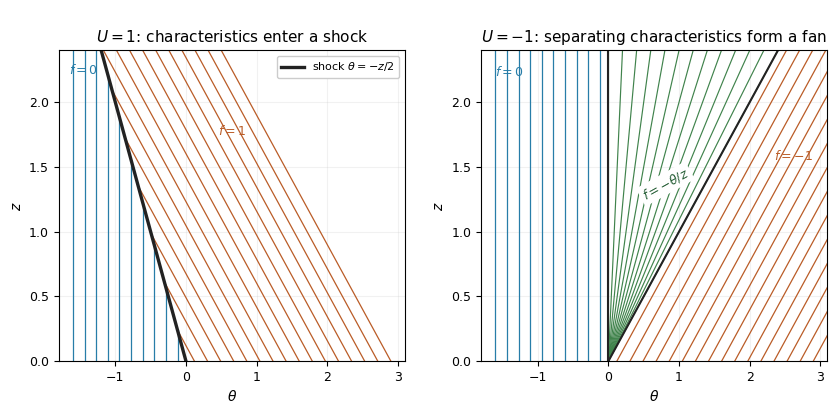
Characteristics of the negative-flux Burgers step: compression gives a shock for positive U, while negative U gives a rarefaction fan
. Details. 
Set and use the sign-appropriate Cole-Hopf transformation . Direct differentiation givesThus the heat equation implies the viscous Burgers equation with the required negative nonlinear sign. Conversely, vanishing of the Burgers residual makes the final quotient depend only on , and a multiplicative time-dependent factor in removes it. The algebraic substitution works for any nonzero where .
For a forward dissipative initial-value solution, take and . This is essential for the supplied heat kernel: at , , its real Gaussian integral diverges even for . More generally that kernel requires . The physical viscosity convention selects the positive case; the mere condition does not justify a forward Gaussian function formula.
Integrating gives a positive continuous initial factor, normalized asIts heat kernel convolution converges for both signs of , since a Gaussian function dominates the one-sided exponential. DefineThe left half-line contributes ; completing the square on the right half-line gives . ThusWhen differentiating, the two moving-endpoint Gaussian function terms cancel, becauseOnly remains in the logarithmic derivative. The viscous Burgers step solution with negative flux is thereforeThe denominator is strictly positive, so lies between and , irrespective of the sign of . Its initial limits away from are the required step.
For the spatial limits, the Gaussian function tails must be compared with ; inspecting that exponential alone gives the wrong inference when . As , the complementary error function asymptotic givesAt , tends to zero even for , because its quadratic decay dominates any exponential linear in . Hence . At , use the identity above to obtainwhile approaches its full Gaussian integral. Thusfor both signs of .
Since is strictly decreasing, holds exactly when . At this point , so the midpoint symmetry of a viscous Burgers step givesMore generally the exact symmetry is . For , the midpoint follows the inviscid shock trajectory. For , it is instead the center of an expanding fan, not a shock.
The vanishing viscosity approximation makes the comparison precise. For fixed and , near both tail integrals tend to the full Gaussian integral, so andThe layer has width and tends to the entropy shock, with value at its center. Outside it the limits are and .
For , inside both Gaussian function tails have large positive lower limits. Their asymptotics giveOutside this interval the limits are on the left and on the right. Thus positive viscosity selects the rarefaction wave, including the same midpoint value as the inviscid fan. The two sign cases agree with the preceding entropy solution construction, while a negative diffusivity would not furnish this dissipative selection.
Articles by others on the same topic
There are currently no matching articles.