In stellar homology, the dimensionless radial profiles are the same after scaling radius, enclosed mass, pressure, temperature and luminosity. At corresponding radii let , , , and . The printed is understood as this local radial scaling, with surface radius .
Let and keep composition, opacity coefficient and nuclear coefficient fixed first. Mass conservation gives , and hydrostatic equilibrium gives . The ideal gas law then gives . Scaling the stellar energy-generation rate equation and the stellar radiative temperature gradient gives respectivelyThe second follows from , not from energy production. Equating the two luminosity scalings givesThis assumes the denominator is nonzero and a consistent homologous family exists. If the mean molecular weight differs by , then andRatios of the opacity and energy-generation coefficients multiply the right-hand side. Thus fixed composition is a real restriction, not an automatic property of every stellar sequence.
Use the Stefan–Boltzmann law to locate the family on a Hertzsprung-Russell diagram. It implies andFor proton–proton chain burning take the usual local approximation , with Kramers' opacity law , . ThenFor the CNO cycle with electron-scattering opacity, , soA conventional local choice gives and slope . Choosing instead gives slope . The source specifies no numerical nuclear exponents, and the effective exponent changes with temperature; the general expression is the unambiguous answer.
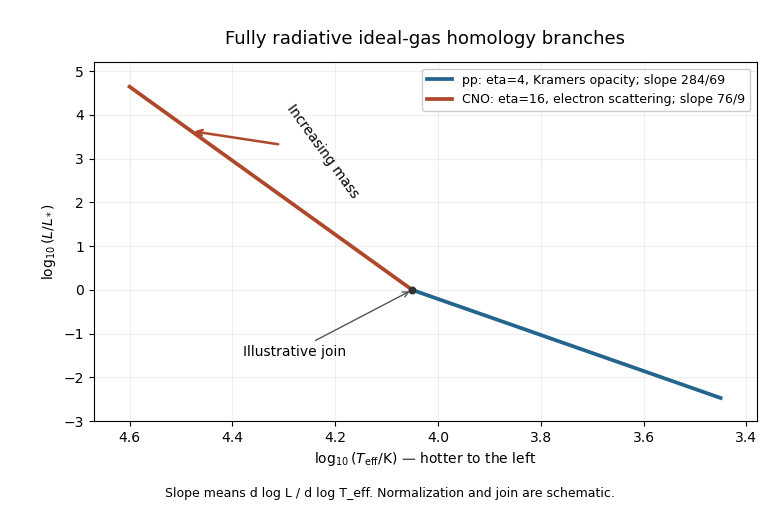
Idealized radiative homology branches on a Hertzsprung-Russell diagram, with pp exponent 4 and CNO exponent 16
. Details. 
The Hertzsprung-Russell diagram places hotter stars to the left. Its branches rise toward higher luminosity and mass, and the CNO cycle/electron-scattering opacity branch has the steeper logarithmic slope. Their illustrative joining point and normalization are arbitrary because the proportional opacity and reaction laws do not specify absolute stellar scales. These are the fully radiative ideal-gas homology predictions, not exact observed main sequence relations: convection and increasing radiation support limit those assumptions in real stars.
Articles by others on the same topic
There are currently no matching articles.