Write for the Levi-Civita connection and define its Christoffel symbols by . For the Riemannian metric matrix and its inverse ,A curve with affine parameter is a geodesic when , equivalentlyThe connection is metric compatible and torsion free; in particular . The coordinate velocities are , and the displayed coefficients are smooth functions of position.
For whose initial-value geodesic exists through time , with and , define . The domain is open and contains a neighborhood of zero. Indeed the geodesic equation is a smooth first-order ODE in ; the constant solution with initial velocity zero exists through time , and existence on a compact time interval and smooth dependence persist for nearby initial data. Reparameterization and uniqueness give wherever defined. Consequently the differential of the exponential map at zero isThe inverse function theorem gives a neighborhood of zero on which is a diffeomorphism onto a neighborhood of . Shrink to a ball in and choose an orthonormal basis there. Its linear coordinate functions composed with are the geodesic normal coordinates on . This establishes well-defined local coordinates without assuming geodesic completeness.
In these geodesic normal coordinates, every radial geodesic has coordinate expression . Its equation at reads for every . The coefficients are symmetric in by the torsion-free connection property. Evaluating at the coordinate unit vectors and their pairwise sums, or using the polarization identity, therefore givesThis is the fact that Christoffel symbols vanish at the center of normal coordinates. Also , since is the identity in an orthonormal basis.
For sufficiently small , the geodesic sphere is . It is a smooth hypersurface because is a diffeomorphism on the ball. It equals the local distance sphere for sufficiently small radius, as the length comparison below shows; no assertion of global smoothness for large radii is needed.
The full Gauss lemma isfor in a star-shaped domain of and . To prove it, set , and , for near zero. Every -curve is a geodesic and has squared speed . The torsion-free connection property and the commuting parameter fields give ; metric compatibility and then giveAt , , so . Integration from to followed by setting proves the boxed identity, because and . For any in the domain, a small neighborhood of its compact radial segment suffices for the variation. The zero vector is covered directly.
In particular, if , the images of the radial and spherical tangent directions are orthogonal; taking also proves preservation of radial length. Thus in geodesic polar coordinates the Riemannian metric has radial part and no mixed radial-angular term. Every curve in a small normal ball from its center to radial coordinate has length at least , by integrating the absolute radial derivative; the radial geodesic realizes this length. To exclude shortcuts leaving the ball, choose a larger normal ball of radius with compact closure in and restrict to : an escaping curve first reaches radial coordinate and already has length at least . This proves the asserted small-radius distance interpretation and orthogonality of radial geodesics to geodesic spheres.
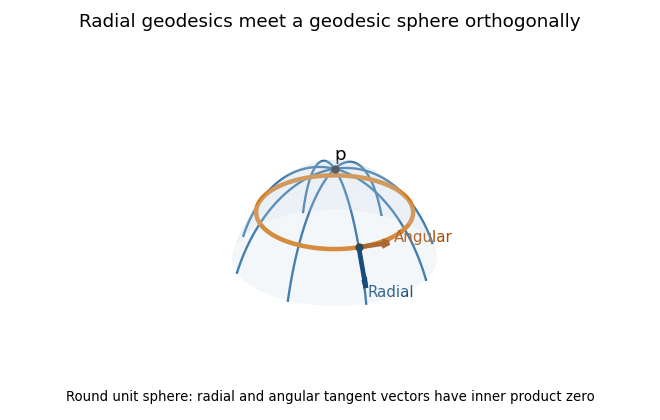
Radial geodesics and a geodesic sphere on the round unit sphere, with orthogonal radial and angular tangent vectors
. Details. 
Articles by others on the same topic
There are currently no matching articles.