Write , where is the atomic mass unit used in the mean molecular weight convention, and let be the Rosseland mean opacity per unit mass. For a static spherical star with negligible thermal storage, the stellar structure equations areHere is the net stellar energy-generation rate per unit mass; is the radiation energy-density constant and the speed of light. The last differential equation follows from radiative diffusion, , with . There is no gravothermal storage term in the specified stellar energy balance equation. Neglecting radiation pressure in force balance does not remove radiation as an energy carrier. Regular central conditions are ; take negligible external pressure, , for the analytic hydrostatic equilibrium model below.
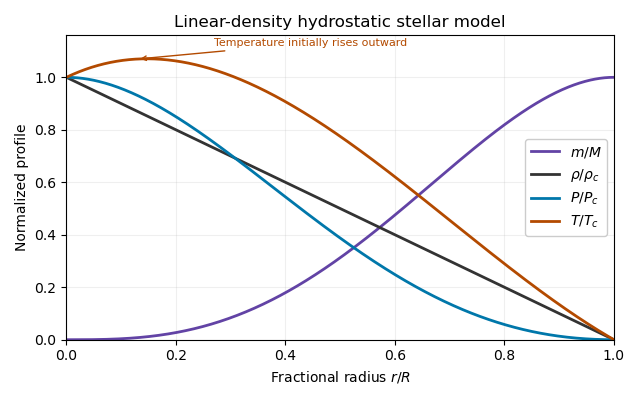
Set . Integrating the enclosed mass directly givesThusThe stellar hydrostatic equation then givesFactorizing makes the surface behaviour transparent:The ideal gas equation of state gives the temperature profileNo small- approximation was needed. In particular, close to the centre,These exact hydrostatic formulas reveal a limitation of the prescribed linear-density stellar model. Its mass density has a central cusp, and . A positive opacity with positive outward luminosity would instead require in radiative diffusion. Moreover, regular positive nuclear heating gives and therefore at the centre. Thus the imposed profile is a hydrostatic toy model, not a complete positive-heating radiative-equilibrium solution of all the stellar structure equations. The requested algebraic profiles and nuclear-luminosity integral can still be computed consistently as properties of that toy model.

Articles by others on the same topic
There are currently no matching articles.