Write , where is the atomic mass unit used in the mean molecular weight convention, and let be the Rosseland mean opacity per unit mass. For a static spherical star with negligible thermal storage, the stellar structure equations areHere is the net stellar energy-generation rate per unit mass; is the radiation energy-density constant and the speed of light. The last differential equation follows from radiative diffusion, , with . There is no gravothermal storage term in the specified stellar energy balance equation. Neglecting radiation pressure in force balance does not remove radiation as an energy carrier. Regular central conditions are ; take negligible external pressure, , for the analytic hydrostatic equilibrium model below.
Set . Integrating the enclosed mass directly givesThusThe stellar hydrostatic equation then givesFactorizing makes the surface behaviour transparent:The ideal gas equation of state gives the temperature profileNo small- approximation was needed. In particular, close to the centre,These exact hydrostatic formulas reveal a limitation of the prescribed linear-density stellar model. Its mass density has a central cusp, and . A positive opacity with positive outward luminosity would instead require in radiative diffusion. Moreover, regular positive nuclear heating gives and therefore at the centre. Thus the imposed profile is a hydrostatic toy model, not a complete positive-heating radiative-equilibrium solution of all the stellar structure equations. The requested algebraic profiles and nuclear-luminosity integral can still be computed consistently as properties of that toy model.
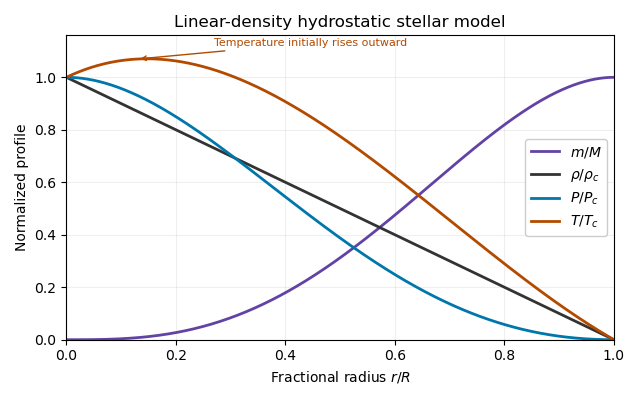

Evaluate radiation pressure on the gas-supported hydrostatic equilibrium solution. At the centre,The factors cancel between and , so at fixed mean molecular weight the ratio depends only on mass. Equivalently it is , withFor this is approximately , or if . If denotes hydrogen-atom mass instead, use the corresponding mean molecular weight convention consistently; the coefficient is about . Equality marks the breakdown of the gas-pressure approximation. It is a diagnostic based on the gas-only model, not an exact mixed-pressure stellar solution.
Since is per unit mass, each shell contributes . Both factors of mass density must be retained. Substituting the linear-density stellar model and its temperature profile givesWriting for this incomplete integral, with , the luminosity isThis supplies both the local and the total luminosity associated with the printed integral extending to one. For fixed composition and fixed , the total scales as . The physical nuclear-heating exponents are positive; mathematically the surface integral converges for . As a simple normalization check, , hence for temperature-independent heating. This is the generated luminosity; the radiative-transport incompatibility noted above is not removed by integrating the heating.
For a uniform-density stellar model, and . With zero surface pressure, integrate the stellar hydrostatic equation:Using the ideal gas equation of state, . ThereforeEquivalently and . The constant mass density is imposed as a structural approximation; a perfect gas can realize it hydrostatically by allowing its temperature and entropy to vary with radius.
Assemble the star from concentric shells. A shell of mass at radius has interaction energy with the already assembled interior. This counts each gravitational pair once. Hence the Newtonian gravitational potential energy isUsing givesThe negative sign expresses gravitational binding. A factor of one half should not be inserted again: the shell assembly already avoids double counting.
For a spherical hydrostatic star with negligible surface pressure, the stellar virial theorem isFor a monatomic nonrelativistic perfect gas, , so and the total energy is . Half the released binding energy raises the internal energy; only the other half can be radiated. With fixed mass, no nuclear supply and no external work, conservation of energy givesFor the uniform-density stellar model, this becomes the contraction-luminosity evolution equationIt relates luminosity to the contraction rate; it does not by itself prescribe . Given ,For constant luminosity, with . This describes quasi-static Kelvin-Helmholtz contraction, not dynamical free fall. If the gas has a different constant specific-heat ratio , the appropriate stellar virial theorem is , so the radiated fraction of binding release is rather than universally one half.
The conventional Kelvin-Helmholtz cooling time is of order . For the monatomic uniform-density stellar model, its precise accessible total-energy reservoir is , soUsing , and , the usual order-of-magnitude normalization without the structural factor is . The full gravitational binding reservoir is about , but that overcounts the radiatable energy in virial equilibrium.
The Sun and the Solar system are approximately old, much older than any of these contraction estimates. Gravitational contraction cannot sustain the Sun's long-lived present power. The dominant long-term source is stellar nuclear fusion. Contraction can still supply transient luminosity, especially in a pre-main-sequence star. The timescale comparison rules out a contraction-only explanation over the observed age; it does not assert that all gravitational energy release is absent.
For a stellar polytrope of index , write and combine hydrostatic equilibrium with mass conservation to obtainIntroduce Lane-Emden variables for a stellar polytrope, , and , whereSince , the mechanical equation reduces to the Lane-Emden equationA constant-density interior corresponds to the formal polytrope of index zero, with where . At , regularity first gives , and a second integration givesHere and , reproducing . The mass density jumps from its constant interior value to zero at the surface, while pressure vanishes continuously. The relation is singular at ; the regular dimensionless pressure/mass density formulation defines this incompressible structural limit. It does not mean that the gas's perturbative stellar adiabatic exponent is infinite: the hydrostatic ideal-gas toy model and its adiabatic response are distinct choices.
Use the printed stellar gas-pressure fraction, , with , and keep composition fixed. For a monatomic perfect gas plus equilibrium blackbody radiation, the specific heats of a monatomic gas-radiation mixture follow from its specific internal energy and specific enthalpy:At fixed total pressure, differentiating the equation of state givesIn particular, is not held constant during that derivative. The specific heat capacity at constant pressure is , soSince , this simplifies toThe pure-gas limit is . For a gas with unspecified molecular degrees of freedom, replace in by its gas heat capacity : then . The boxed formula uses the conventional monatomic stellar-gas interpretation.
The stellar adiabatic exponents are fixed-composition, constant-specific entropy derivatives:The chain rule gives . Define the pressure derivatives and . The first law of thermodynamics, with , givesCombining this with on an adiabat givesThus the specific-heat ratio is not generally equal to the three stellar adiabatic exponents.
For the mixture, and . The specific heat capacity at constant volume, obtained by differentiating at fixed mass density, isTherefore the adiabatic exponents of a monatomic gas-radiation mixture and its specific-heat ratio areIf a relation involving only the exponents is wanted, eliminate from :For a pure monatomic perfect gas, and . For any calorically perfect gas with constant heat capacities, the same equality holds with its own . In a genuine gas-radiation mixture, , while the exponents are given separately above.
In the radiation limit, and the adiabatic temperature gradient is . This follows independently from photon entropy: a comoving volume has , so an adiabat obeys and . However, is singular in the pure-radiation limit, not . This is the pure-radiation constant-pressure heat-capacity singularity. The equation fixes temperature whenever pressure is fixed, so an ordinary constant-pressure temperature derivative is not available; along the mixture limit and . For photons alone, mass-specific quantities additionally require a material mass label. The often quoted radiation index is its pressure-density adiabatic exponent, not a finite constant-pressure/constant-volume heat-capacity ratio.
Let , , , and . Consider a small radial fluid displacement whose sound-crossing time is short enough to keep its pressure equal to its surroundings. Its composition is frozen and its heat exchange negligible. This is the local stellar convective stability test.
For gas-pressure-dominated ideal gas matter, . The ambient gradient is thereforeThe displaced element conserves specific entropy and mean molecular weight, giving , where . The parcel-minus-environment mass density difference isIts buoyancy acceleration is minus times this difference. ThusPositive stellar buoyancy frequency squared gives a restoring force. The gas-pressure-dominated Ledoux criterion is thereforeEquality is marginal in this ideal adiabatic test. For monatomic gas . An inward increase of mean molecular weight has and stabilizes the layer; uniform composition recovers the Schwarzschild criterion. For a radiative layer one substitutes the stellar radiative temperature gradient, .
More generally define and . The same displacement argument gives and stability for . Both coefficients equal one in the gas-dominated ideal-gas limit used above. This is local dynamical stability against convection; it is distinct from global radial collapse and from instabilities requiring heat or composition diffusion.
Take a static, nonrotating, nonmagnetic spherical equilibrium with and . Use a fluid displacement . Write for Eulerian fluid perturbations. The Lagrangian pressure perturbation and corresponding mass density change obey , . Linearizing mass conservation, the Euler equations for an inviscid fluid and Poisson equation for Newtonian gravity givesThere is no equilibrium acceleration to multiply a perturbed mass density. The adiabatic process condition, with composition carried by the parcel, closes the system:These are the complete linear adiabatic stellar oscillation equations, including the perturbation of self-gravity. Neglect of heat exchange is appropriate when oscillation periods are short compared with relevant thermal relaxation times; it does not determine nonadiabatic excitation or damping.
For the pressure and buoyancy modes, separate angular dependence using spherical harmonics:The horizontal amplitude has dimensions of length. Angular differentiation gives , and tangential momentum gives . Define the adiabatic sound speed, stellar buoyancy frequency and Lamb frequency byThe adiabatic mass density relation becomes . Substitution produces a radial form of the full oscillation equations for nonzero :The apparent factor is evaluated through its defining gradient at the centre rather than by dividing two zeros.
Regularity at the centre excludes singular solutions. At a free surface the Lagrangian pressure perturbation vanishes, ; outside the star the gravitational perturbation decays as . For a model with mass density tending to zero at its surface, continuity of and its radial derivative gives . If the equilibrium mass density jumps to vacuum, include the displaced-surface mass sheet: the outward-minus-inward derivative jump is , so the interior condition is . An atmospheric boundary condition can replace the ideal free surface.
These conditions make an eigenvalue, not an arbitrary local sound frequency. With conservative boundary conditions the adiabatic operator is self-adjoint, giving real ; negative values describe instability. The frequencies depend on , self-gravity, stratification and boundaries, as well as angular degree and radial order. In a spherical nonrotating star they are degenerate in . For homologous equilibrium structures, their scale isthus the typical oscillation time measures inverse square root of mean mass density, while individual frequencies probe the interior adiabatic sound speed and stellar buoyancy frequency profiles.
For radial modes, write . Eliminating the pressure and gravitational perturbations gives the radial stellar pulsation equationThis is a Sturm-Liouville problem. Multiplication by and integration, with vanishing boundary terms, gives its Rayleigh quotientFor constant , makes both numerator contributions nonnegative. At , a homologous displacement is neutral; for constant the same trial displacement makes the quotient negative. For the uniform-density stellar model, constant is an exact mode and . With varying , the integral criterion, rather than a universal pointwise threshold, controls radial stability.
The Cowling approximation neglects while retaining the equilibrium gravitational field. It is useful for short-wavelength modes, but is not needed for the full derivation above. In a locally slowly varying region, take both remaining amplitudes proportional to and retain the leading derivative terms. ThenEliminating either amplitude gives the acoustic-gravity propagation relationPositive is oscillatory propagation; negative means an evanescent wave. The high-frequency branch, , describes stellar acoustic modes, restored chiefly by compressibility and pressure. At frequencies well above , this gives . The low-frequency propagating branch in stable stratification, , instead describes stellar gravity modes, restored by buoyancy. At there is no such nonradial gravity-wave cavity.
A stellar acoustic mode is trapped between an inner turning point near and an outer reflecting region. Low- modes penetrate deeply; radial modes reach the centre. Higher-degree modes turn farther out. Standing waves require the WKB quantization conditionwhere the phase depends on the central or turning-point behaviour and surface reflection. For high radial order and small degree, the leading acoustic travel-time result is the large frequency separationThe term is the leading central angular phase shift; smaller frequency separations depend on detailed interior gradients. The near-surface mass density stratification sets the acoustic cutoff frequency. In a plane-parallel isothermal atmosphere with mass density scale height , . Modes below this cutoff can reflect and form a cavity; waves sufficiently above it escape and need an outgoing-wave boundary condition. Nonadiabatic damping, driving and rotation alter real-star mode properties, but the adiabatic frequency problem isolates their dependence on the equilibrium structure.
Articles by others on the same topic
There are currently no matching articles.