A cataclysmic variable is a close semidetached binary in which a white dwarf accretes from a cool, usually low-mass donor star filling its Roche lobe. In an ordinary hydrogen-rich system the donor star is often near the lower main sequence. In a nonmagnetic cataclysmic variable (a disk-fed CV), the white dwarf's magnetic field is too weak to control the flow over the disk. This leaves a characteristic disk-fed geometry, summarized in the original schematic below. NASA's introduction to cataclysmic variables describes the basic components.
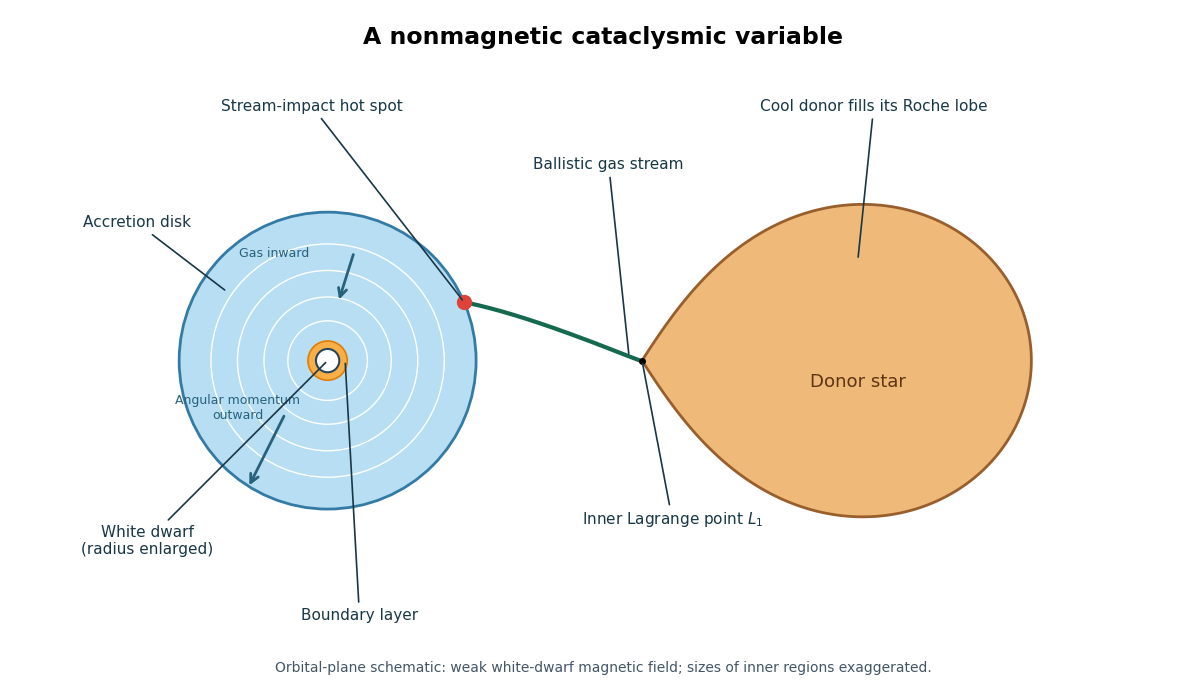
Nonmagnetic cataclysmic variable: Roche-lobe-filling donor, L1 gas stream, accretion disk, hot spot, white dwarf and boundary layer
. Details. 
Roche-lobe overflow passes through the inner Lagrange point . A nearly ballistic stream bends in the rotating frame and strikes the outer accretion disk, producing an accretion-disk stream-impact hot spot. Its retained angular momentum prevents direct radial infall. Viscous evolution of an accretion disk transports angular momentum outward while gas moves inward through a nearly Keplerian accretion disk. Close to the white dwarf, gas slows from orbital rotation toward the stellar rotation in an accretion-disk boundary layer. The disk, accretion-disk stream-impact hot spot, accretion-disk boundary layer, white dwarf and donor star all contribute to the spectrum and, where the orbital inclination permits, to the eclipses of an eclipsing binary. In particular, “nonmagnetic” describes the accretor's control of the flow; it does not imply that the donor star cannot sustain a magnetic field.
The gravitational power available from accretion is approximately . For a slowly rotating white dwarf and a thin steady Keplerian accretion disk, the specific energy changes from approximately zero far out to at the inner disk. Roughly half the available power is radiated by the accretion disk; the rest is released in the accretion-disk boundary layer as the orbital kinetic energy is dissipated. Stellar rotation and departures from a steady thin disk change this partition.
A classical nova has a different energy source. Transferred hydrogen accumulates on the white dwarf; compression heats the base of its envelope until temperature-sensitive hydrogen burning accelerates. Electron degeneracy pressure initially weakens the expansion response to heating, helping a thermonuclear runaway develop. The envelope subsequently expands and ejects material, producing a large optical outburst followed by a decline as the ejecta expand and residual burning ends. The white dwarf usually survives, so continued accretion can build another fuel layer. A rough recurrence scale is the ignition-envelope mass divided by the mean accretion rate; both this mass and the rate vary strongly among systems. The event is an envelope eruption, and the retained fraction is not automatically unity. Starrfield, Iliadis and Hix's nova calculations explains this nuclear mechanism. A classical nova is powered by unstable nuclear burning on the white dwarf.
A dwarf nova undergoes recurrent, shorter brightenings powered principally by enhanced gravitational accretion. The hydrogen-ionization disk instability creates cold, mostly neutral and hot, ionized branches of the disk's accretion-disk thermal S-curve, separated by unstable equilibria. In quiescence the cool disk stores matter because inward transport is slow. Once a critical surface density is reached, a heating transition puts the disk into a hotter, more state with higher effective viscosity: the inward accretion rate and luminosity rise and the disk drains. A cooling transition returns it to quiescence, completing the cycle. A persistent increase in the donor star's transfer rate is not required. Sufficiently high transfer rates can keep the disk on its hot stable branch, giving a nova-like variable rather than ordinary disk cycles. Lasota's disk-instability analysis and Hameury's disk-instability review develop this picture. A dwarf-nova outburst is a disk instability, not a white-dwarf thermonuclear explosion. The names classify mechanisms and need not identify permanently distinct binaries: a nova-producing binary can also possess an unstable disk between nuclear eruptions.
The cataclysmic-variable orbital-period distribution is not smooth. For ordinary hydrogen-rich cataclysmic variables, prominent features are a cataclysmic-variable period gap around two to three hours, a cataclysmic-variable period minimum near eighty minutes, and an accumulation near that minimum. These are population features rather than absolute exclusions. Selection effects matter: luminous high-accretion rate systems are easier to find than faint evolved systems. Helium-transferring binaries have a different period range and are not described by the hydrogen-rich minimum. Gänsicke and collaborators' period-minimum study documents the observed accumulation.
The Roche-lobe-filling period-density relation makes the orbital period a measure of donor structure. Combining with Kepler's third law givesAs the donor star loses mass, its stellar radius response exponent impliesA donor with evolves toward shorter orbital periods. When its effective response falls below , continued mass loss instead lengthens the orbital period: this is the cataclysmic-variable period bounce. A very low-mass donor may be substellar and increasingly affected by electron degeneracy pressure; the ideal degenerate scaling illustrates the reversal. The precise cataclysmic-variable period minimum depends on thermal disequilibrium and the strength of orbital angular momentum loss. Near a turning point is small; for an approximately steady evolutionary flow of systems, the number per period interval scales as , explaining the accumulation. Knigge, Baraffe and Patterson's donor-based evolutionary study relates the donor star's response to these period features.
Long-term transfer is driven mainly by losses of orbital angular momentum, rather than by disk outbursts. Magnetic braking of a binary star removes the cool donor star's spin through a magnetized stellar wind. Tidal synchronization makes the orbit replenish that spin, so the wind extracts orbital angular momentum. This is usually the dominant standard driving mechanism above the cataclysmic-variable period gap. Gravitational-wave emission from a binary system supplies a baseline loss, especially important below the gap. For a weak-field, slowly moving circular orbit, the circular gravitational-wave inspiral givesBecause ordinary transfer from the lighter donor star tends to expand its Roche lobe if orbital angular momentum is conserved, an external loss is needed to sustain contact. In the conservative contact approximation, the binary mass-transfer contact equation readswhere the stellar radius response exponent must match the evolutionary timescale and additional donor expansion has been neglected. The positive denominator on the stable branch makes drive . Nova ejecta can introduce additional nonconservative binary mass transfer. Knigge's evolutionary discussion describes the standard loss mechanisms and their limitations.
In the disrupted magnetic braking model, relatively rapid mass loss above the cataclysmic-variable period gap keeps the donor star inflated relative to stellar thermal equilibrium. When the donor approaches the fully convective star transition, the model postulates a substantial reduction in magnetic braking of a binary star. The donor star can contract within its Roche lobe, suppressing Roche-lobe overflow near the upper edge of the gap. Gravitational-wave emission from a binary system continues to shrink the detached binary; near the lower edge the Roche lobe again reaches the donor radius and transfer resumes. No mass transfer is needed during the detached crossing. The density relation predicts a radius ratio between contact at three and two hours if the masses remain nearly fixed, illustrating the required inflation before detachment. The torque reduction is a model ingredient, not a claim that all fully convective stars lose their magnetic fields. Zorotovic and collaborators' detached-binary study tests the predicted detached population in the gap.
The standard formation channel starts with an initially wider binary star containing two main sequence stars. The initially more massive component evolves first and becomes a giant. Unstable Roche-lobe overflow can engulf the companion in a common envelope. Drag causes inward orbital motion, releasing two-body orbital energy and transferring angular momentum to the envelope. If the envelope is expelled before merger, a close detached binary survives, containing the exposed core, which becomes a white dwarf, and the lower-mass companion. This explains how a binary becomes much tighter than the giant progenitor's radius would have allowed. The outcome depends on envelope binding and the efficiency of energy deposition, summarized approximately by the common-envelope energy formalism; ejection is not guaranteed. Ivanova and collaborators' common-envelope analysis discusses the relevant physics and uncertainties.
Subsequent magnetic braking of a binary star and gravitational-wave emission from a binary system shrink the detached binary until its companion fills its Roche lobe. Stable Roche-lobe overflow, for a suitable binary mass ratio and stellar radius response exponent, then creates a cataclysmic variable. Its later nuclear eruptions, disk cycles and secular orbital period evolution occur on different timescales. The formation sequence is a wide binary, envelope ejection, a close detached white-dwarf binary, and angular-momentum-driven contact.
Articles by others on the same topic
There are currently no matching articles.