Continue with downward coordinate and . By Stokes drag law, the small-particle isolated settling velocity is . Normalize concentrations by : write . In suspension the specified independent hindered settling laws give fluxes and . The initial state is .
Two upper sedimentation shocks clear the species separately. The faster front removes large particles, leaving behind it; the small concentration is unchanged across this front because the species fluxes are independent. The slower front separates that small-only suspension from clear fluid. Their downward velocities areThere is also a growing mixed deposit at the bottom. Let its normalized solid concentrations be , with , and let its upward speed magnitude be . Applying the Rankine-Hugoniot condition to each species givesAdding these relations provesThe deposited flux is zero even though each species occupies only part of the packing: the settling law applies to the suspension, while the deposit is a separate stationary state. These jump relations determine the deposit composition from sedimentation jump conditions.
The large-particle clearing front has height and meets the mixed-deposit front at height . ThusAt this merger all large particles have entered the deposit. Only the small particles remain suspended, at normalized concentration . The new material deposited above the mixed layer is pure small-particle solid, at total concentration . Its sedimentation shock therefore has downward speedFor , the deposit top and the remaining clearing front have heightsTheir meeting, or the total solid-volume balance, givesThis is two-stage bidisperse batch sedimentation: the fast species finishes first, followed by deposition of the remaining slow species.
The final solid composition by volume, and also by mass because the particle densities are identical, isThe upper pure-small layer has thickness . As checks, accounts for all large-particle solid volume, and accounts for all small-particle solid volume, in units of . If “percentage of particles” means number rather than volume, a large sphere occupies eight times the volume of a small sphere: the mixed bottom layer contains large particles by number and small. The upper layer remains entirely small under either convention.
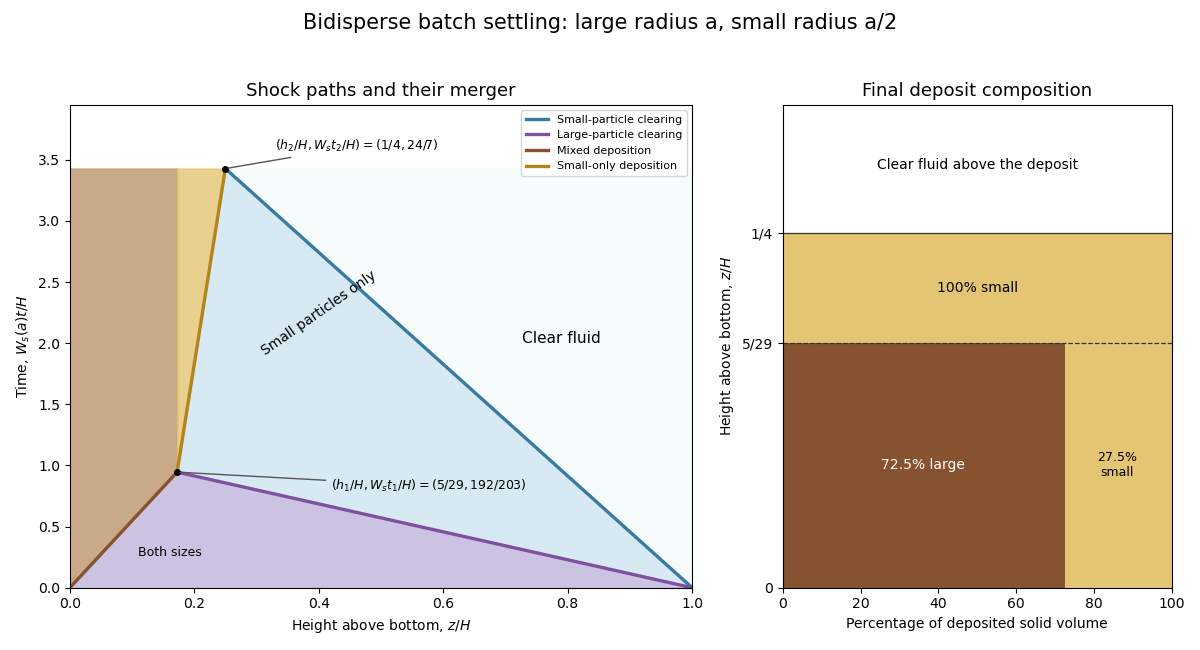
Bidisperse sedimentation: three initial shocks, merger at t1 and h1, final settling at t2 and h2, and solid-volume composition of the deposit
. Details. 
Articles by others on the same topic
There are currently no matching articles.