The settling velocity is a particle's vertical velocity relative to a stated frame. With height increasing upward, a sedimenting particle has .
For spheres with the same density contrast, balance submerged weight, proportional to , against Stokes drag law, proportional to , to obtain . With constant drag coefficient, quadratic drag is proportional to , giving . The two radius laws require their corresponding particle Reynolds number limits.
A Reynolds number based on particle diameter and relative speed in the carrier fluid. Small values justify Stokes drag law; a high-Reynolds-number regime with nearly constant drag coefficient instead gives quadratic drag. The drag law must be evaluated in the appropriate regime for every species.
For downward settling velocity magnitude and near-bed particle volume fraction , a horizontal absorbing bed receives particle volume per area per time . A bed inclined at angle to the horizontal receives per unit actual area, in the absence of resuspension or additional normal fluid motion.
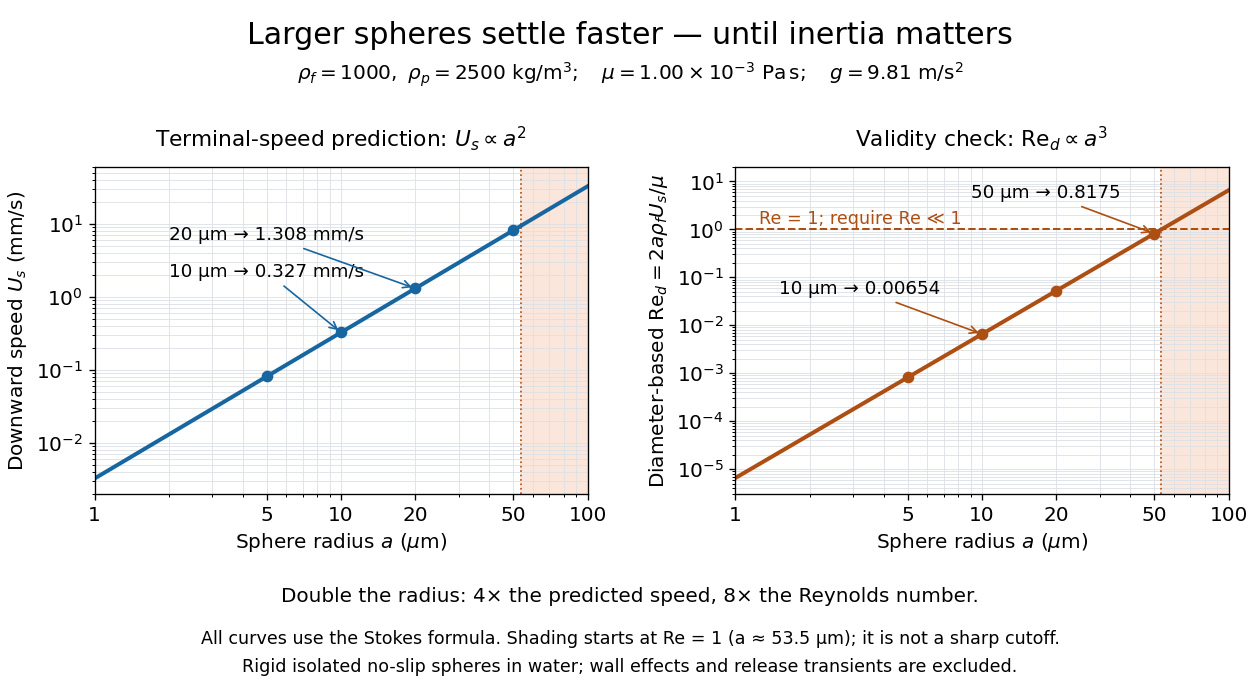
Sphere settling in water: terminal speed grows as radius squared while Reynolds number grows as radius cubed
. Details. 
Take downward as positive and let gravity have magnitude . For a rigid sphere of density in otherwise stationary fluid of density , its weight minus buoyancy is . At terminal velocity, this balances the Stokes drag law:This signed downward settling velocity is negative for a buoyantly rising sphere and zero for equal densities. For fixed density contrast and dynamic viscosity, the submerged weight grows as while linear drag at fixed speed grows as ; their balance gives the settling-velocity radius scaling . Meanwhile,Thus doubling the radius multiplies the predicted Stokes settling speed by four and the particle Reynolds number by eight. This makes the formula useful for separating particles by size, while also providing its own check against extrapolation to large particles.
For a computed water example, take , , , , and . These are specified rounded inputs rather than a claim of exact water properties at every temperature. They giveThe diameter is , and both the net downward weight and the upward drag force are . At this terminal velocity, falling takes . At the prediction is with ; at it is with , which is no longer a convincing small-Reynolds number case. The figure labels these as predictions of the Stokes settling velocity formula and shows where its inertia check fails.
The calculation describes the eventual terminal velocity, not the release transient governed by particle acceleration and possibly the Unsteady Stokes equation. Walls, hydrodynamic interactions, departures from a rigid sphere, or a different surface condition require a different resistance. For sufficiently small particles, Brownian motion can obscure individual settling trajectories; the formula still specifies the gravitational drift within its assumptions. The balancing argument already appears in article 43 of [ref]
https://mural.uv.es/daroig/documentos/stokes1850.pdf. Stokes's original investigation, collected-paper reprint
.Hindered settling is the reduction or modification of particle settling by the displaced carrier-fluid backflow and by interactions with other particles. A simple dilute mixture model gives every species the same volume-averaged backflow.
A one-dimensional particle suspension settling without particle diffusion or overturning obeys the scalar conservation law . The upward flux is negative for downward settling. Characteristic curves, compressive shocks and rarefaction waves describe concentration transport rather than individual particle paths.
For hindered settling with normalized particle volume fraction , upward coordinate and downward isolated settling velocity magnitude , the scalar conservation law has conservation law flux . For , its convexity changes at when this lies in the physical interval. This change distinguishes spreading rarefaction waves from compressing characteristic curves; a flux with an inflection can produce both a shock wave and a rarefaction wave in one transition. At the flux is linear and the profile simply translates.
A particle suspension contains two particle species with separate particle volume fractions. In an independent-settling model, each species obeys its own flux conservation equation, while a shared stationary deposit can couple the jump conditions through its maximum total packing fraction. Such independence is an imposed model; general hindered settling need not decouple species.
Initially, separate clearing fronts of fast and slow species coexist with a mixed deposition front. After the fast clearing front meets that deposit, the remaining suspension contains only the slow species. Its later sedimentation shock builds a pure-slow layer above the earlier mixed deposit. Final layer thicknesses and composition follow from separate particle-volume conservation.
For a bidisperse kinematic sedimentation model with normalized suspension concentrations , isolated speeds , and a stationary deposit with , the upward deposit-front speed magnitude obeys . Adding gives ; substitution determines each deposited fraction. These are Rankine-Hugoniot conditions with a stationary compacted branch.
A moving discontinuity of particle volume fraction in kinematic sedimentation. Conservation of particle volume gives the Rankine-Hugoniot condition in a consistently oriented coordinate. A clearing front and a deposit front can both be sedimentation shocks. A stationary deposit uses zero particle flux; its compacted branch need not obey the suspension flux law.
Particle mass conservation gives . Averaging concentration over the entire original container gives . This average differs from the concentration inside the deposit itself.
With upper concentration and lower concentration , the clearing, internal and deposit fronts have speeds , and . If the lower two merge, the resulting deposit/upper-suspension front has speed . Final deposit thickness is by mass conservation.
For initial concentrations above and below it, all three straight shocks meet when . The common time is and height is . Afterwards only a stationary deposit/clear-fluid boundary remains.
For downward settling speed in upward coordinate , particle flux is . The concentration-characteristic speed is and differs from particle speed. Since , decreasing concentration with height creates a compressive shock, while increasing concentration creates a rarefaction wave.
For on , with clear fluid above and no imposed bed discontinuity, the first compression of the smooth profile occurs at and . The nascent shock enters clear fluid with initial signed speed . Its downward speed subsequently decreases as the state behind it becomes more concentrated, until a boundary interaction changes the problem. This is characteristic breaking, not the time of initiation of a separately imposed packed-bed front.
If lower initial concentration is less than upper concentration , the entropy solution expands into a fan with . Its characteristic speeds range from to . The fan can be clipped by a clearing or deposition shock.
For upper concentration , lower and interface height , both curved fronts meet inside the fan only if . At smaller , the deposition front reaches the fan upper edge first, then advances through uniform concentration . The clearing front remains straight and final time is .
For upper concentration , lower concentration and , define and . Once inside the settling rarefaction fan, clearing and deposition shocks obey and . These curves apply only while their neighboring concentration remains within the fan.
If both shocks meet inside a settling rarefaction fan, and the last characteristic has concentration . It runs from the initial internal interface to the final deposit point. This construction requires ; otherwise a front exits the fan before final deposition.
The Rankine-Hugoniot condition for the quadratic hindered-settling flux gives , with lower and upper states labelled . It includes a downward clearing front (), an upward deposition front (), and a stationary final deposit/clear-fluid interface.
Articles by others on the same topic
There are currently no matching articles.