A square circle packing of equal radii has one circle per cell of side . Its packing fraction is thereforeFor the alternating-radius square circle packing shown in the source figure, let be the nearest unlike-centre separation. A two-circle repeat cell has area and solid area . Unlike circles require ; like circles on the two sublattices require and . ThusAll three nonoverlap constraints matter when varying the radius ratio.
Take as in the illustrated arrangement and set . If , the large circles determine the spacing and increases with . If , unlike contacts determine it and , whose derivative is proportional to and is nonpositive. The maximum is therefore at the joining point:The large circles then touch their large neighbours, while each small circle exactly fills a square interstice. Interchanging the species gives the reciprocal radius ratio. This is the highest packing fraction within the specified alternating square arrangement; it is not a claim about every possible unequal-circle packing.
Let the particle and carrier-fluid mass densities be and , with identical density contrast for both species. At small particle Reynolds number, balance Stokes drag law against submerged weight:ConsequentlyAt large particle Reynolds number, use approximately constant drag coefficient and quadratic drag. Balancing against the same submerged weight gives , soBoth particles must lie in the constant- regime for this simple square-root ratio. More generally it contains an additional factor . The speeds are positive downward magnitudes; the signs of the shock velocities below depend on the chosen spatial coordinate.
Use downward distance , with the height above the bottom, and write . This convention will also reproduce the printed negative deposit-front velocity in part (d). The ideal simple-cubic sphere packing has packing fraction ; leaving symbolic keeps the jump calculation independent of its value. In suspension, the kinematic sedimentation equation isIntegrate this conservation law across a moving discontinuity to obtain the Rankine-Hugoniot conditionThe brackets denote values on the increasing- side minus those on the other side. A sedimentation shock is a concentration jump moving at this secant slope of the particle flux. Deposited material is stationary and has zero flux.
For the upper clearing front, the states are and , giving downward. For the lower deposition front, the states are and , giving , upward. ThusIn terms of height above the bottom, the shock paths areThey meet when . Therefore complete settling occurs atThe final height also follows directly from particle volume fraction conservation, . The stationary deposit after the meeting carries no particle flux.
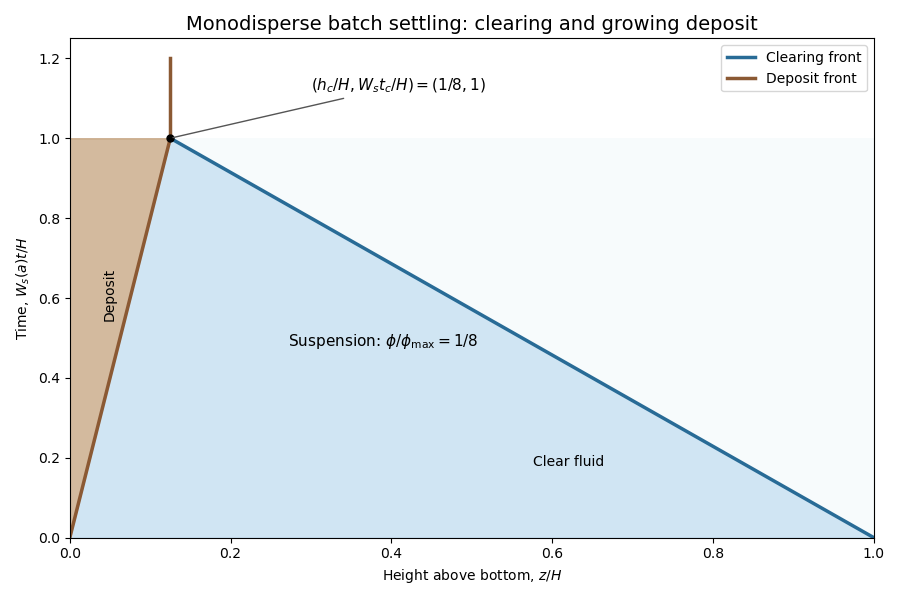
Monodisperse batch sedimentation: clearing and deposition shock paths meet at time H/Ws and height H/8
. Details. 
The diagram plots time vertically against height, as requested. Its shock slopes have the opposite spatial sign to , because those velocities were defined in the downward coordinate.
Continue with downward coordinate and . By Stokes drag law, the small-particle isolated settling velocity is . Normalize concentrations by : write . In suspension the specified independent hindered settling laws give fluxes and . The initial state is .
Two upper sedimentation shocks clear the species separately. The faster front removes large particles, leaving behind it; the small concentration is unchanged across this front because the species fluxes are independent. The slower front separates that small-only suspension from clear fluid. Their downward velocities areThere is also a growing mixed deposit at the bottom. Let its normalized solid concentrations be , with , and let its upward speed magnitude be . Applying the Rankine-Hugoniot condition to each species givesAdding these relations provesThe deposited flux is zero even though each species occupies only part of the packing: the settling law applies to the suspension, while the deposit is a separate stationary state. These jump relations determine the deposit composition from sedimentation jump conditions.
The large-particle clearing front has height and meets the mixed-deposit front at height . ThusAt this merger all large particles have entered the deposit. Only the small particles remain suspended, at normalized concentration . The new material deposited above the mixed layer is pure small-particle solid, at total concentration . Its sedimentation shock therefore has downward speedFor , the deposit top and the remaining clearing front have heightsTheir meeting, or the total solid-volume balance, givesThis is two-stage bidisperse batch sedimentation: the fast species finishes first, followed by deposition of the remaining slow species.
The final solid composition by volume, and also by mass because the particle densities are identical, isThe upper pure-small layer has thickness . As checks, accounts for all large-particle solid volume, and accounts for all small-particle solid volume, in units of . If “percentage of particles” means number rather than volume, a large sphere occupies eight times the volume of a small sphere: the mixed bottom layer contains large particles by number and small. The upper layer remains entirely small under either convention.
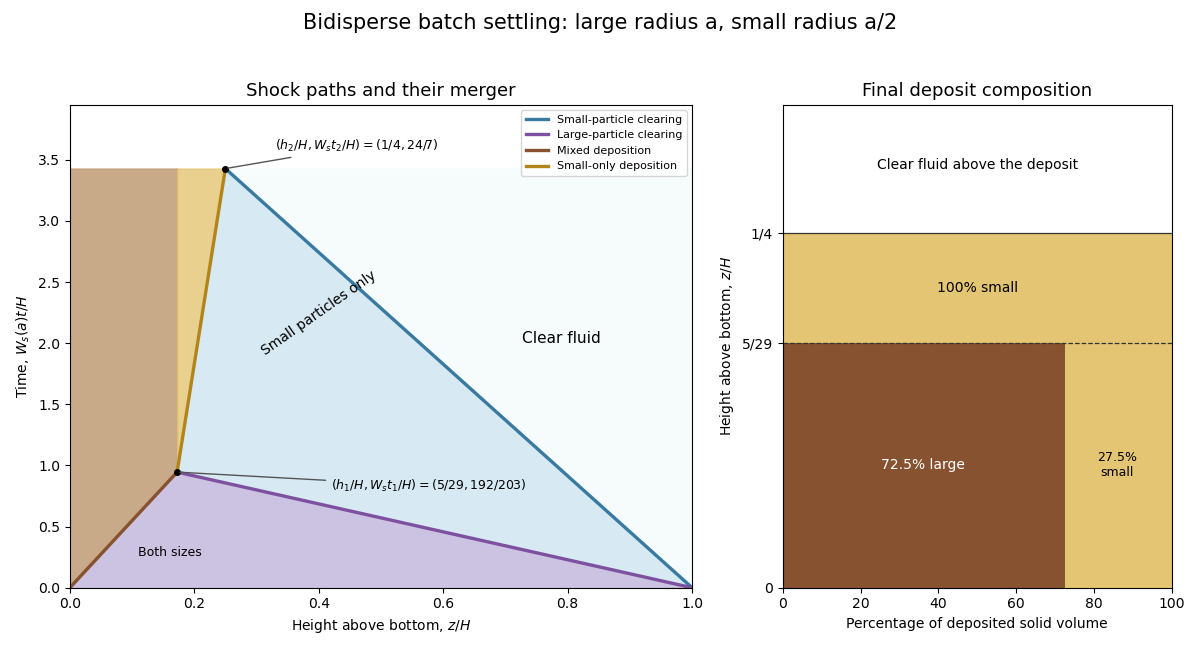
Bidisperse sedimentation: three initial shocks, merger at t1 and h1, final settling at t2 and h2, and solid-volume composition of the deposit
. Details. 
Articles by others on the same topic
There are currently no matching articles.