Away from the impulse, the harmonic oscillator equation has a homogeneous solution. Before , the initial conditions select . The jump condition for an impulse requires continuity of and a unit jump in : a jump in would produce a derivative of the Dirac delta distribution, which is absent from the forcing, while integrating through the impulse gives .
Just before the impulse, and . Just afterwards, and , so uniqueness for the harmonic oscillator equation makes the subsequent solution identically zero. Equivalently the causal response is , with the Heaviside step function, and it cancels the original oscillation.
The solution isThe impulse cancellation of a harmonic oscillator produces a continuous graph with a corner at , followed by a horizontal zero line.
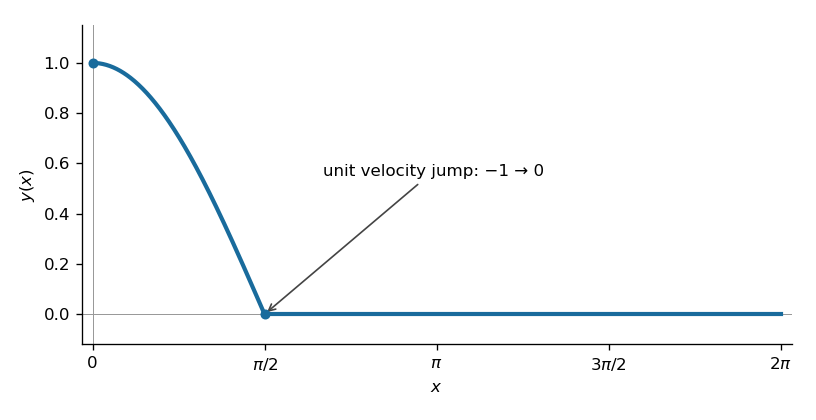
An impulse cancels the oscillator at zero displacement
. With a positive cooling rate , Newton's law of cooling gives . The temperature excess satisfies the first-order linear differential equation . Applying the initial condition to its exponential decay solution givesThe temperature approaches the ambient value , rather than zero. The intended cooling situation has and .
At the first half-temperature time, the solution of Newton's law of cooling givesSince , this time is positive and finite. The instantaneous temperature increase supplies the new initial condition . Restart the same first-order linear differential equation at :This is Newton cooling with an instantaneous temperature jump. The time translation in the exponential decay is essential: its prefactor is the excess immediately after the jump.
Each smooth segment follows Newton's law of cooling: and . Thus the graph decreases and is convex on both sides of . It starts at , falls to , jumps upward by , and then decreases asymptotically to .
The right-hand limit at the jump is above the original temperature, because implies . The vertical dotted segment in the sketch denotes an instantaneous jump, not a continuous evolution through intermediate temperatures. The example uses , ; its qualitative shape holds for all the stipulated parameters.
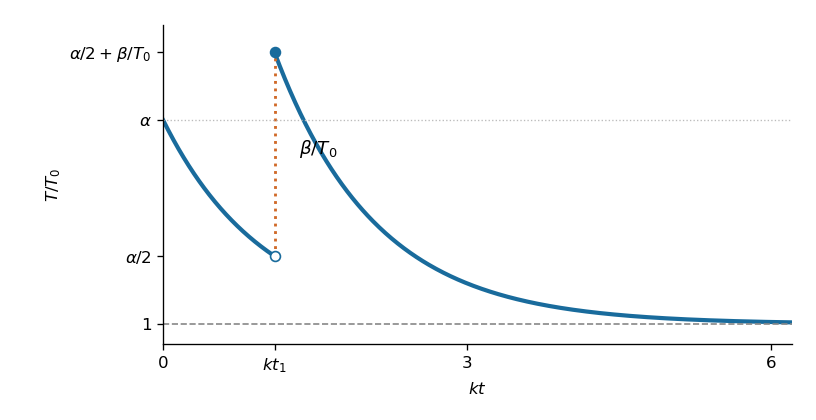
Cooling interrupted by an instantaneous temperature increase
. Impose the target temperature on the post-jump exponential decay:Solving for the jump and eliminating using givesThis is the unique required temperature increase, and it satisfies the stipulated lower bound. Indeed impliesThus no additional restriction on the prescribed time is needed.
Articles by others on the same topic
There are currently no matching articles.