Use the simple-root form of Hensel lemma: if and satisfy and , there is a unique with and . More generally the same assertion holds over a complete discrete valuation ring, with its maximal ideal in place of .
Every nonzero 3-adic number has a unique expressionIndeed its normalized P-adic valuation fixes , and its unit residue modulo three fixes . Cubing is an automorphism on , so it remains to compute the cube map on the principal units.
For ,Thus . Conversely, given , apply Hensel lemma toModulo three it is , and is always a unit. The residue root therefore lifts, giving with . HenceThis is the cube map on 3-adic principal units. Introducing is essential: applying simple-root lifting directly to would fail because its derivative is divisible by three at every unit.
The map induces an isomorphism , since multiplication adds the first principal-unit digits modulo three. The valuation factor contributes independently, so the cube-class group of the 3-adic numbers isExplicit generators are the classes of and . Representatives are with . The class of is detected by valuation modulo three, and that of by its nonzero first principal-unit digit, so the two generators are independent.
Normalize the discrete valuation on by , set , and write for its valuation ring. For a finite Galois extension of local fields, define and, for integers ,Equivalently, is the kernel of the action on . These are the lower ramification numbering of the ramification groups. In particular, is the inertia group, the kernel of the action on the residue field, and is the wild inertia group. They form a decreasing sequence of normal subgroups, eventually trivial.
For a real index , extend by . Define the Herbrand function byIt is continuous, strictly increasing and piecewise linear; denote its inverse by . The upper ramification numbering isThe definition includes the placement of the groups at break endpoints: the group at a break is the group before the drop. Lower numbering is compatible with subgroups; upper numbering is the one compatible with quotients. In a totally ramified extension, the uniformizer criterion for lower ramification groups permits testing the defining valuation inequality on one uniformizer instead of on every integral element.
Let and let be a primitive cube root of unity. The splitting field is . The polynomial is an Eisenstein polynomial, so . Meanwhile shows that is quadratic: is not a square because its valuation is odd. A quadratic field cannot lie in the degree-three field. Consequently , and the action on the three roots identifies its Galois group with the symmetric group .
A useful uniformizer isSince , we obtainThus is a root of the Eisenstein polynomial . Its degree is six, so , the extension is totally ramified, and is a uniformizer. With ,This is the Eisenstein sextic presentation of the splitting field of X3 minus 3 over Q3.
Let , , and let , . Then has order three, has order two, and . Their actions on the uniformizer areThe two nonidentity elements of therefore satisfyEach transposition sends to for some , so its displacement has valuation one: is a unit, reducing to modulo the maximal ideal. The uniformizer criterion for lower ramification groups now givesFor real indices, this is on , on , and for . In particular the lower breaks are and .
On the index is two; beyond three it is six. Thus the Herbrand function isThe positive lower break becomes the upper break . ThereforeThe fractional upper break is allowed because the full extension is nonabelian. As a check, the different exponent from ramification groups is . The derivative of the minimal polynomial gives the same result: . This is the case of ramification groups of the splitting field of Xp minus p over the p-adic numbers.
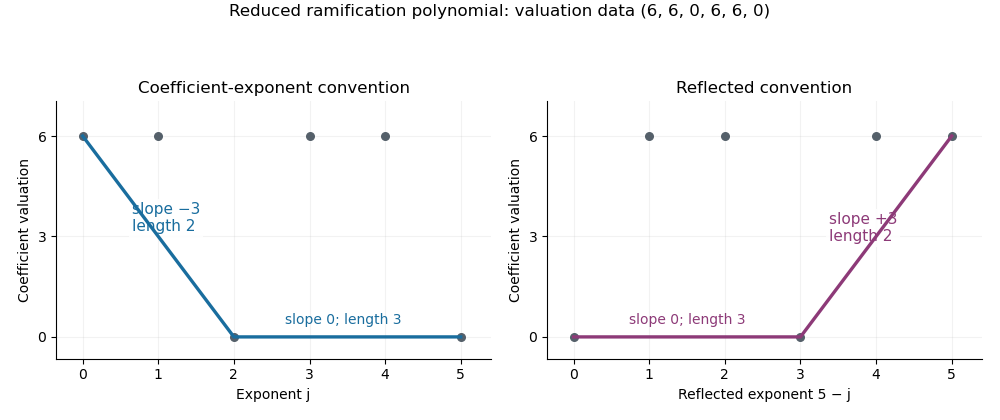
Normalize by and put . Write , with and . In the usual coefficient-exponent convention, the Newton polygon is the lower boundary of the convex hull of the upward vertical rays starting atIt runs from to , with nondecreasing slopes from left to right. Zero coefficients contribute no finite point. Equivalently it is the largest convex piecewise-linear function lying below all these coefficient points.
The Newton polygon root valuation theorem says that a segment of slope and horizontal length accounts for exactly roots of valuation , counted with multiplicity, using the extended valuation on an algebraic closure. The nonzero constant coefficient excludes a zero root.
For a short justification, use the weighted Gauss valuation for . It is multiplicative: after scaling by an element of valuation in a valued extension, the initial nonzero residue polynomials multiply without vanishing. Rational suffice. Factoring a monic polynomial into linear factors gives . This supporting-line function changes derivative at precisely the root valuations; its derivative drops count their multiplicities. Supporting lines to the lower polygon have slope , proving the sign and horizontal-length assertion.
Slope convention for part (b). Reflecting the horizontal axis, by plotting , produces the reflected Newton polygon convention; its slopes are the root valuations themselves. Part (b)'s wording with instead of is correct under this positive-root-valuation convention. The proof below gives both forms explicitly, so the result does not depend on silently changing the sign.
The denominator is ; dividing by removes the zero at . A uniformizer of a degree- totally ramified extension generates the field: its valuation over is , so already has ramification index at least . Hence , its minimal polynomial has degree , and its conjugates are the distinct for .
Factor the minimal polynomial over . The reduced ramification polynomial isEvery displayed root is nonzero and integral, since two uniformizers have a difference of valuation at least one. Thus is monic of degree , has nonzero constant coefficient, and belongs to . For it is the constant polynomial , with no slopes and no ramification jumps.
Here is also a justification of the uniformizer criterion for lower ramification groups in this setting. The powers are a -basis. In an expansion , the nonzero terms have valuations , distinct modulo ; therefore there is no cancellation at the least valuation. If is integral, all those values are nonnegative, which forces . Thus . For , is divisible by , with the remaining factor integral. Consequently every has valuation at least , and equality is attained at .
For a nonidentity automorphism, write . By the defining inequality for the lower ramification numbering,The Newton polygon root valuation theorem therefore proves the ramification breaks from a reduced ramification polygon relation:The segment's horizontal length is exactly . Equivalently, in the reflected Newton polygon convention required for a positive-slope formulation,All occurring root valuations are nonnegative integers. For negative indices, extend ; total ramification means that there are no negative-index jumps, so the reflected formulation remains true for all integers.
The sign distinction is substantive. Using the uniformizer from question 2, whose minimal polynomial is , givesIts coefficient valuations are , because . The usual lower hull has vertices and slopes , of lengths . These correspond exactly to the drops and . With the reflected axis the slopes are , as in the printed positive- wording. If the coefficient-exponent definition is used throughout, the printed assertion needs the minus sign shown above.

First compute the class number. The ideal-form correspondence for imaginary quadratic fields identifies the ideal classes with proper equivalence classes of primitive positive definite binary quadratic forms of discriminant . Each has a unique reduced positive definite binary quadratic form representative under the convention , with when or . From we get . Checking these three possible leading coefficients gives exactlyFor , neither odd residue choice makes integral. The listed forms are primitive and satisfy the reduction convention, soThis computes the ideal class group of Q of square root minus thirty-one.
Now take a root of , and let be its splitting field over . There is no rational root: the only candidates are , and neither vanishes. Thus the cubic is irreducible. Its polynomial discriminant isSince this is nonsquare, the Galois group of an irreducible cubic is . Its quadratic subfield is : the product of pairwise root differences squares to and changes sign under odd permutations. Thus is cyclic of degree three, and . Indeed the cubic field and have coprime degrees, so their compositum already has the full splitting-field degree six. The squarefree polynomial discriminant also shows, by the discriminant-index formula for an integral lattice, that is the full integer ring of the cubic field.
It remains to prove that is unramified everywhere. At any rational prime , the reduction of is separable. Over a finite residue extension in which it splits, all residue roots are simple and lift by Hensel lemma to the corresponding unramified extension of . Therefore the local splitting field is unramified over , and its extension over a completion of is unramified as well.
At the only possible ramified prime, direct reduction givesThe simple root lifts to . Write , with monic quadratic over . The discriminant product formula givesHere is a unit, so the quadratic discriminant has square class . Hence the entire local splitting field isIt is quadratic over , but its extension over the completion of is trivial. Thus the prime over splits completely in ; in particular it is not ramified there. This is the local splitting-field argument behind an unramified cyclic cubic extension from a prime-discriminant cubic. There are no real places of the imaginary quadratic field , so no infinite-place ramification remains to check.
The Hilbert class field theorem identifies the maximal everywhere unramified abelian extension with an extension of degree . Our cyclic unramified extension already has that degree, so it must be the whole Hilbert class field. ThereforeEquivalently, it is the splitting field of , of degree six over and degree three over . Replacing by gives the alternative defining cubic . This is the Hilbert class field of Q of square root minus thirty-one.
Articles by others on the same topic
There are currently no matching articles.