For a square matrix over a field, the minimal polynomial is the unique monic polynomial of least degree satisfying . The Cayley-Hamilton theorem guarantees at least one such polynomial: the characteristic polynomial. The minimal polynomial divides every polynomial that annihilates , so reducing matrix powers modulo can need fewer coefficients than reducing modulo the characteristic polynomial.
For example, has minimal polynomial , whereas the Jordan block has minimal polynomial . Both have the same characteristic polynomial. Their different matrix powers are illustrated in repeated eigenvalues in the Cayley-Hamilton theorem.
For a linear operator on a finite-dimensional vector space over a field , all polynomial kernels stabilize at their first power exactly when its minimal polynomial has no repeated irreducible polynomial factor in . This formulation does not require those factors to be linear.
To prove it, the Bézout's identity for polynomials gives : a greatest common divisor is a combination of and , while is its multiple. If is square-free, , proving the displayed equality. Conversely, if an irreducible factor occurs to exponent , its primary decomposition theorem summand has minimal polynomial . On this summand is nonzero, while . Thus the kernels of those two powers differ. An eigenbasis follows from this criterion precisely when the distinct factors of are also linear over ; a real rotation through a right angle has square-free but no real eigenvalues.
For a linear operator on a finite-dimensional vector space, an eigenvector gives , proving the forward implication from eigenvalue to root. Conversely write . If were invertible, the equation would imply , contradicting minimal degree. Thus has a nonzero kernel of a linear map. The equivalence concerns roots in the scalar field; roots in an extension describe eigenvalues after extending scalars.
For a linear operator on an -dimensional vector space over a field, the polynomials annihilating a fixed vector form an ideal of . It is nonzero because are linearly dependent. Since is a principal ideal domain, its unique monic generator exists and has degree at most . It divides exactly when . For it equals one. Its degree is the dimension of the cyclic subspace generated by : the vectors up to are independent by minimality and span an invariant space by the annihilating recurrence.
Let be a companion matrix of a monic irreducible polynomial of degree . Form the -by- block matrix with on its diagonal, immediately above the diagonal, and zero elsewhere. If the field characteristic is , write with maximal, so that ; in characteristic zero take and . ThenThus a separable polynomial gives , but an irreducible polynomial with zero formal derivative can give a smaller exponent. For example, over the rational function field , the irreducible polynomial has , so a two-block chain still has minimal polynomial .
To prove the formula, write , where has diagonal blocks and is the block shift. These are commuting operators, and vanishes exactly when . The binomial theorem in positive field characteristic gives . Expanding gives , with commuting with . The diagonal blocks of are , which are invertible by Bézout's identity for polynomials, since is irreducible with nonzero formal derivative and . Therefore vanishes exactly when . Finally, the block upper triangular matrix determinant gives the displayed characteristic polynomial, while the Cayley-Hamilton theorem and irreducibility force the minimal polynomial to be a power of .
On a real or complex inner product space of finite dimension, a normal operator has a square-free polynomial as its minimal polynomial. To prove this without the spectral theorem, suppose an irreducible polynomial occurs at least twice in . Put and . Since polynomials of a normal operator are normal, is a normal operator. For every ,By kernel stabilization for a normal operator, . Hence the smaller-degree monic polynomial annihilates , contradicting minimality.
Over the complex numbers, all irreducible polynomials are linear, so the primary decomposition theorem for linear maps now gives a basis of eigenvectors. Over the real numbers, irreducible quadratics can remain: a nontrivial planar rotation need not have any real eigenvectors, although its minimal polynomial is square-free.
On two-by-two complex matrices let . In row-entry coordinates, its matrix is , so its characteristic polynomial is the square of that of . For every polynomial , . Thus implies , and the reverse implication follows by taking . The operators have exactly the same annihilating polynomials and hence the same minimal polynomial. In general, right multiplication on -by- matrices has characteristic polynomial and the same minimal polynomial.
The minimal polynomial of a real matrix, initially computed over the complex numbers, has real coefficients. Its coefficientwise complex conjugate is also a monic polynomial of the same degree annihilating the matrix. Uniqueness of the minimal polynomial forces the two polynomials to agree.
If a square matrix satisfies , then , and every integer matrix power lies in the span of . Writing , the universal formula is , where , and . The polynomial on the right satisfies , and . These value and derivative conditions implement interpolation at a repeated root. For negative integers the inverse formula first puts in the same polynomial algebra; the nilpotent block identity for proves the derivative rule for every integer.
A square matrix is invertible exactly when its minimal polynomial has nonzero constant term. If , then , and invertibility would contradict the minimality of . Conversely, if with , then .
For square matrices ,Indeed, . Thus the two minimal polynomials have the same nonzero factors with the same multiplicities, while their powers of differ by at most one.
The identity gives . If is diagonalizable, its minimal polynomial has simple roots. Hence all nonzero Jordan blocks of have size one and its zero blocks have size at most two. Squaring kills these nilpotent blocks, making both squared products diagonalizable. Their eigenvalue multisets agree by Characteristic polynomials of AB and BA, so the squared products are similar matrices.
If are pairwise coprime, thenBezout identities between the factors construct the corresponding projections.
Suppose for a linear operator , and Bézout's identity for polynomials gives . The kernel decomposition for coprime polynomials is . The displayed operators are the corresponding projection operators: is the identity on and zero on , while has the opposite action. Thus , , and . These actions also prove independence from the choice of Bézout coefficients. Every summand is an invariant subspace of , since the projections are polynomials in and commute with it.
For a linear map on a finite-dimensional vector space over a field , factor its minimal polynomial as with distinct monic polynomials that are irreducible polynomials. ThenEach is an invariant subspace, since commutes with every polynomial in . These are canonical vector subspaces, determined by , without requiring any eigenvalues in .
For a proof, put and . The coprime polynomials admit a Bézout's identity for polynomials . Set . Its image is contained in because . The polynomial is divisible by every , hence by their product, so . On , ; on with , because divides . These facts prove the direct sum and identify as its projection operators. Finally, if the minimal polynomial of any restriction had a smaller exponent, would annihilate every summand and hence all of , a contradiction.
If an upper-triangular by matrix has diagonal entries , its standard invariant flag satisfiesThe commuting product therefore vanishes, proving without invoking the full Cayley-Hamilton theorem.
Every square matrix satisfies its own characteristic polynomial. More explicitly, for an -by- matrix over a commutative ring with identity, formThenHere is the zero matrix, and the constant term multiplies the identity matrix. This is a polynomial evaluated at a matrix; it is stronger than saying that each eigenvalue is a root of a polynomial. Neither diagonalizability nor distinct eigenvalues is required.[ref]
Universal Identities by Keith Conrad. §3, Theorem 3.4 and the universal-identity discussion, printed pp. 6–7: matrices over arbitrary commutative rings
The practical payoff is that arbitrarily high matrix powers can be reduced to a combination of . These powers arise when repeatedly applying a linear map, solving a linear recurrence relation, or evolving a finite state space model. The characteristic polynomial turns that repeated action into a fixed-order scalar recurrence. The minimal polynomial may reduce the number of required powers further.
For a polynomial , substitute a fixed square matrix for , taking . In particular, becomes , not with the scalar added separately to each entry. Polynomials in the same matrix commute with each other, even though arbitrary matrix multiplication is noncommutative.
Consider the real matrixThe Cayley-Hamilton theorem gives . ConsequentlyThusAll four entries come from just two scalar coefficients. If , multiplying once by and replacing gives the linear recurrence relationEquivalently , with . The appearance of Fibonacci numbers is explained by , where advances the Fibonacci recurrence. No eigenvectors need to be computed.
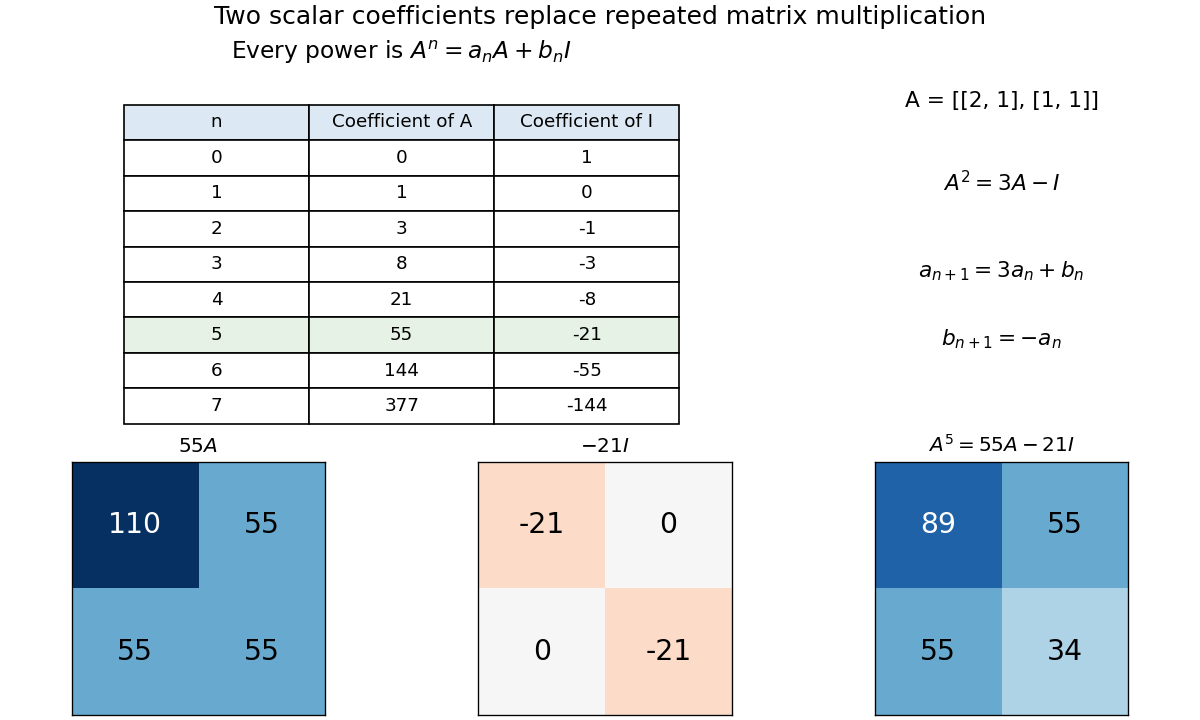
Cayley–Hamilton reduces powers of a chosen two-by-two matrix to two integer coefficients; the fifth power is 55A − 21I
. Details. 
The same identity computes an inverse. Rearrange it as , givingThis works because the constant term of this characteristic polynomial is nonzero and the coefficients lie in a field. Generally, when over a field, rearranging the Cayley-Hamilton theorem expresses as a polynomial evaluated at a matrix. Over a general commutative ring, a nonzero constant need not be a unit; invertibility requires that extra condition.
By polynomial division, write with . Because is a monic polynomial, this division works even over a commutative ring. Evaluating at makes the multiple of vanish, leaving . This explains the reduction in two-coefficient reduction of matrix powers without multiplying out every intermediate matrix.
Over a field, the minimal polynomial divides and gives the strongest such universal reduction: use the polynomial remainder modulo instead. For the scalar matrix , the characteristic polynomial is , while the minimal polynomial is only . Every matrix power is then a scalar multiple of .
Take a different real matrix,Its only eigenvalue is , with algebraic multiplicity two. However, the polynomial , which vanishes at that eigenvalue, gives . Merely checking values at eigenvalues cannot prove a matrix identity. The full characteristic polynomial does work:The matrix is a Jordan block, and its minimal polynomial is also .
The binomial theorem gives, for positive integers ,Terms containing or a higher matrix power vanish. After removing the common growth factor , the remaining linear map is the shear mapping . It moves to . The single eigenvalue controls the exponential scale, while the nilpotent matrix adds a factor growing linearly in .
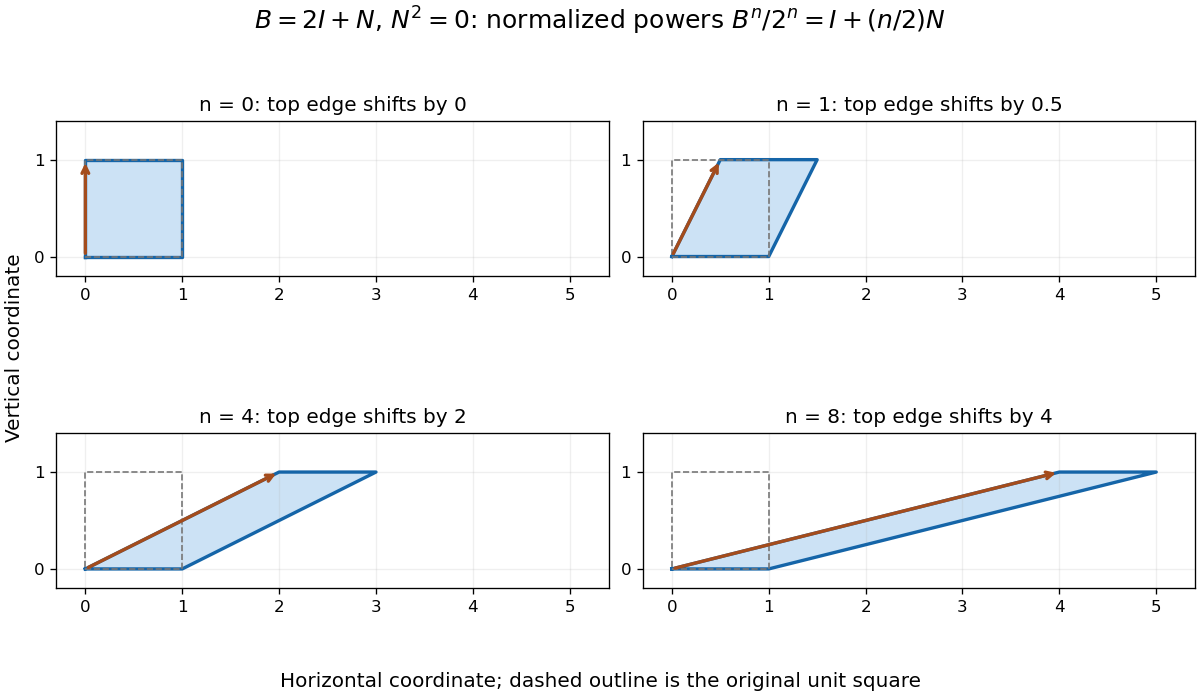
Normalized powers of a Jordan block retain a growing shear despite having only one eigenvalue; equal axes scales show the top edge moving by n/2
. Details. 
In terms of polynomial interpolation, reduction modulo retains both a value and a derivative:Indeed, polynomial division gives . This is a simple Hermite interpolation condition. For , it gives exactly the displayed matrix power. Repeated eigenvalues retain information about how a polynomial changes, not just where it vanishes.
Arthur Cayley's 1858 paper A Memoir on the Theory of Matrices motivates matrices as an abbreviated way to write systems of linear equations. Its opening already connects the characteristic equation with reducing polynomials in a matrix to lower degree. In §21 he works out the two-by-two identity; in §23 he says he has verified the three-by-three case but does not give a formal proof for every size. Thus this source distinguishes the general statement from a general proof.[ref]
A Memoir on the Theory of Matrices by Arthur Cayley. Printed pp. 17–18, opening motivation; pp. 23–24, §§21–25, characteristic equation and reduction of matrix functions; received 10 December 1857, read 14 January 1858, published 1858
The theorem's name also commemorates William Rowan Hamilton.Over a field, a cyclic vector gives a companion matrix, whose characteristic relation annihilates its generator and hence every iterate. If there is no cyclic vector spanning the whole space, a nonzero proper cyclic subspace is invariant. Induction annihilates the restriction and the quotient; the quotient polynomial first sends the whole space into the invariant subspace, and the restriction polynomial then kills it. The block-triangular characteristic polynomial is the product of these two polynomials.
Articles by others on the same topic
There are currently no matching articles.