Use the ergodic theorem for a positive Harris recurrent Markov chain: for an invariant distribution and an integrable function , the time average converges almost surely to under the usual ergodicity conditions. This is the relevant theorem for correlated Metropolis–Hastings algorithm output, rather than the strong law of large numbers. Here is integrable. Indeed, puttingwe have , which bounds the unnormalized density by a constant times an integrable Gaussian density and also gives finite first moments.
For a proposal scale , initialize anywhere in . At each step draw independent random variables with the standard normal distribution and an independent uniform , propose , and accept whenOtherwise set . The normal proposal is symmetric, so its density cancels; the target normalizing constant also cancels. Include every state in the average, including repeated states after rejection. The ergodic theorem for a positive Harris recurrent Markov chain then givesA fixed discarded initial segment does not change this limit.
Small proposal variance gives high acceptance but tiny moves and strong serial dependence. Large variance gives more ambitious moves, but many proposals enter very low-density regions and are rejected, creating long runs at one state. An intermediate scale should be assessed by exploration and effective sample size of a Markov chain, not acceptance rate alone.
This density has two modes, at and their interchange. To see this, stationary points satisfy , implying either or . The unequal solutions have and are local minima of ; the equal solution is a saddle. Mode switching is therefore a material part of proposal-scale selection: a chain confined to one mode can have high acceptance and a misleading finite-run estimate.
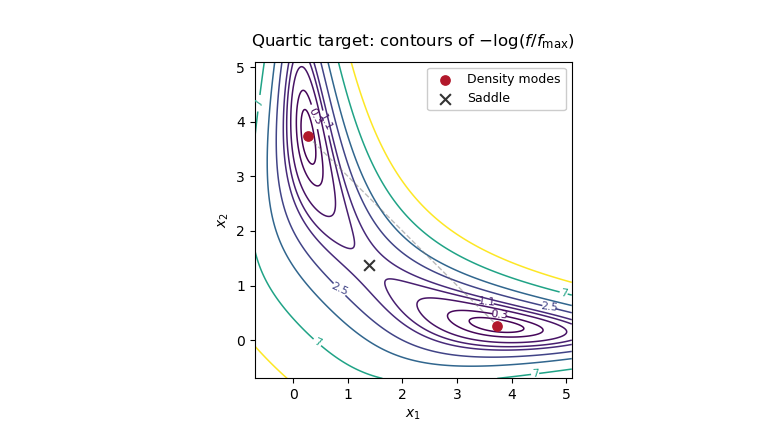
Two modes of the quartic target density, with the diagonal saddle between them, explaining slow mode switching in random-walk Metropolis-Hastings
. Details. 
Articles by others on the same topic
There are currently no matching articles.