Both the left-handed electron and the electron neutrino participate in weak charged currents through , and both have weak neutral currents mediated by the Z boson. Their electromagnetic interactions differ: the electron has electric charge and couples to the photon, while the neutrino is electrically neutral and has no tree-level electromagnetic coupling.
In the minimal massless-neutrino Standard Model, the active neutrino has only a left-handed particle state and a right-handed antiparticle state. The electron has both chiralities: its right-handed component has electromagnetic interactions and a weak neutral current, but no weak charged current. Its nonzero mass comes from a Yukawa coupling to the Higgs field; the minimal massless-neutrino model contains no right-handed neutrino for an analogous Dirac mass term.
Observed neutrino oscillations establish nonzero neutrino mass-squared differences. Atmospheric muon-neutrino disappearance depends on travel distance and energy, and solar electron neutrinos convert into other active flavors; reactor and accelerator oscillations provide complementary evidence. In propagation, the relative phase of two mass eigenstates is . If all masses were zero there would be no such relative phase. Thus at least two neutrino mass eigenstates are nonzero in the three-neutrino description with two independent measured splittings. A flavor state is a superposition of mass eigenstates, so the evidence does not assign a single definite mass to a flavor label.
The two tree-level Feynman diagrams have t-channel W boson exchange. The antiquark process reverses the fermion-flow arrows on the lower line.
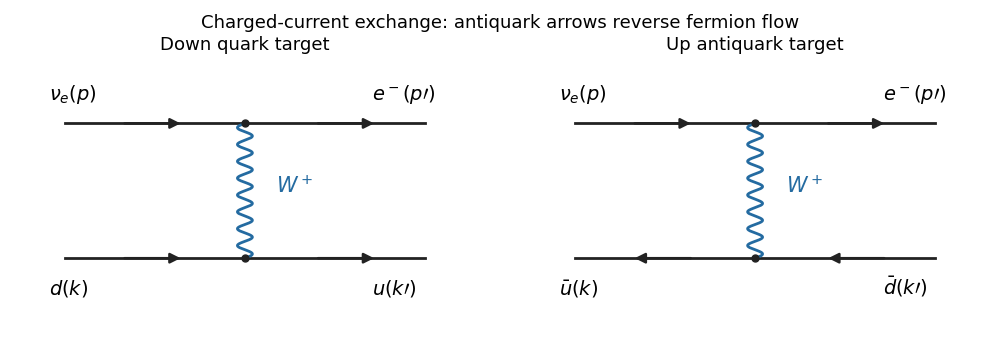

Each vertex contributes multiplying a chiral current. At momentum transfer , the gauge-boson propagator is approximated by its momentum-independent term , up to the overall phase. The longitudinal term does not contribute to these conserved massless currents. Thus the coefficient is , giving the Fermi interaction. For the quark and antiquark amplitudes, apart from irrelevant overall phases,andThe low-energy operator form is ; its external spinor matrix elements are the displayed products.
For an unpolarized initial parton, average over its two spin states. There is no factor for the incoming active neutrino, which has one allowed helicity. The initial color average cancels the final color sum, so there is no surviving color multiplicity in this parton cross section. DefineThe symmetric and antisymmetric parts have zero cross contraction. Their separate contractions are and . Thus the given Levi-Civita symbol identity yieldsIncluding the coefficient and the initial-parton spin average givesMassless kinematics and imply . From , . ThereforeTo reduce the supplied phase-space formula, use the massless center-of-mass flux and . This gives . In that frame , so . HenceThe antiquark channel's angular factor is a consequence of the chiral current and the reversed lower-line spinor order, rather than a color factor.
In the parton model, the incoming parton has and the outgoing massless parton has . Neglecting and imposing its on-shell condition givesThus the Bjorken scaling variable measures the struck parton's longitudinal momentum fraction in this approximation. The inelasticity is unchanged when the hadron momentum is replaced by its parton's collinear momentum:Let . The partonic invariant in part (b) is , and . Insert its two parton cross sections into the parton distribution function convolution:Since the event's measured fixes , the integrand is the cross-section density in . No additional Jacobian from is needed because . ThereforeEquivalently in the chosen massless-hadron frame. The explicit factor comes from the partonic energy , not from redefining the parton distribution functions. This expression uses the stated two-flavor and low-energy approximations, with masses and generation mixing omitted.
Articles by others on the same topic
There are currently no matching articles.