For brevity write , , and . The quadratic disturbing function is . Differentiation in Lagrange planetary equations givesThe separate longitude of pericentre equation is singular at , because a circular orbit has no distinguished periapsis. The complex eccentricity, , is regular there. Using and givesSince and ,The approximations are planar, small-orbital eccentricity, first order in the planet-to-star mass ratio, and secular averaging away from important mean-motion resonances. The semimajor axis values remain constant at this order.
For a planet with fixed orbit, set and . Then , so . With ,On the Argand diagram, the complex eccentricity traces a circle centred on the forced eccentricity , of radius . For an interior test particle, and , so the motion is counterclockwise, starting at the origin. The rotating radius is the free eccentricity. The orbital eccentricity ranges from zero to , attaining its maximum at half a secular period. If is placed on the positive real axis, the initial tangent points downward, which is consistent with counterclockwise motion from the leftmost point of this circle.
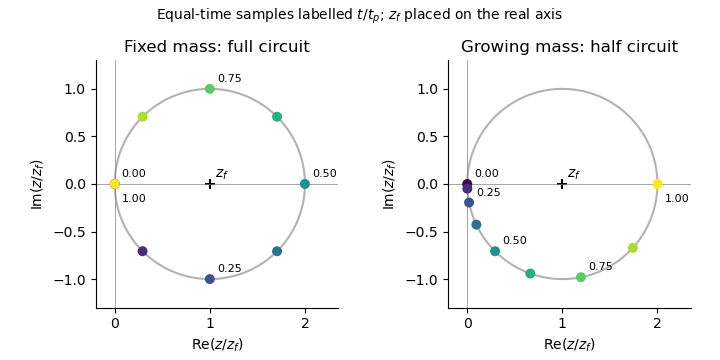
The same forced-eccentricity circle sampled at equal times: a fixed-mass planet completes one circuit while a linearly growing planet completes half a circuit by its growth time
. Details. 
Now let the planetary mass grow as for , while the planet's orbital elements and the test particle's semimajor axis remain fixed. Both the precession and forcing coefficients acquire the same factor . Their ratio, and hence , remain constant. ThusandThis is the secular phase integral for proportional mass growth. The Argand diagram circle and the free eccentricity amplitude are unchanged; only the rate of traversal changes. The angular speed about starts at zero and rises linearly to . The early displacement is quadratic in time rather than linear. Since , , soA planet already at its final mass would instead return the particle to at . After growth stops, the circle continues at rate , with for . Slow mass growth does not damp the free eccentricity here: the fixed centre of the circle and the conservative equation preserve its amplitude.
For several planets with fixed masses, Laplace-Lagrange secular theory gives for the planets andfor a massless particle, with real secular coupling coefficients . Resolve planetary complex eccentricities into secular eigenmodes, . Away from secular resonances, the test-particle solution has the formIts Argand diagram trajectory is a superposition of rotations: generally a quasiperiodic curve with beats, rather than a circle with one fixed centre. Even if the planetary orbits are artificially held fixed, their combined forcing shifts the centre to the sum of the individual forced eccentricities. At , the resonant contribution is proportional to in linear theory; its growing amplitude eventually invalidates the small-orbital eccentricity approximation.
If one planetary mass changes, the Laplace-Lagrange secular matrix, its eigenvalues, its eigenvectors, and the particle's forced response generally change with time. Planetary modes need not remain independent. Frequencies drift and a secular resonance can sweep across the particle, changing or exciting its free eccentricity. Very slow evolution away from resonances permits an approximate adiabatic mode description; rapid evolution or a resonance passage can mix modes. The simple substitution of a phase integral works only in the special proportional-growth case above, where the entire particle equation is multiplied by one scalar and its forced centre stays fixed. It does not apply to a general many-planet system.
Articles by others on the same topic
There are currently no matching articles.