Let and , with and small. Define the sound speed by , assumed positive. The background Keplerian shear balances the radial Coriolis force and the shearing-sheet tidal potential. For disturbances preserving axisymmetry , its advective derivative vanishes, but remains. The linearized Euler equations and continuity equation areThe azimuthal coefficient is , not : it combines the background velocity gradient with the Coriolis force. The uniform background has no buoyancy or vertical stratification in this stated model.
Substitute the axisymmetric Fourier mode into the linearized equations. With hats denoting amplitudes,For a nondegenerate nonzero frequency, eliminate the azimuthal velocity and useContinuity then givesEquivalently, taking the determinant of the original four amplitude equations avoids division by zero and gives the full dispersion relationThe two squared frequencies areThe discriminant is . For , both squared frequencies are nonnegative. The high-frequency branch is predominantly acoustic and the low-frequency branch is an inertial wave. Zero-frequency limiting modes, including , are retained by the determinant calculation.
Take , retaining a finite low-frequency branch and a nonzero wavevector. In the dispersion relation, neglect against and neglect against in their coefficient. The inertial wave limit isChoose the signed branches , . The phase velocity normal to the phase planes and the group velocity areTherefore , soThe geometric reason is that this limiting dispersion relation is homogeneous of degree zero in : its frequency depends on direction, not magnitude. Euler homogeneous function theorem gives . Exact orthogonality holds for this inertial wave limit; finite compressibility introduces corrections. At a zero-frequency degeneracy the usual propagating-wave interpretation needs a limiting treatment.
For the polytropic equation of state , take and for the physical model. The specific enthalpy relative to vacuum isIts gradient obeys , so the Euler equations becomeFor the material derivative , . The continuity equation thus becomesThe choice at zero mass density fixes the additive convention in this equation. Although the momentum equation alone is unchanged by adding a constant to , the polytropic relation and enthalpy evolution must use the same vacuum reference.
For , the velocity divergence is zero and . Substituting into the steady Euler equations yieldsIntegration givesThe steady enthalpy equation also requires . Its coefficient is , so, since ,For a bounded patch with positive mass density and a vacuum fluid free boundary, choose and require both quadratic coefficients to confine the fluid. With and , this meansThe lower bound is imposed by ; the upper bound by bounded positive . At , is constant and has no nontrivial finite vacuum boundary; violates or degenerates the stipulated elliptical flow.
For a polytropic elliptical patch in a shearing sheet, the physical fluid free boundary is . It is the ellipsewhere and . In the interior . The boundary is a material streamline because . Since , it is elongated in the azimuthal direction.
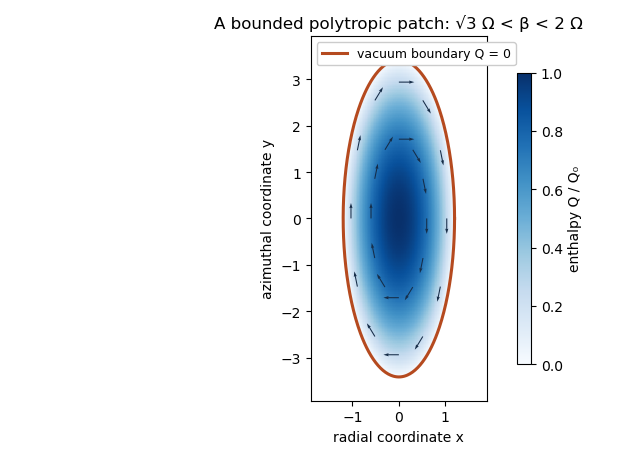
The polytropic shearing-sheet patch has an elliptical vacuum boundary with tangential anticyclonic flow and positive interior enthalpy
. Details. 
This is a pressure-supported fluid patch in the supplied tidal model; no additional planetary self-gravity potential was assumed.
Articles by others on the same topic
There are currently no matching articles.