Let and let denote present stellar age, rather than time measured from the galaxy's birth. With a fixed initial mass function, constant star formation rate also gives a constant number of births per unit time, as in the birth-age distribution under constant star formation. Counting the supplied stellar evolution model's remnants as part of the population, ages have a uniform distribution on . Integrating the constant birth rate therefore givesOutside this interval the cumulative fraction is zero or one as appropriate.
Write for the birth-mass parameter and . The normalization cancels when integrating the initial mass function:Thus the mass-tail fraction isIt is one at and below the lower cutoff. The normalization constant has no effect on any number fraction.
For evolutionary-state selection by stellar lifetimes, a red giant has completed its main sequence lifetime but not its giant lifetime. Its stellar lifetime regions in a mass-age diagram are bounded byThe lower boundary meets at and the upper boundary meets it at . A white dwarf lies above the upper lifetime curve, within the same age interval.
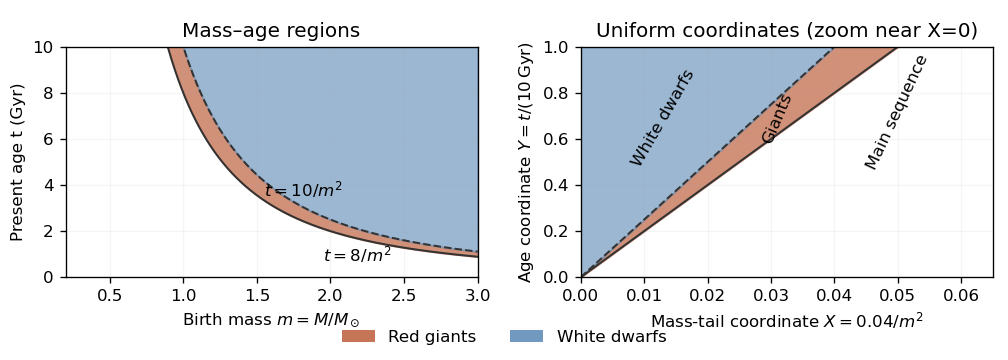
Red-giant and white-dwarf regions in the birth-mass–age plane and their triangular images in uniform mass-tail–age coordinates
. Details. 
The probability integral transform, applied to the decreasing mass-tail coordinate, makes uniform on : . The independent birth age gives uniform on , so number fractions are areas in a unit square. Since , the red giant region becomes , a triangle with vertices , and . Its area is . The white dwarf region is a triangle of area . Hence the present individual-star fractions areThe rest are on the main sequence under the given toy lifetime model.
For the binary stars, draw two independent mass-tail coordinates , but only one shared age coordinate : components born together are coeval. The coeval binary population therefore occupies a uniform unit cube . At a fixed age , the state probabilities for either component areTheir evolutionary states have conditional independence given . They generally do not have unconditional independence, because sharing an age correlates their states. The binary fractions below are slice areas averaged over .
At a fixed age, the probability that at least one component is a red giant is . Integrating over the common age in the coeval binary population givesThis is just under one percent of systems. Squaring the marginal single-star fraction would incorrectly give two independently sampled component ages.
For the evolved-companion fraction, a red giant has another evolved component precisely for unordered or pairs. By conditional independence at fixed age, their combined slice probability is . ThereforeDivide by the system fraction containing at least one red giant to obtain the requested conditional fraction:A double-giant system is counted once in this denominator, and the factor two for a giant–white dwarf pair represents its two possible component orderings.
For the three unordered evolved pairs, conditional independence gives the slice probabilities , and . Averaging over the shared age in the coeval binary population yieldsThus their system-number ratio is , as required.
For the unheaded instantaneous-burst continuation, put , with . All binary stars now have the same age, so the individual red giant fraction is . Independent component masses give the giant-pair fraction in an instantaneous stellar burst, the two-giant system fractionThe final comparison has an ambiguity about which population is being counted. Taken literally as a comparison with the first galaxy's individual-star giant fraction , it would require . There is no allowed burst age: throughout , the two-giant fraction is less than , well below .
If the intended comparison instead concerns two-giant systems in both galaxies, the comparison fraction is . Then givesFor completeness, a comparison of individual red giant fractions in both galaxies would give . These three comparisons have different denominators and should not be conflated.
Articles by others on the same topic
There are currently no matching articles.