Let and let denote present stellar age, rather than time measured from the galaxy's birth. With a fixed initial mass function, constant star formation rate also gives a constant number of births per unit time, as in the birth-age distribution under constant star formation. Counting the supplied stellar evolution model's remnants as part of the population, ages have a uniform distribution on . Integrating the constant birth rate therefore givesOutside this interval the cumulative fraction is zero or one as appropriate.
Write for the birth-mass parameter and . The normalization cancels when integrating the initial mass function:Thus the mass-tail fraction isIt is one at and below the lower cutoff. The normalization constant has no effect on any number fraction.
For evolutionary-state selection by stellar lifetimes, a red giant has completed its main sequence lifetime but not its giant lifetime. Its stellar lifetime regions in a mass-age diagram are bounded byThe lower boundary meets at and the upper boundary meets it at . A white dwarf lies above the upper lifetime curve, within the same age interval.
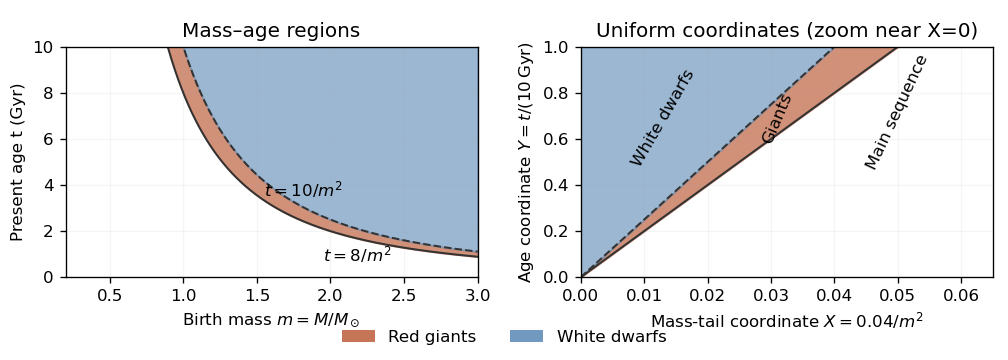
Red-giant and white-dwarf regions in the birth-mass–age plane and their triangular images in uniform mass-tail–age coordinates
. Details. 
The probability integral transform, applied to the decreasing mass-tail coordinate, makes uniform on : . The independent birth age gives uniform on , so number fractions are areas in a unit square. Since , the red giant region becomes , a triangle with vertices , and . Its area is . The white dwarf region is a triangle of area . Hence the present individual-star fractions areThe rest are on the main sequence under the given toy lifetime model.
For the binary stars, draw two independent mass-tail coordinates , but only one shared age coordinate : components born together are coeval. The coeval binary population therefore occupies a uniform unit cube . At a fixed age , the state probabilities for either component areTheir evolutionary states have conditional independence given . They generally do not have unconditional independence, because sharing an age correlates their states. The binary fractions below are slice areas averaged over .
At a fixed age, the probability that at least one component is a red giant is . Integrating over the common age in the coeval binary population givesThis is just under one percent of systems. Squaring the marginal single-star fraction would incorrectly give two independently sampled component ages.
For the evolved-companion fraction, a red giant has another evolved component precisely for unordered or pairs. By conditional independence at fixed age, their combined slice probability is . ThereforeDivide by the system fraction containing at least one red giant to obtain the requested conditional fraction:A double-giant system is counted once in this denominator, and the factor two for a giant–white dwarf pair represents its two possible component orderings.
For the three unordered evolved pairs, conditional independence gives the slice probabilities , and . Averaging over the shared age in the coeval binary population yieldsThus their system-number ratio is , as required.
For the unheaded instantaneous-burst continuation, put , with . All binary stars now have the same age, so the individual red giant fraction is . Independent component masses give the giant-pair fraction in an instantaneous stellar burst, the two-giant system fractionThe final comparison has an ambiguity about which population is being counted. Taken literally as a comparison with the first galaxy's individual-star giant fraction , it would require . There is no allowed burst age: throughout , the two-giant fraction is less than , well below .
If the intended comparison instead concerns two-giant systems in both galaxies, the comparison fraction is . Then givesFor completeness, a comparison of individual red giant fractions in both galaxies would give . These three comparisons have different denominators and should not be conflated.
Use a circular orbit, as in the stated Roche lobe approximation, with orbital angular speed and negligible stellar spin. The center of mass distances are and . Summing the two orbital angular momenta givesKepler's third law, , makes this . In conservative mass transfer, both and are fixed, while . ThusThe Roche-lobe radius response exponent is consequentlyDuring a dynamical mass-loss perturbation, the deep interior and luminosity do not have time to change. The supplied giant structure therefore has stellar radius response exponent . Its fractional overfill changes by . The binary mass ratio uses donor mass divided by accretor mass. Since , self-limiting Roche-lobe overflow requires . Hence the dynamical stability condition isAt equality the linear restoring response vanishes. This conservative mass-transfer critical mass ratio uses the given radius exponent, rather than imposing the different fully convective approximation.
The initially more massive component normally evolves first. If it first overflowed only after acquiring the given giant response, it would have and the mass loss would be dynamically unstable: its radius grows while its Roche lobe initially contracts. Starting overflow earlier can avoid this outcome. A main sequence or early post-main-sequence donor star can have a radiative envelope with a stabilizing contraction response. Transfer then reverses the binary mass ratio before the donor develops the giant structure. This is the route to an Algol binary through Case A mass transfer during core hydrogen burning, or early case B mass transfer after core hydrogen exhaustion but before a deep giant envelope develops.
For the initial Roche-lobe overflow to occur before the base of the giant branch, its lobe must be smaller than the base-of-branch stellar radius. Combining with Kepler's third law cancels the companion dependence:Writing , substitute the mass-radius relation to obtain the pre-giant period limit:We use the specified below. This is a pre-giant Roche-lobe-filling period limit, not a condition on the current stripped donor's radius.
At fixed total mass, Kepler's third law gives , while fixed orbital angular momentum gives . Therefore the conservative period invariant isTo find the smallest possible pre-giant period ratio, use solar-unit masses and fixed . Let . Along this period-product invariant for conservative mass transfer,The denominator has logarithmic derivative , with a strictly negative derivative of its own. Its unique maximum, hence the unique minimum of , occurs atSince diverges at either endpoint, this is the global minimum period-to-donor-mass ratio for conservative evolution.
For the quoted Algol binary, and . Choosing the minimizing progenitor gives , andIts pre-giant upper limit is , comfortably above this initial period. Subsequent conservative mass transfer of produces the stated masses and period. Thus the data permit the proposed early-overflow formation route.
For RT Lac, instead and . At its most favorable conservative progenitor, , andNo conservative progenitor meets the pre-giant overflow condition. An initially more massive giant donor also fails the dynamical-stability condition derived above. Within this stable Algol-type formation model, the current RT Lac system therefore requires nonconservative mass transfer.
A plausible history is substantial envelope loss from the system, through a stellar wind or escaping overflow, possibly with a common envelope episode. Escaping matter also carries orbital angular momentum, so the total-mass and period-product invariants no longer constrain its initial orbit. A more massive progenitor can then shed its envelope and reach the present low donor mass without requiring the excluded conservative sequence. The supplied final data do not determine a unique mass-loss or angular-momentum-loss history.
For constant component masses, the center of mass frame has and . Newton's law of universal gravitation gives the relative equation . Substitution in the component angular momenta yieldsHere is the reduced mass, while is specific angular momentum.
The printed total-energy expression lacks a factor of in its kinetic term. With the stated physical separation coordinate, the dimensionally consistent total two-body orbital energy isThe second expression is specific orbital energy; these two conventions must not be mixed. Its conservation follows directly:For the eccentricity vector, differentiate . Since is constant,The cancellation is the vector triple product identity. Thus all three corrected Kepler integrals are conserved. Dotting the eccentricity relation with also gives the useful orbit identity
For ballistic streamline focusing by a moving star, work in the star's rest frame and take the incoming gas to have velocity , with downstream behind the star at . A streamline with impact parameter approaches from . Its upstream specific angular momentum and eccentricity vector areAt its downstream axis crossing, . The orbit identity gives , hence the collision distance isAt that point, , while the component of gives . ThereforeA symmetric streamline with opposite impact parameter has the opposite transverse velocity. Their shock wave removes the opposing transverse motion while preserving the common downstream component. Thus the remaining velocity is in the star frame. In the frame where the undisturbed medium is stationary, adding the star's velocity gives zero velocity immediately after this idealized collision.
After transverse kinetic energy is dissipated, the remaining specific orbital energy is . It is negative if , or equivalently if the upstream impact parameter satisfies . This is the post-shock capture criterion in ballistic accretion; bound axial streams can return to the star. The captured incident mass flux through the corresponding disk gives the ballistic Bondi--Hoyle--Lyttleton accretion rate:This is the pressureless, dissipative capture model, with the shock's transverse energy unavailable to unbind the wake.
For wind mass transfer in a binary star, steady isotropic donor mass loss gives the local wind mass density at the companion:A fast wind has and a capture scale small compared with , so its relative incident speed is to leading order. Apply the same Bondi--Hoyle--Lyttleton accretion rate with accretor mass to obtainFinally, Kepler's third law eliminates the unquoted separation, , giving the rate in terms of the stated orbital period:Equivalently, the fast-wind accretion fraction in a circular binary is , with the relative circular orbital speed. Its smallness is consistent with using an almost undisturbed isotropic stellar wind.
Articles by others on the same topic
There are currently no matching articles.