Use conventional mean longitudes and take the positive integers in lowest terms. Rotational invariance requires the angular coefficients of a resonant argument to sum to zero. Since the inner planet has zero orbital eccentricity, the eccentricity-type term involving its undefined apsidal angle has zero amplitude. The surviving outer-eccentricity argument isIts leading disturbing function term is proportional to . Near the period commensurability, is small, so the resonant argument is slow and repeated perturbations can add coherently. Trapping produces resonant-argument libration, rather than circulation, with .
A near-integer period ratio alone does not prove mean-motion resonance: the diagnostic is bounded resonant-argument libration. At this eccentric resonant term vanishes and is undefined. If have a common factor, reduce the ratio first; the unreduced is not the actual lowest resonance order.
In the mean-conjunction approximation set . The resonant conjunction geometry is thenThere are phase directions spaced by . The integer determines their temporal order: at exact resonance the synodic period is , and the conjunction longitude advances by per conjunction. For coprime this visits all branches; resonant-argument libration broadens each direction by about its libration amplitude of a resonant argument divided by .
Mean conjunction and actual alignment are different for an eccentric orbit. If is the true common longitude, write and , with the mean anomaly. Because while the circular planet has , the exact geometric relation isThe displayed equally spaced directions use , hence are leading-small-eccentricity geometry. With appreciable , use Kepler's equation to locate true conjunctions; equating true and mean longitudes silently is not exact.
In the weak, non-crossing, leading-eccentricity model the exterior resonant coefficient has positive sign: write its disturbing function as , with for the orders considered. The physical feedback can be seen for first order. Before an outer conjunction near apoapsis, the faster inner planet pulls the outer one backwards; after passing it pulls forwards. On the outward side, the nearer, stronger earlier pull wins, reducing the outer semi-major axis and increasing its mean motion. Thus is driven upward. On the inward side, the later forward pull wins and drives downward. The paired impulses cancel at the symmetric centre.
For higher order, sum the feedback over all conjunction phases. The first surviving angular Fourier harmonic is ; the lower Fourier harmonics cancel over the equally spaced directions. A local Hamiltonian reduction with canonical momentum hasThe negative curvature of the Kepler orbit Hamiltonian gives the displayed sign. Linear stability analysis at gives a restoring acceleration. The symmetric libration centres of an eccentricity resonance are thereforeThe corresponding conjunction phases relative to periapsis are , and . They suppress repeatedly close passages and provide resonance protection.
These are expected centres of the specified leading-harmonic model, not centres fixed solely by the integer order for arbitrary orbital eccentricity and masses. Asymmetric resonant-argument libration can occur when higher Fourier harmonics matter. For example, if , , , the symmetric equilibrium loses stability and stable centres satisfy . Thus further dynamical information is needed beyond the PDF's unrestricted eccentric orbit to assert unique centres. Exterior asymmetric branches are documented by Winter and Murray, “Resonance and chaos. II. Exterior resonances and asymmetric libration”.
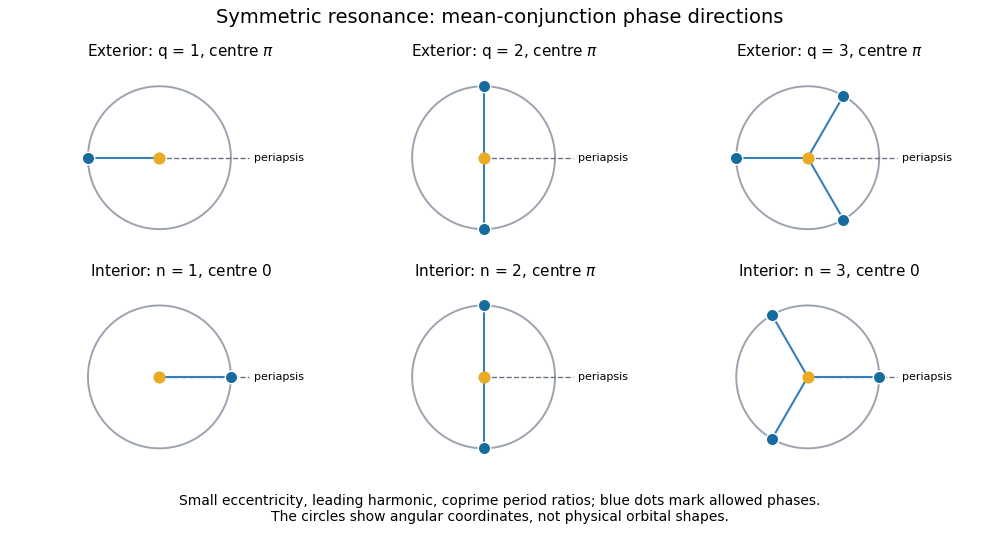
Mean-conjunction phase directions in symmetric orbital resonances
. Leading-eccentricity mean-conjunction phases relative to periapsis, with exterior and interior symmetric resonant-argument libration centres. Details.
Now the eccentric planet is inside the circular perturber . The interior eccentricity-type mean-motion resonance hasIn the mean-conjunction approximation, , so . Successive conjunctions advance by ; coprime visit distinct phases.
The near-conjunction tangential pulls are reversed for an eccentric body inside its perturber. Just before conjunction the inner body is pulled forwards and afterwards backwards. Near periapsis, an inward-moving inner body experiences the stronger earlier forward pull; its semi-major axis grows, its mean motion falls, and increases because its coefficient of is negative. On the outward side the feedback reverses, restoring the first-order centre zero. Higher-order feedback is strongest on the side closest to the external perturber, near apoapsis; the leading coefficient alternates in sign with order.
Writing gives for odd and for even in the leading non-crossing model. The same negative-curvature Hamiltonian argument therefore givesConjunction phases relative to periapsis are , and , respectively, as shown in the lower row of the figure. As before, these are small-eccentricity symmetric predictions; additional resonant Fourier harmonics and coupled secular dynamics can change the stable branches.
For actual alignment of the eccentric body at true longitude , the exact phase relation is instead , where and . The simple equally spaced angles replace by at leading order.
A simultaneous transit in a resonant chain requires both conjunction patterns to admit the observer's longitude at the same time. In the leading mean-conjunction geometry put . The necessary phase compatibility at symmetric centres isLet . Eliminating , and using that ranges over multiples of , gives the exact modular compatibility criterionHere denotes the greatest common divisor. For the orders above, the two phase sets intersect only whenThe common directions are the two quadratures relative to periapsis. In reduced resonances this requires and odd; otherwise the apparent second-order ratios reduce to different resonance orders. There is no additional restriction on those odd values from angular compatibility alone. A shared direction and suitable temporal phase can be chosen, and the rational period ratios allow its recurrence.
This is a potential low-amplitude configuration, not a guarantee of an observed triple exoplanet transit. The observer must lie in the common orbital plane and near an allowed direction. Finite stellar radii, nonzero libration amplitudes of a resonant argument, apsidal motion and asymmetric centres broaden or change the possibilities. At finite , true simultaneous alignment obeys the more precise equations and , with . Thus the order-only conclusion is not a universal necessary condition for every eccentric resonant chain.
First adopt the uniform-angular-motion approximation implicit in the requested formula. Set the line of sight to longitude zero, the exoplanet transit to , and the next exoplanet transit to , with . Write , , with . The next conjunction satisfiesThe common longitude is modulo . Subtracting one gives the conjunction longitude from a transit time lagSubstitution of the period ratio yieldsIt is exact in this uniform-angle model; no first-order expansion in is necessary here. For other choices of which exoplanet transit is used, choose the appropriate whole-turn branch.
For the finite-eccentricity orbit specified earlier, this is an approximation. Let and be the true anomaly and mean anomaly at the line of sight. The eccentric planet has and true angular advance , whereTrue conjunction therefore requires . The PDF omits this term, which is generally .
For a concrete counterexample take , , , , and a line of sight along 's periapsis. The uniform model predicts and longitude . At that time , but Kepler's equation gives , so the planets are not truly aligned. Accurate finite-eccentricity conjunctions must be found from the corrected equation.
For constant mean motions, consecutive mean conjunctions are separated by and advance in longitude by . To follow one of the branches, compare conjunctions steps apart. At exact resonance that advance is ; subtract it to measure the slow drift. Hence conjunction-pattern precession near a mean-motion resonance isThe printed expression is its leading small-offset term:Positive gives retrograde drift and negative prograde drift. The tracked-branch rotation time is about ; the full set of interchangeable directions repeats after a rotation , giving the usual mean-pattern super-period . The slow, continuously tracked branch interpretation assumes the resonance neighbourhood ; merely need not give a slow pattern for an arbitrarily large integer ratio . At there is no offset-driven drift.
The allowed directions can consequently move through the observer's line of sight. Triple exoplanet transits require the and patterns, together with their timing phases, to overlap that line of sight within the finite exoplanet transit windows; differing drift rates can open and close such windows. A small offset neither guarantees a triple event nor prohibits it permanently.
Moreover, in a true mean-motion resonance, bounded can coexist with a period offset because . The mean conjunction pattern then follows apsidal precession plus the resonant-argument libration correction. For appreciable orbital eccentricity, the true-conjunction geometry has the periodic corrections identified above; the drift calculation is a mean-phase result.
Articles by others on the same topic
There are currently no matching articles.