Take the logarithm to base ten and write pressure in units of , so its argument is dimensionless. Continuity of the atmospheric pressure-temperature profile givesThusIf the logarithm means , the equivalent constant is . A plot of temperature against logarithmic pressure is vertical in each isothermal region and straight between the two endpoints.
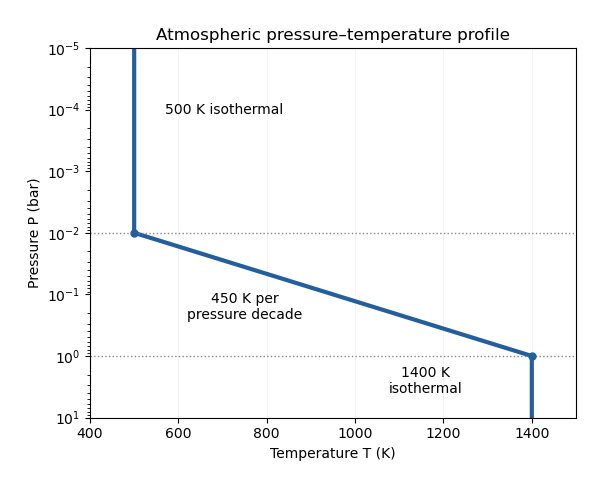
Atmospheric pressure-temperature profile
. Details. 
The processes can be organized by the supplied pressure ranges, although the exact boundaries require reaction rates, irradiation and mixing information:
- At , the dense gas can approach thermochemical equilibrium because collisions and reactions are relatively rapid. Deep carbon monoxide and molecular nitrogen can provide reservoirs for transported material.
- At , the falling temperature slows chemical conversion. Vertical transport can produce a chemical quench level when the chemical relaxation time crosses the eddy mixing time. Horizontal chemical quenching is also possible if dayside and nightside conditions differ. Suitable species can condense and undergo atmospheric condensate rainout where a saturation curve is crossed.
- At , slow thermal chemistry permits a quenched atmospheric mixing ratio to survive. Atmospheric photochemistry can dominate where stellar ultraviolet photons penetrate, often at still lower pressures; atmospheric haze may form from its products. Extremely high layers can also experience atmospheric escape.
The profile identifies plausible chemical regimes, but does not fix their transition pressures by itself. In particular, cloud formation depends on the species-specific condensation curve, and ultraviolet processing depends on shielding.
For solar elemental abundances, take a molecular hydrogen- and helium-dominated atmosphere with atmospheric carbon-to-oxygen ratio near . The principal oxygen-bearing molecule is generally water; the carbon and nitrogen carriers depend on both temperature and pressure.
At the cool observable upper layers, methane is the expected main carbon reservoir under chemical equilibrium, with abundant water and much less carbon monoxide. At the hotter layers approaching , carbon monoxide becomes the main carbon carrier and water contains much of the oxygen not bound in it. The relevant law of mass action follows fromLower temperature favors the exothermic methane-forming direction, while increasing pressure favors the side with fewer molecules. This explains why the change of dominant carrier cannot be specified by temperature alone.
Nitrogen is distributed between molecular nitrogen and ammonia. Cooling favors ammonia, but low pressure favors molecular nitrogen; it is therefore unsafe to call ammonia dominant throughout the low-pressure region. The exact partition requires the equilibrium constant for .
Carbon dioxide is usually a minor constituent at solar composition; hydrogen cyanide and acetylene are much less abundant than the principal carbon carriers in this oxygen-rich equilibrium case. Condensation can remove refractory species where a condensation curve is crossed. The robust cool-atmosphere expectation is a molecular hydrogen–helium background with methane and water, changing toward carbon monoxide in hotter layers. Precise mixing ratios require thermodynamic data and an explicitly specified elemental inventory after rainout.
Four possible molecular signatures of disequilibrium chemistry in an exoplanet atmosphere, measured through an exoplanet transmission spectrum or exoplanet emission spectrum, are:
- Excess carbon monoxide in the cool upper layers, where local chemical equilibrium would place most carbon in methane. This can indicate carbon monoxide–methane quenching from deeper hot gas.
- Suppressed methane bands relative to the same cool equilibrium model, consistent with transport preventing complete carbon monoxide conversion or with photochemical loss.
- An ammonia abundance inconsistent with the local equilibrium nitrogen partition, potentially recording nitrogen–ammonia quenching. Its direction must be evaluated for the actual atmospheric pressure-temperature profile; a depleted value is possible when hotter, molecular nitrogen-rich gas is transported upward.
- Enhanced hydrogen cyanide or acetylene bands, consistent with atmospheric photochemistry acting on the transported carbon and nitrogen reservoirs.
The first two signatures can be consequences of the same process and are not independent evidence for two mechanisms. Changes in atmospheric carbon-to-oxygen ratio, atmospheric metallicity of a giant planet, exoplanet cloud coverage, and the atmospheric pressure-temperature profile can mimic abundance changes. A convincing inference compares several molecular bands with a chemically consistent equilibrium model rather than identifying one unusual band alone.
At fixed temperature and pressure, the atmospheric carbon-to-oxygen ratio controls the division of the elemental inventory among carbon monoxide, methane, water and other molecules. For an oxygen-rich mixture, water can remain after carbon monoxide consumes its share of oxygen. Increasing the atmospheric carbon-to-oxygen ratio reduces the oxygen available for water, particularly in the hotter layers where carbon monoxide is stable. Near or above unity there, water can become strongly depleted while excess carbon feeds methane, hydrogen cyanide and acetylene. This familiar hot carbon-rich behavior should not be applied unchanged to every cool layer: at , methane formation can leave substantial water even at high atmospheric carbon-to-oxygen ratio.
Increasing the atmospheric metallicity of a giant planet at fixed elemental ratios increases the heavy-element inventory relative to molecular hydrogen and helium. Abundances of water and the major carbon-bearing molecules generally rise while molecular hydrogen remains dominant. In that regime, the law of mass action for givesWhere carbon monoxide and water each scale roughly linearly with enrichment , carbon dioxide consequently scales approximately as . This scaling changes when molecular hydrogen ceases to dominate or chemical partitioning changes. Higher enrichment can also favor carbon monoxide over methane at fixed conditions, increase mean molecular weight, and reduce the atmospheric scale height and transmission-feature amplitudes. Cloud formation and atmospheric condensate rainout alter the observable elemental ratios relative to the bulk ones.
Articles by others on the same topic
There are currently no matching articles.