Let . A spherical grain has submerged weightNeglect lift and contact torque, and use a sliding static friction model with normal reaction . The inertial quadratic drag iswhere the last equality fixes the convention . Equivalently is the bed shear velocity and is an effective drag coefficient referred to it. A literal grain-level flow speed can differ from the shear velocity; that conversion must then be absorbed into .
Downstream sliding begins when . Defining the Shields parameter by , the threshold force balance isThe grain moves downstream above this threshold in the stated sliding model. Real grain motion can instead involve lift, rolling, irregular contacts, or viscous drag; the printed constant belongs to the particular inertial-drag convention and force balance above.
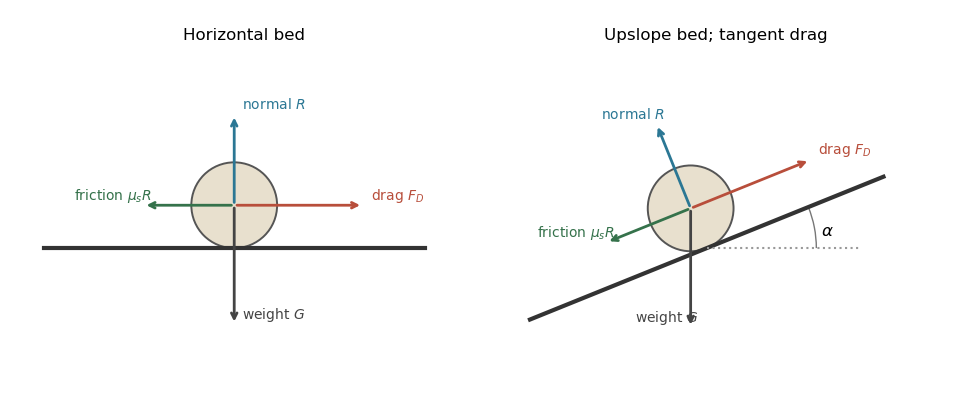
Grain force balances on horizontal and inclined beds
. Details. 
The normal contact force and resisting static friction balance the drag force and submerged weight at impending motion. The right panel uses locally bed-tangent drag force.
Articles by others on the same topic
There are currently no matching articles.