The outgoing solution obtained from the retarded fundamental solution of the wave equation isIn the radiation zone, put , , and retain the leading term at retarded time . The trace term disappears after applying the transverse-traceless projectorsoTwice using stress-energy conservation, , and integrating by parts givesThe projector removes the trace, so in terms of the mass quadrupole momentthe far field isThe gravitational-wave energy flux isFor a trace-free symmetric tensor , the isotropic tensor integral over the observation direction givesConsequently the standard quadrupole formula, in the units used by the paper, isThus the printed coefficient is inconsistent with the stated definition of and the standard wave-energy normalization; it appears to be a typographical error.
For the planet, choose its circular orbit in the -plane and write . With the star treated as fixed,and henceDirect differentiation givessoRestoring units multiplies this by . If the printed coefficient is followed literally, the answer is instead times larger,For two bodies of comparable mass, is replaced by the reduced mass and by their separation.
At each point, apply the indefinite-signature version of the Gram-Schmidt process to any local coframe, choosing one timelike and three spacelike one-forms. This produces an orthonormal coframe in spacetime satisfyingIt is unique only up to a local Lorentz transformation. The torsion-free connection 1-forms are then determined by Cartan's first structure equation and metric compatibility,Cartan's second structure equation gives the curvature 2-formsand contraction gives the Ricci tensor .
For the displayed metric, takeThen and . The nonzero connection forms are thereforewith . A second application of the structure equations givesEquivalently,so this is a constant sectional curvature spacetime with . In four dimensions,The Vacuum Einstein equations with a cosmological constant are , and henceThe metric is the contracting flat slicing of de Sitter spacetime with curvature radius one.
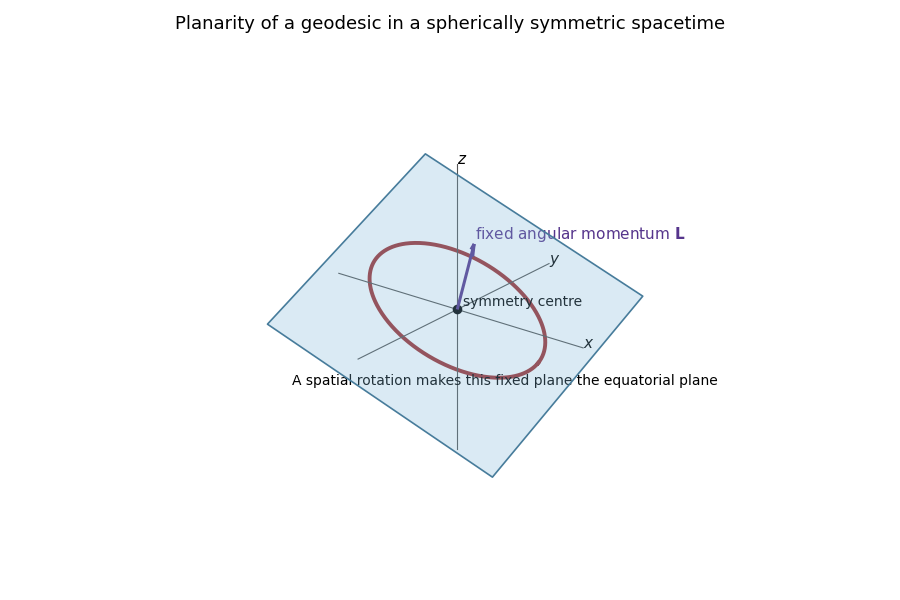
The rotational Killing vector fields of the spherical symmetry conserve the angular-momentum vector. Its direction is fixed, so every nonradial orbit lies in the plane through the symmetry centre orthogonal to that vector. A spatial rotation can make this the equatorial plane. Equivalently, the initial conditions and solve the equation uniquely. This is the planarity of geodesics in spherical symmetry; a radial geodesic has zero angular momentum and may be assigned any plane.

On , the cyclic coordinates and produce geodesic conserved quantities from Killing vectors,For a timelike geodesic parametrized by proper time, the proper-time normalization is . Substitution of and gives the first-order radial equationThis is the timelike geodesic effective potential for static Anti-de Sitter spacetime with curvature radius one.
A geodesic passing through must have . If it moves away from the origin, , andTaking proper time at departure givesIt turns around at and first returns to the origin atThis energy-independent refocusing is the characteristic radial timelike geodesic in anti-de Sitter spacetime result; for curvature radius , the answer is .
For the torsion-free Levi-Civita connection, cyclically summing the displayed coordinate expression and using gives the algebraic first Bianchi identityApply the Jacobi identity to three covariant-derivative commutators, or differentiate the coordinate formula in normal coordinates. The third-derivative terms and the derivatives of quadratic connection terms cancel cyclically, giving the differential second Bianchi identityContracting the first and third curvature indices and then contracting once more yieldsor the contracted Bianchi identity
For the metric variation ,while the two double-divergence terms in the supplied metric variation of scalar curvature become a boundary term after integration by parts for tensor fields. The Einstein-Hilbert action therefore contributes . Varying the Proca action with respect to the metric gives the Proca stress-energy tensor, and the full Einstein-Proca theory equation is
Since , variation with respect to and one integration by parts give the covariant Proca equationTaking its covariant divergence givesbecause the resulting contractions pair the symmetric Ricci tensor with the antisymmetric electromagnetic field tensor. Since , the Lorenz constraint in Proca theory follows:Moreover, and , so the Electromagnetic Bianchi identity is
Finally, use that identity to differentiate the matter tensor. The result groups naturally asBoth terms vanish by the Proca equation and its Lorenz constraint in Proca theory. Thus , exactly as required by the contracted Bianchi identity applied to the Einstein field equations. The vector equation is therefore consistent with the gravitational equation.
Articles by others on the same topic
There are currently no matching articles.