In the rotating shearing sheet, write the background orbital shear as . The rotating momentum equation contains Coriolis acceleration and the shearing-sheet tidal potential; the background shear balances the radial tidal acceleration.
SetGauss's law for magnetism gives , and the vertical ideal magnetohydrodynamic induction equation gives . Horizontal invariance and remove the nonlinear horizontal advection. The remaining background-shear term is . The horizontal magnetic tension is , while horizontal pressure gradients vanish. Subtracting background balance yieldsFor ideal magnetohydrodynamics, the ideal magnetohydrodynamic induction equation is . Its horizontal components giveThese horizontally invariant magnetized shearing-sheet equations are exact within the stated local, incompressible ansatz, even for finite horizontal amplitudes. The vertical equation determines the pressure needed to balance vertical gravity and magnetic pressure; it does not add another horizontal evolution equation.
Write and , and assume and . In a steady state, the horizontally invariant magnetized shearing-sheet equations giveSince vanishes at both boundaries, for , and then throughout. The other two equations areEliminating gives the harmonic oscillator equationThe midplane-symmetric magnetic bending in an incompressible disk has odd and even . Applying givesFor nonzero imposed inclination , this equilibrium exists only when . More generally, ; the boundary conditions require and . Thus the displayed solution is unique away from these resonances. At , an additional even homogeneous solution is possible unless midplane symmetry is imposed. At , an arbitrary constant is also allowed because its coefficient in the azimuthal equation vanishes; choosing gives the same symmetric equilibrium.
The horizontally invariant magnetized shearing-sheet equations are linear in the horizontal fields, so perturbations about the equilibrium satisfy the same equations. The fixed surface boundary conditions require at . Choose a normal mode withwhere the vertical wavenumber is , . With the Alfvén frequencythe four amplitude equations becomeEliminating the velocities leavesA nonzero amplitude requires the determinant of this system to vanish, yielding the ideal magnetorotational dispersion relationEquivalently, with ,As a quadratic equation for , its discriminant is . If , its constant term is negative, so one root is positive and there is an exponentially growing mode. If , both the constant term and the coefficient of are positive, giving two negative roots and only oscillatory modes. Equality is marginal.
The lowest allowed vertical wavenumber, , is the last to be stabilized as increases. Therefore the finite-thickness magnetorotational instability criterion isThere is also a vertically uniform velocity mode with zero magnetic perturbation; for the usual orbitally stable regime , it is just stable epicyclic motion. For , that uniform mode is already hydrodynamically unstable, independently of the magnetic criterion. At it is marginal. The criterion above concerns the magnetic modes.
Using , the finite-thickness magnetorotational instability criterion is preciselyFor the midplane-symmetric equilibrium with , the absolute radial magnetic field isIts first maximum occurs at . The instability condition puts strictly inside the disc: . The magnitude rises from zero to this maximum, then decreases on a nonempty interval before the surface. Thus the unstable equilibrium exhibits nonmonotonic magnetic bending, as illustrated below.
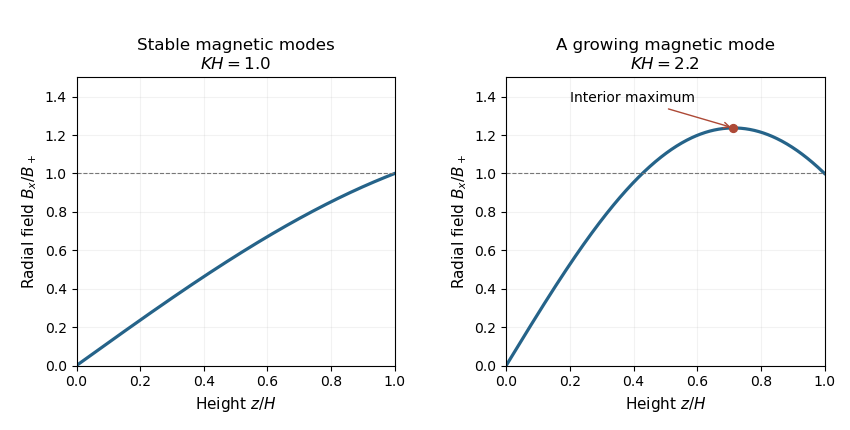
Monotonic and nonmonotonic magnetic bending
. The symmetric equilibrium profiles have . The weak-field example has an interior maximum and admits a growing magnetic mode. Details.
The link between bending and instability concerns a nonzero imposed surface inclination. If , the unbent equilibrium can still have magnetorotational instability; the literal nonmonotonic-bending conclusion does not apply to that degenerate case. Resonances with also require the separate equilibrium analysis in part (b).
Articles by others on the same topic
There are currently no matching articles.