The zero streamfunction gives zero velocity. The temperature obeys both prescribed temperature values, has no horizontal gradient, and has zero Laplacian. Thus it satisfies both equations with :This is the conductive state of Darcy-Bénard convection.
Linearizing about the conductive state givesThe perturbations vanish at . For a normal mode with vertical dependence , put . The two modal equations are and . Eliminating givesNeutrality requires . The arithmetic-geometric mean inequality bounds this below by , with equality at . The first unstable vertical mode is therefore , givingThe wavelength statement applies at the first onset. At a general larger , maximizing the growth rate within a fixed vertical mode gives , so its preferred wavelength need not remain exactly two. This is the onset of convection in a horizontal Darcy layer.
The full perturbation equations arewhere the streamfunction advection bracket is . Put and introduce the slow time , so on the amplitude-dependent fields. ThenThe weakly nonlinear expansion balances the small linear growth against the cubic saturation on this slow time scale.
At first order, and . Since and , the first equation fixes . The homogeneous temperature boundary conditions and the second equation remove any horizontally uniform term, givingAt second order,The forcing is horizontally uniform. Taking no additional critical-mode component, a solution satisfying the homogeneous boundaries isThis mean-temperature correction in weakly nonlinear Darcy convection modifies the vertical temperature gradient and provides the feedback that saturates the convection.
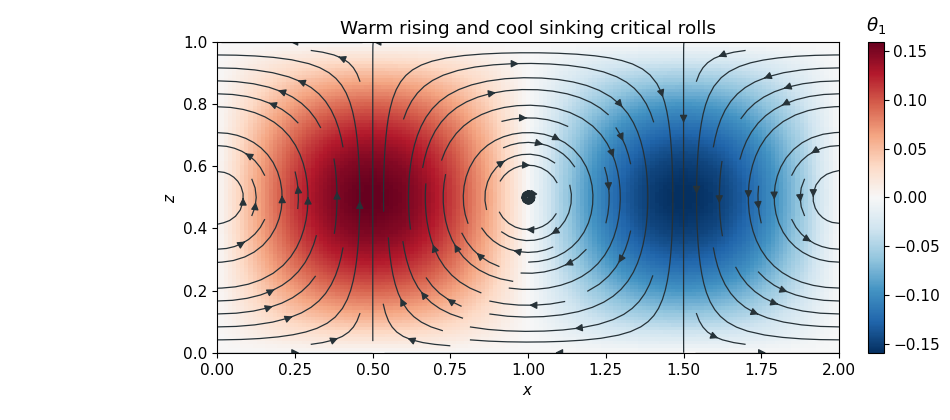

Let and denote the full third-order coefficients. This notation keeps the detuning term, proportional to , and the slow-time term, proportional to , visible. DefineThe equations at order areEquivalently, where , the question's coefficients satisfy and . Eliminate from the full coefficients:Use the Fredholm solvability condition for a self-adjoint operator. With , projection onto the critical eigenfunction makes the left side vanish. Therefore the Landau amplitude equation isThese integrals already answer the requested coefficient calculation. Evaluating them gives , , and . Hence, for the prescribed normalization,The cubic term opposes growth, so the nonzero steady amplitudes are stable equilibria within the chosen roll phase. The conductive state is unstable for this positive detuning. This is supercritical saturation of Darcy convection rolls.
Articles by others on the same topic
There are currently no matching articles.