For a spherical grain of diameter , density , and radiation-pressure efficiency , comparison of the stellar momentum flux with Newton's law of universal gravitation gives the radiation-pressure coefficientFor much larger than the characteristic stellar wavelength, , so . When becomes comparable to the optical wavelength, diffraction and the grain's composition make size dependent and reaches a broad maximum. Deep in the Rayleigh scattering regime, absorption can give and hence nearly constant , while scattering alone gives and hence . A realistic curve therefore rises roughly as toward micron sizes, turns over near the stellar spectral peak, and falls or flattens for still smaller grains.
Immediately after release, the grain has the comet's position and velocity, but its effective stellar gravitational parameter is . Using the comet's specific orbital energy,the grain energy isThereforeRelease with zero relative velocity preserves the specific angular momentum . Applying then givesThe paper instead prints in the first three terms. That expression is incompatible with both its printed and conservation of , except at . The next part is the result obtained from the printed eccentricity, so both consequences are recorded below.
First follow the expression printed in the paper. Put and compare its numerator with . To first order in ,Thus the grain is unbound, , whenSince the cometary apoapsis is ,For completeness, the energy and angular-momentum-consistent formula derived in part (ii) instead gives . The distinction is not a matter of approximation: it exposes the typographical inconsistency in the question.
At periapsis, . The grain's energy from part (ii) is nonnegative whensoThe strict inequality gives a hyperbolic Kepler orbit, while equality gives a parabolic Kepler orbit. The printed eccentricity formula yields , which has the same requested lowest-order limit .
At periapsis the release velocity is tangential. A grain with feels no net stellar inverse-square force and therefore moves on the tangent line. A grain with retains an inward acceleration and bends toward the star; a grain with feels a net outward acceleration and bends away from it. At the common observation time, joining these positions in increasing gives the synchrone shown below. It starts near the low- orbital trajectory, passes through the force-free position, and extends outward through the repelled high- grains.
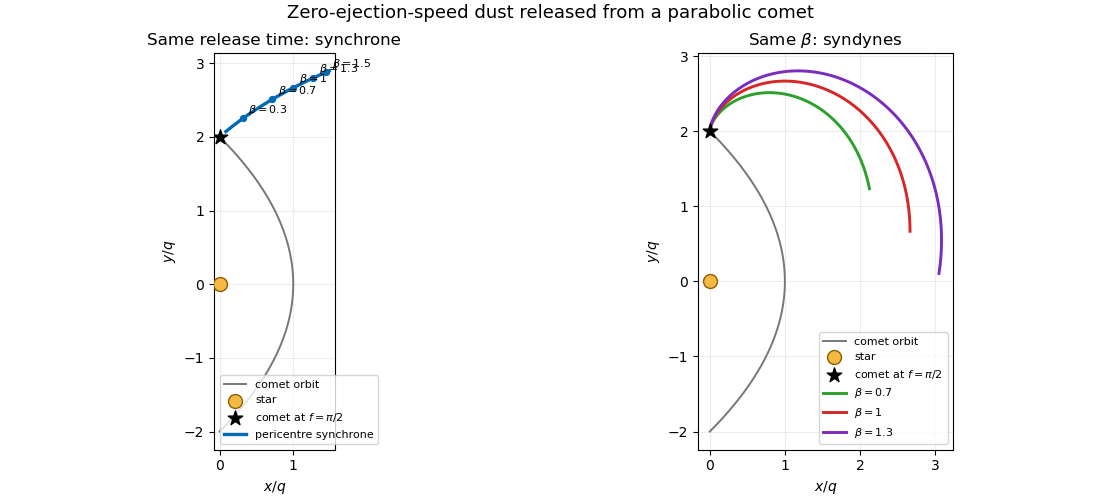

For a fixed , release points from through the current generate a syndyne. The newest grain is still at the comet, whereas earlier grains have had longer to separate. The right panel of the figure shows the resulting family. The curve consists of particles following the tangent lines inherited at their respective release points. Residual gravity bends the syndyne starward and shortens its displacement; net repulsion bends the syndyne anti-stellar and lengthens it.
A cometary dust tail is a superposition of synchrones and syndynes, rather than a material line emitted in one fixed direction. For grains larger than the stellar wavelength, : small grains have large , are displaced rapidly in the anti-stellar direction, and make a relatively straight broad tail. Large grains have small , remain closer to the comet's Kepler orbit, and make a more strongly curved dust trail. The observed position angle consequently depends on grain size, release time, orbital phase, and projection onto the plane of the sky.
Articles by others on the same topic
There are currently no matching articles.