For a piecewise continuously differentiable parametric curve, the arc length is the integral of speed:The Pythagorean theorem gives the length of an infinitesimal displacement as . Integration counts traversal length, including repeated portions if the parametrization retraces them. Piecewise continuous derivatives, or suitable absolute continuity, justify the formula; mere differentiability as stated in the source is not by itself the usual sufficient regularity hypothesis.
In polar coordinates, and . The product rule givesSquaring and adding cancels the mixed terms and gives . Hence the arc length is
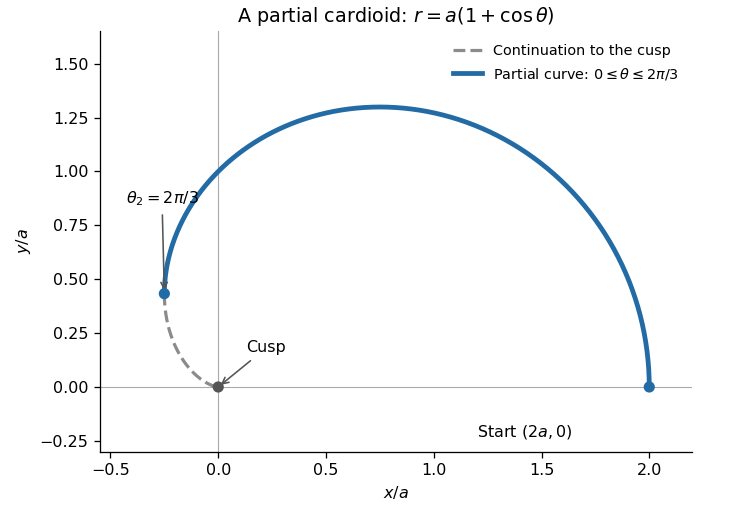
For the cardioid, . The expression under the square root simplifies toSince , the cosine is nonnegative. ThereforeThe upper half of the cardioid starts at , passes through , bends to negative , and ends at the cusp when . Its full upper-half arc length is ; reflecting gives for the full cardioid.
The fundamental theorem of calculus givesThis decreases from to zero, so the arc length increases fastest at , interpreted as the right-hand rate at the initial endpoint. If only positive endpoints are allowed, the rate has supremum as , rather than an attained interior maximum.

Articles by others on the same topic
There are currently no matching articles.