Solutions to all seven questions, including every optional question, of the examination sat on 21 June 2023.
Write for the paper's . In a right-handed Cartesian coordinate system, the cross product isIt is perpendicular to both vectors, has norm , where is their angle, and has direction given by the right-hand rule when nonzero. Its norm is the area of the parallelogram spanned by the two vectors.
If , use that parallelogram as the base of the parallelepiped. Its perpendicular height is , where . Thus its volume isIf , both the volume and this scalar triple product vanish. If the cross product is nonzero, the scalar triple product vanishes exactly when lies in the plane spanned by . If it is zero, are linearly dependent, and adjoining still spans at most a plane. Consequently the three vectors are coplanar if and only if , including cases involving a zero vector.
Expand the first component using the definition of the cross product:The added terms cancel in the last step. Cyclically permuting the component indices gives the other two components, proving the vector triple product identity
Put . The vector triple product identity givesTaking its dot product with and using cyclic invariance of the scalar triple product yieldsThere was no division by , so this also proves the identity for coplanar vectors.
Let . The scalar triple product is invariant under a cyclic permutation, so the definitions of the reciprocal basis give
The cross product is perpendicular to both factors. ThusCyclic permutations give all the off-diagonal dot products between the original basis and its reciprocal basis.
Apply the squared scalar triple product from cyclic cross products proved in c:Hence the reciprocal basis has scalar triple product , with its sign retained.
Since , iii gives . The criterion in a therefore proves that are non-coplanar. In particular they form a basis of .
The vector triple product identity givesEliminate with iii to obtain the reciprocal basis involution:This formula actually holds without the unit-length assumptions. Under those assumptions it also says ; normalizing this cross product alone would lose the sign of and could return .
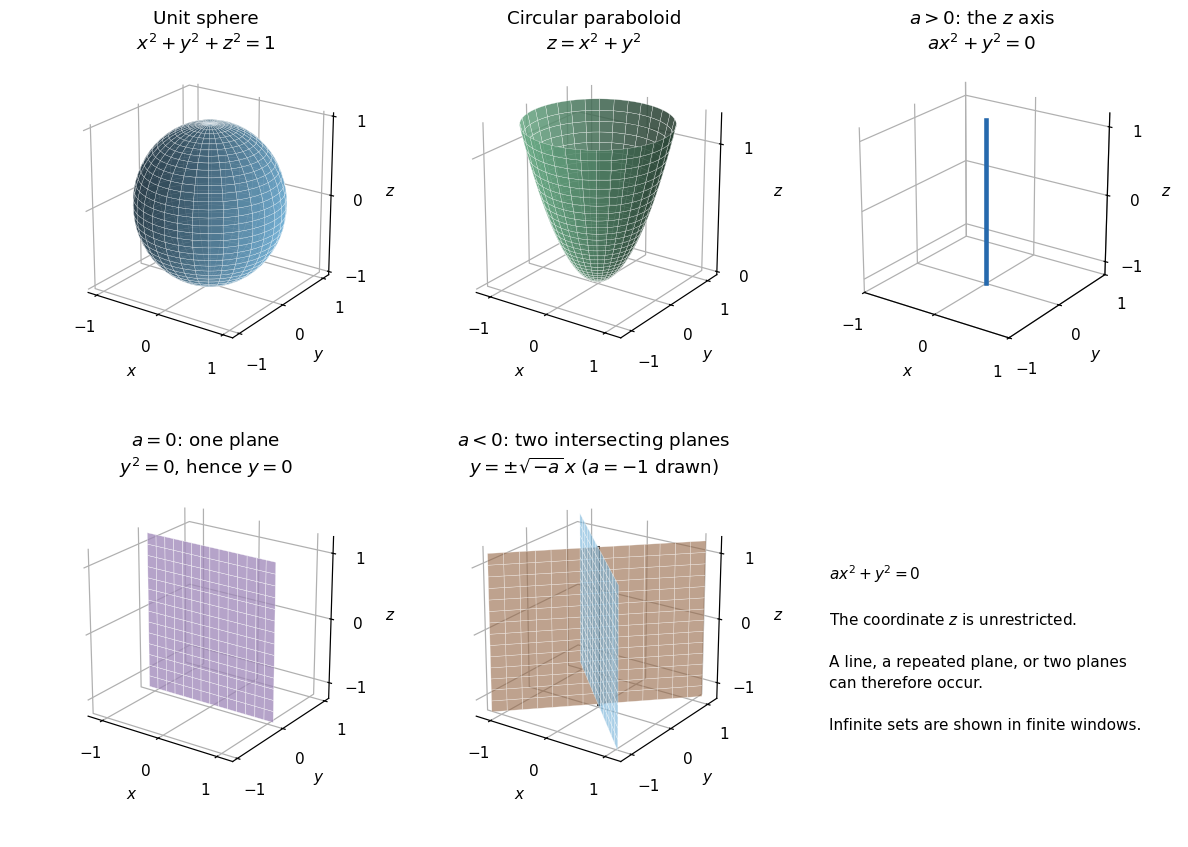
The quadric surface is the unit sphere centered at the origin. Each section , for , is a circle of radius .
The quadric surface is a circular elliptic paraboloid, opening in the positive direction with vertex at the origin. Its horizontal sections are circles of radius , and its vertical sections through the axis are parabolas.
For , is unrestricted. If , both nonnegative terms must vanish, so the locus is the axis, a straight line. If , it is the plane , represented by the repeated factor . If , factorization givesso the locus is two distinct planes, , meeting along the axis. These are degenerate quadrics, not ordinary curved cylinders.
Choose the rotated Cartesian coordinatesTheir inverse is , . Consequently and , giving the canonical form of a quadricThe orthogonal diagonalization identifies the eigenvalues of the symmetric matrix of the quadratic form.
For , all three coefficients are positive: the surface is an ellipsoid with semiaxes . At it is a sphere.
For , the equation is , an elliptic cylinder parallel to the axis. For , it is , an elliptic cylinder parallel to the axis. The absent coordinate is unrestricted; its disappearance does not turn the surface into an ellipse.
For , the negative coefficient is that of : this is a one-sheet hyperboloid with axis . For , the negative coefficient is that of : it is a one-sheet hyperboloid with axis . This gives the signature transition from an ellipsoid to an elliptic cylinder and a one-sheet hyperboloid, including both transition values.
Write . Restriction to the plane givesThis is an equation of degree at most two in two Cartesian coordinates, the general algebraic form of a conic, with possible degenerate conics and an empty set of real points. No determinant hypothesis is needed for this substitution.
For an arbitrary plane, choose a point and an orthonormal basis of its direction linear subspace. Put and , where . With , the symmetric part of a matrix, the restricted equation isThis proves the plane-section result whenever “conic” allows the appropriate degeneracies. A rigid motion taking the chosen plane to gives the same argument.
The source's assumption does not guarantee a nondegenerate conic. Even with and , the section is a single point, and has no real points. With the nonsingular symmetric matrix giving , the section is the repeated straight line .
There is a further literal omission: the source does not assume is symmetric. Forone has but . Thus the section is the entire plane, rather than a conic. Only controls the quadratic form; invertibility of an arbitrary cannot remove this exception. If the intended hypothesis is that is symmetric and nonsingular, the quadratic restriction to a plane cannot vanish identically: otherwise , so would map a two-dimensional linear subspace injectively into its one-dimensional orthogonal complement, which is impossible. Degenerate and empty sections still remain possible.
For a piecewise continuously differentiable parametric curve, the arc length is the integral of speed:The Pythagorean theorem gives the length of an infinitesimal displacement as . Integration counts traversal length, including repeated portions if the parametrization retraces them. Piecewise continuous derivatives, or suitable absolute continuity, justify the formula; mere differentiability as stated in the source is not by itself the usual sufficient regularity hypothesis.
In polar coordinates, and . The product rule givesSquaring and adding cancels the mixed terms and gives . Hence the arc length is
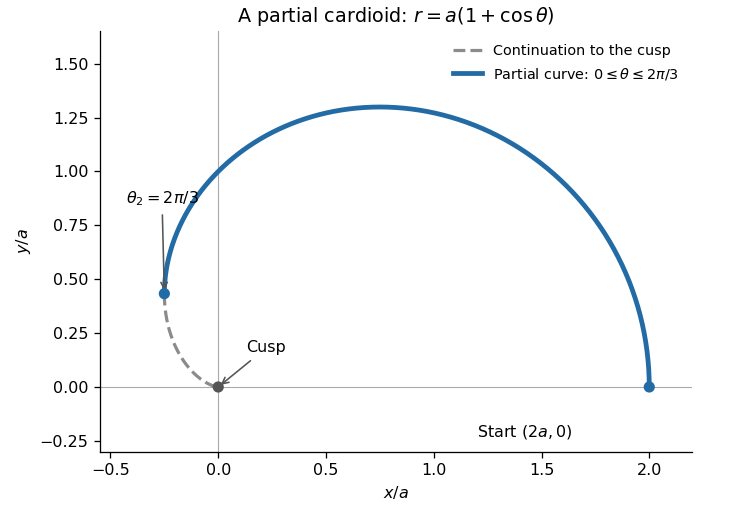
For the cardioid, . The expression under the square root simplifies toSince , the cosine is nonnegative. ThereforeThe upper half of the cardioid starts at , passes through , bends to negative , and ends at the cusp when . Its full upper-half arc length is ; reflecting gives for the full cardioid.
The fundamental theorem of calculus givesThis decreases from to zero, so the arc length increases fastest at , interpreted as the right-hand rate at the initial endpoint. If only positive endpoints are allowed, the rate has supremum as , rather than an attained interior maximum.
Parametrize the function graph by . Its two tangent vectors are and . A small parameter rectangle maps, to first order, to a tangent parallelogram with area . Sincethe surface area of a graph isFor example, ensures a regular surface chart; more general domains can be handled by the corresponding convergent improper integral.
A parametrization of the surface of revolution isIts tangent vectors are orthogonal, with norms and . ThusThe absolute value is necessary if the function graph passes below the axis. The formula gives the curved surface area; it adds no end discs. Zeros of can be treated by splitting the integral into regular portions and taking limits.
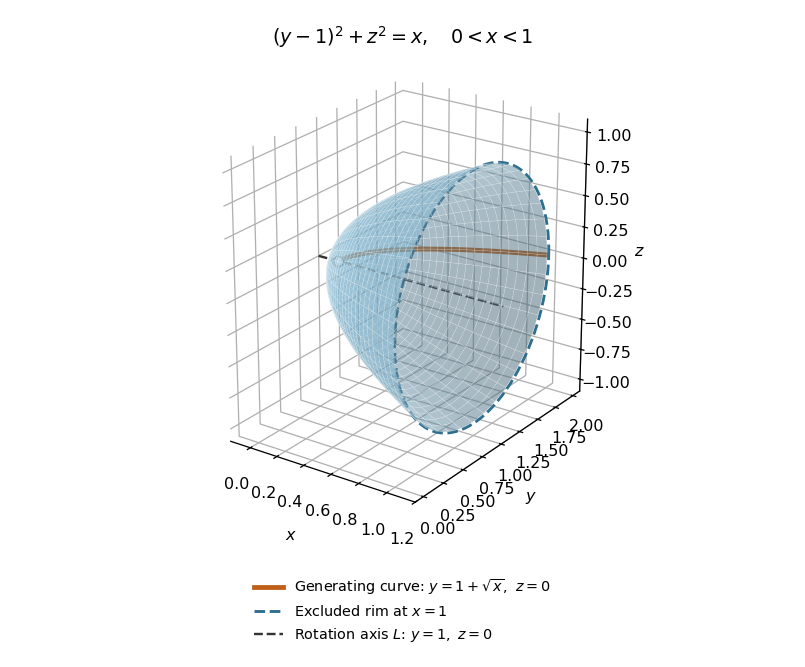
The rotation axis is . The distance of the generating function graph from this axis is , so a parametrization isThe surface of revolution therefore has equation : it is a circular elliptic paraboloid opening along the positive direction, with its vertex and its rim at excluded. Translating the axis does not change the surface area formula, soThe cancellation makes the improper integral finite at the vertex. Neither the missing vertex nor the missing boundary circle changes the surface area, and no cap is included.


Divide Newton's second law by the mass and resolve along the radial and transverse unit vectors in polar coordinates. A central force has no transverse component, soMultiplication of the second equation by shows that . Thuswhere is the signed specific angular momentum perpendicular to the orbital plane.
If and , the polar angle is locally a valid independent variable. For , use primes for derivatives with respect to . The chain rule givesSubstitution into the radial equation gives the Binet equationIf , the orbit is radial and division by is unavailable; the first radial equation still applies with away from the origin.
The initial transverse velocity gives . From , the initial conditions are and . DefineThe Binet equation becomes the constant-coefficient linear ordinary differential equationIts particular solution is . Applying the two initial conditions to the complementary solution givesThe physical branch is the connected range containing on which the right-hand side is positive. A zero corresponds to escape to infinite radius, rather than continuation to negative .
The source calls an inward force magnitude, but here changes sign at . The stated initial condition has inward radial velocity, so the particle immediately enters , where the force is outward. The consistent interpretation is that is the signed inward radial component of the force per unit mass.
The oscillatory numerator has amplitude . Therefore the reciprocal radius stays bounded away from zero exactly whenIn this case the radial bounds areFor completeness, the potential energy per unit mass is , and conservation of mechanical energy givesThis effective potential diverges positively at zero, has one minimum at , and tends to zero from below at infinity. Since the initial radial velocity is negative, the particle first reaches an inner turning point. If , the subsequent outward motion has no finite outer turning point and escapes. At equality the escape speed tends to zero, but the radius is still unbounded; infinity is approached only as time tends to infinity. HenceThe minimum of permits a circular orbit for other initial data, but the nonzero initial radial velocity here excludes that exceptional solution.
With , one has . Since , ii proves boundedness. Write the positive rational number in lowest terms. The radius and its angular derivative repeat after . After such radial oscillations,so both the position and the radial and transverse velocities return to their initial values. The elapsed time iswhich is finite and positive because is bounded above and below by positive constants. Thus the motion is periodic. The orbit is a closed, generally self-intersecting rosette orbit, with radial oscillations during complete revolutions; for integral it has evenly spaced lobes around the origin. It never reaches the origin and is not a circular orbit.
Let be the normal reaction of the stationary smooth surface of revolution. Its normal lies in the span of , so it has no component. The transverse component of Newton's second law, , is thereforewhich gives .
The velocity is tangent to the stationary surface, so . Take the dot product of Newton's second law with :Using proves conservation of mechanical energy per unit mass:The ideal constraint does no work. These equations describe motion while the particle remains constrained to the surface.
Take and the intended horizontal launch around a parallel of the surface of revolution: , . Then and . Since , the conserved energy becomesHere is the radial effective potential on a surface of revolution. Rearrangement givesFor a nonconstant bounded radial motion with , there must be another finite radial bound satisfying , equivalentlyThe interval between the radial bounds must be dynamically accessible: inside, and a simple endpoint must have a forbidden region beyond it. Equivalently the motion must lie in a bounded part of separated from escape by a potential barrier. When stays finite near zero and , the centrifugal barrier already excludes ; an outer barrier is the additional requirement. An arbitrary second algebraic root on a disconnected allowed branch would not establish boundedness.
The initial radial acceleration, obtained by projecting Newton's second law along , isThus starts the particle outward, and starts it inward. Equality gives the exact circular orbit and needs no second distinct radial bound. A double root at a different radius can instead be approached asymptotically: this separatrix is bounded, although the radial motion is not periodic. If , the centrifugal barrier disappears and the particle may pass through the axis, still with bounded .
The source leaves a direction ambiguity at points where : every horizontal tangent direction is then possible, so “projected horizontally” alone does not imply . The displayed inequality uses the azimuthal launch specified above; at that direction is forced by horizontality and tangency.
Use the dimensionless variablesThe stated gives . Since , the inequality from b factorizes asThe two additional possible turning points areThey are real exactly when . This exposes the intended critical valuebut the ordering of the initial radius relative to these roots must also be checked.
First suppose . Then . If , the allowed branch starting at is trapped either between and or between and , according to its initial direction. At the coincident-root value it is exactly a circular orbit. For , the inner radial bound is the axis rather than a nonzero turning point.
At , the additional roots coalesce at . The particle starts outward and approaches , orwithout reaching it in finite time. Indeed is proportional to and the radial energy equation gives proportional to near . Its integral diverges. This is a bounded separatrix approaching an unstable circular orbit. For , there is no outer root and the particle escapes. Thus for , boundedness holds exactly when , with the equality case included. At , the same inequality characterizes boundedness, but equality is the exact circular orbit at the starting radius.
The source's weaker assumption is insufficient to make this single threshold a general criterion. For , the initial radius lies beyond the coalescing-root position. The transition is instead the unstable circular orbit atBelow this speed the initial radial acceleration is inward and the particle remains in the inner allowed interval. At equality it stays exactly circular; above it the initial acceleration is outward and the accessible branch extends to infinity, even if . For , the surface slopes downward outward and every such launch escapes. At , only remains at rest on the summit circle.
Consequently the complete classification for the intended azimuthal launch, including zero launch speed and exact equilibria, isFor a concrete counterexample to the unqualified proposed criterion, take and . Then , but and the outward motion has no accessible outer barrier. This satisfies the printed radius assumption and escapes. A sufficient additional radius restriction for the intended threshold is , with the equality and circular orbit qualifications above.
The uniform rod has linear mass density . Integrating squared distance from the pivot gives its moment of inertia about the axis perpendicular to the plane of motion:Measure from the downward vertical. The center of mass is at distance from the pivot, so gravity produces the restoring torque . The fixed-axis rotational equation of motion is . Therefore the physical pendulum obeysThe pivot force has zero torque about the pivot.
The disc is rigidly attached, so its rotation axis is perpendicular to its face. Its moment of inertia about its center is : with surface mass density , an annulus of radius contributes , whose integral is . The parallel axis theorem adds at the pivot. Adding the rod's moment of inertia gives
The rod and disc contribute restoring torques and , respectively. Using i in the rotational equation of motion givesOnly the disc's center of mass enters its gravitational torque; its finite radius enters its moment of inertia. The formula is also regular at , although the source happens to exclude that value.
The small-angle approximation reduces ii to , whereThe coefficient is positive, so the solution is simple harmonic motion, . Here is the angular frequency; the ordinary frequency and period are
For a fixed attachment ratio , making the disc much heavier than the rod givesIf the disc is also small relative to the attachment distance, , its moment of inertia about its own center is negligible compared with . ThusThis is a simple pendulum with a point mass at the disc's center and effective length ; it is length only if . Even before the small-angle approximation, its equation tends to .
If is allowed to tend to zero together with the other parameters, the bare conditions and do not alone justify that reduction. The needed dominance conditions are , , and , so that the rod contributes negligible gravitational torque and moment of inertia, and the disc behaves as a point mass. They follow automatically in the combined limit with fixed .
Back-substitution in the Euclidean algorithm gives the Bezout identityMultiplying by five produces a particular solution . Since and are coprime integers, all solutions of the linear Diophantine equation areReplacing by gives the smaller equivalent starting solutionIndeed . Conversely, subtracting this solution from any other gives . Coprimality forces to divide , and then is the corresponding multiple of . This proves completeness of the family.
Define the relative reciprocal error . The iteration has the exact identitysoConsequently guarantees . For real , this condition is . A starting guess can be found without division by choosing with the sign of and repeatedly halving its magnitude until .
For the absolute signed error , the same identity givesThus the method has cubic convergence, of order of convergence three, with asymptotic error constant for a nonexact convergent start. Convergence requires a suitable guess: and correspond to and , respectively, so both are fixed failures. For the error magnitude grows without bound. The exact initial value is already the answer.
For a twice continuously differentiable function , its gradient and Hessian matrix areA critical point solves . The Jacobian matrix of this vector equation is , so the multivariable Newton iteration isEquivalently when the Hessian matrix is invertible. Solving the linear system is the direct computational form. A critical point found in this way need not be a local minimum; its type requires a separate check.
The gradient and constant Hessian matrix areAt , and . Hence one multivariable Newton iteration givesAt this point the gradient vanishes, so every subsequent iterate is . The one-step result follows because the gradient of a quadratic polynomial is affine and its linearization is exact. Since the leading principal minors of are and , it is a positive-definite matrix. Alternatively,directly proves that is the unique global minimum, with value .
Articles by others on the same topic
There are currently no matching articles.