For a piecewise continuously differentiable parametric curve, the arc length is the integral of speed:The Pythagorean theorem gives the length of an infinitesimal displacement as . Integration counts traversal length, including repeated portions if the parametrization retraces them. Piecewise continuous derivatives, or suitable absolute continuity, justify the formula; mere differentiability as stated in the source is not by itself the usual sufficient regularity hypothesis.
In polar coordinates, and . The product rule givesSquaring and adding cancels the mixed terms and gives . Hence the arc length is
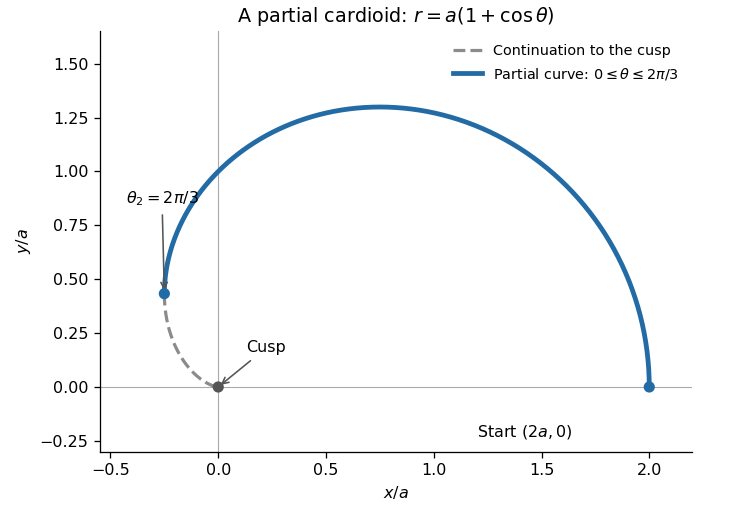
For the cardioid, . The expression under the square root simplifies toSince , the cosine is nonnegative. ThereforeThe upper half of the cardioid starts at , passes through , bends to negative , and ends at the cusp when . Its full upper-half arc length is ; reflecting gives for the full cardioid.
The fundamental theorem of calculus givesThis decreases from to zero, so the arc length increases fastest at , interpreted as the right-hand rate at the initial endpoint. If only positive endpoints are allowed, the rate has supremum as , rather than an attained interior maximum.
Parametrize the function graph by . Its two tangent vectors are and . A small parameter rectangle maps, to first order, to a tangent parallelogram with area . Sincethe surface area of a graph isFor example, ensures a regular surface chart; more general domains can be handled by the corresponding convergent improper integral.
A parametrization of the surface of revolution isIts tangent vectors are orthogonal, with norms and . ThusThe absolute value is necessary if the function graph passes below the axis. The formula gives the curved surface area; it adds no end discs. Zeros of can be treated by splitting the integral into regular portions and taking limits.
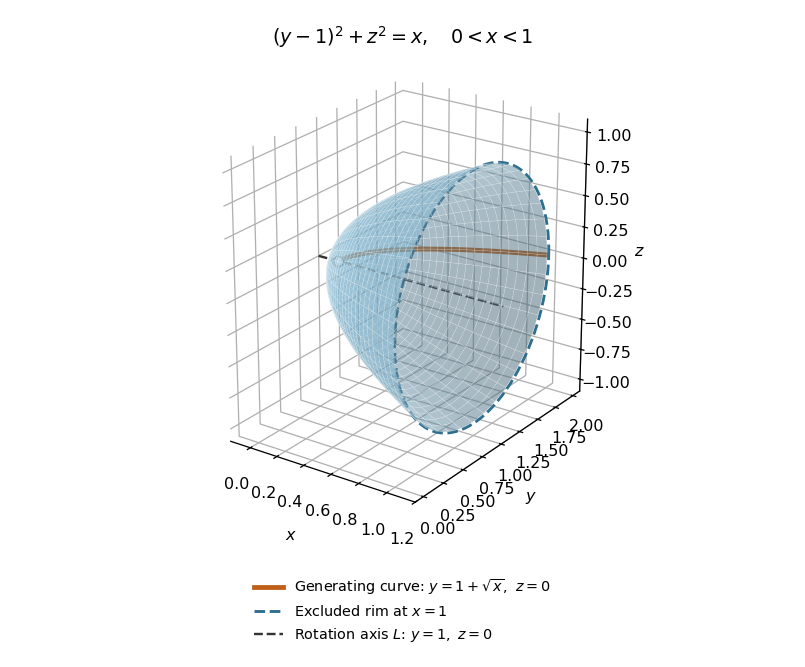
The rotation axis is . The distance of the generating function graph from this axis is , so a parametrization isThe surface of revolution therefore has equation : it is a circular elliptic paraboloid opening along the positive direction, with its vertex and its rim at excluded. Translating the axis does not change the surface area formula, soThe cancellation makes the improper integral finite at the vertex. Neither the missing vertex nor the missing boundary circle changes the surface area, and no cap is included.


Articles by others on the same topic
There are currently no matching articles.