Put and . The gradient has components and , so a stationary point requires . In the closed square, and , and the compatible possibilities are precisely the four corners and .
The Hessian matrix is
Its eigenvectors and have eigenvalues and . The second-derivative test gives the following classification:
Point || || Hessian eigenvalues || Classification | | | Minima | | | Maxima | | | Saddle point of a scalar function
The corner classifications also hold for the smooth extension beyond the square, and hence for the restricted region. The global bounds show that the stated minima and maxima are global within it. The central point has opposite curvature along the two diagonal directions.
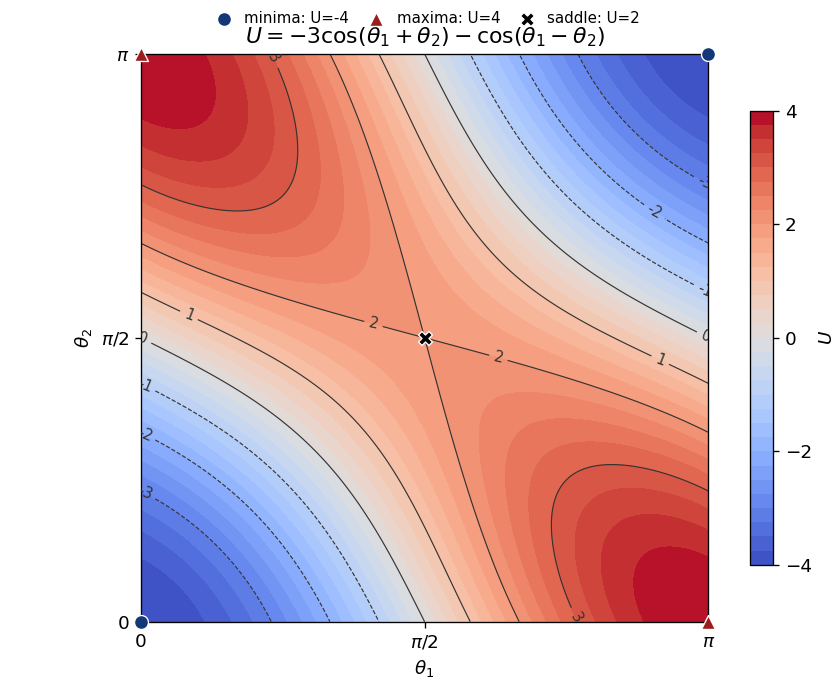
Figure 1.
Energy contours show two minima, two maxima and a central saddle
. The contour crosses at the saddle. Filled markers locate all five points where the gradient vanishes; color and labeled level curves show how the energy changes between them. Details.

Articles by others on the same topic (0)

There are currently no matching articles.