The zero set consists of the three lines , and . Their pairwise intersections areThe bounded triangle has and . Its edges and interior contours are shown below.
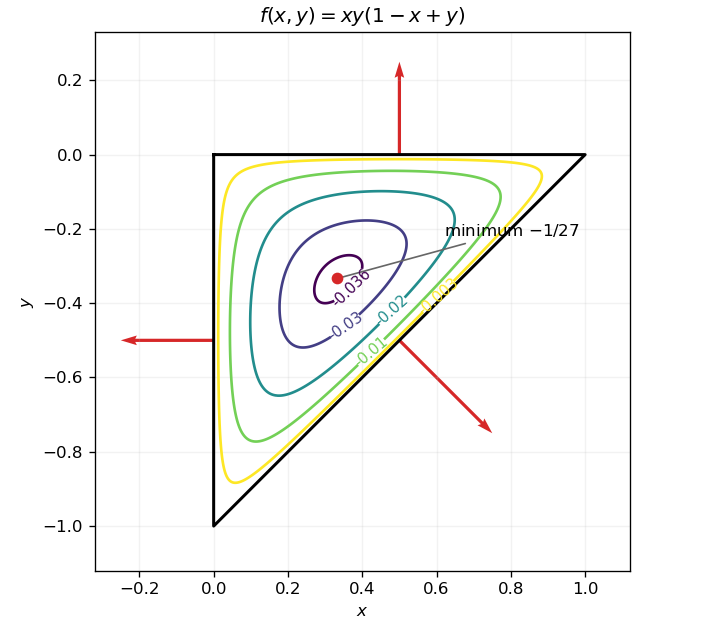
Negative contours inside the zero triangle, with outward boundary gradients and the interior minimum
. Details. 
The gradient is . At the three specified points it is respectivelyEach vector is perpendicular to its straight boundary edge and points out of the triangle, where increases from its negative interior values. The arrows in the preceding figure mark these directions.
Inside the triangle, both and are nonzero. Thus reduces to and , whose unique solution is . At that pointThe Hessian matrix has positive eigenvalues and , so this is a strict local minimum. It is also the minimum on the closed triangle: on the boundary, inside, and there is no other interior stationary point. Therefore
The interior values satisfy away from the minimum. The contours are closed curves surrounding , approximately ellipses near that point, and approach the three edges as the level tends to zero. To see their shape globally, put , , . These are positive inside and satisfy , while . Since is strictly concave, its nonempty superlevel sets are convex and surround the unique maximum of . Thus the negative contours nest without additional components, as in the figure.
The gradient is . Its second component vanishes only if or . The latter gives the impossible first-component equation . With , the first component gives or . The Hessian matrix isAt it has eigenvalues , giving a saddle point. At its eigenvalues are , giving a strict local minimum, of value . These are all real stationary points. The minimum is local: for example as .
Articles by others on the same topic
There are currently no matching articles.