Differentiate the numerator and denominator using the product rule and quotient rule:The numerator simplifies to , giving
For the real inverse hyperbolic tangent, take and . Its logarithmic expression givesThe same derivative holds on a differentiable complex branch away from its singularities.
First take and , and put , . Then . The chain rule givesConsequentlywhich proves the identity on the open domain of differentiability. The squared inverse sine is unchanged when is replaced by , so the identity also holds for negative with . The value is excluded.
An axial section gives similar right triangles. At height above the base, the cone's remaining height is , so the cylinder's radius is . Therefore its volume isAssume and for a nondegenerate cone. The geometry and the dimensionless optimization curves are illustrated below.
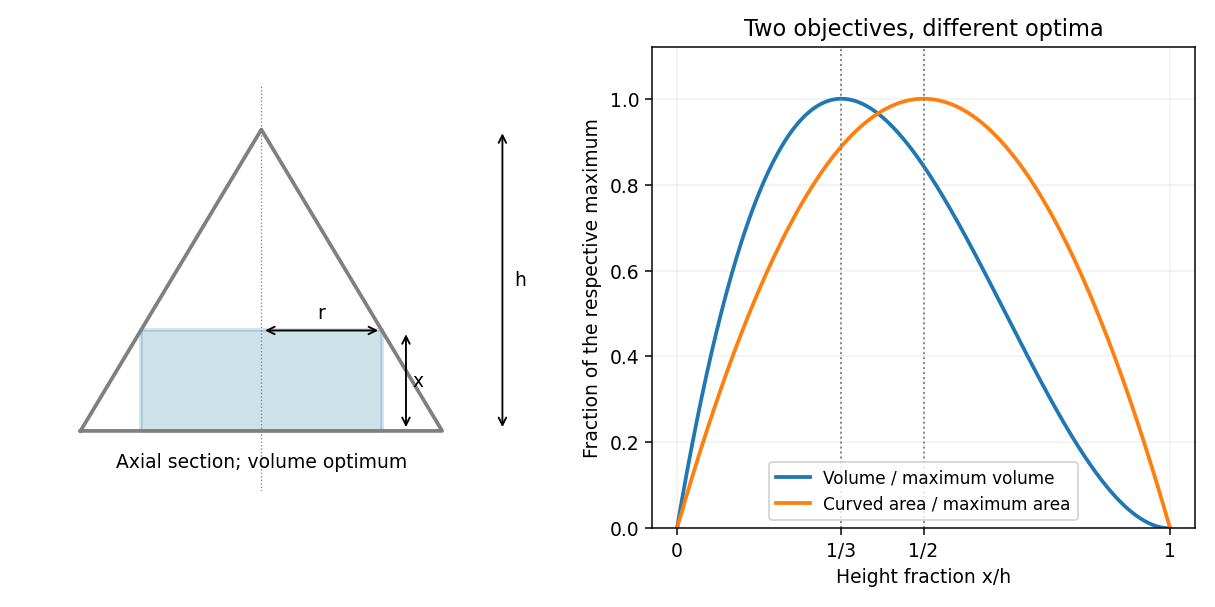

At fixed , the derivative is . It is positive for and negative for . The endpoint volumes are zero. Thus the unique positive-volume global maximum is atIts value is , whereas the cone volume is . HenceThis is the volume case of the optimal cylinder inscribed in a cone.
The curved surface area excludes the two end disks, so . Completing the square givesThusIt differs from the volume optimum because the objective contains one power of the radius rather than two.
Articles by others on the same topic
There are currently no matching articles.