The factor theorem supplies the factor . Polynomial division givesThe quadratic formula then gives the other two roots of a polynomial:
Isolate the square root: . A real solution must have , because a real principal square root is nonnegative. Squaring gives , hence . The candidate zero violates ; substitution verifies the other candidate. ThusThe sign restriction prevents the extraneous solution introduced by squaring.
Use partial fraction decomposition:Integrating the two logarithmic derivatives givesThis holds on each interval avoiding the two poles and , with an independent integration constant on each interval.
The double-angle identity reduces the equation to . On the specified interval the cosine takes each of the values and once, giving
This geometric series has first term one and ratio , whose absolute value is less than one. Therefore
The graph is nonnegative, tends to as and as , and vanishes only at . Its derivative is , negative before one and positive after one, so is the unique global minimum. The second derivative is : the graph is convex for and concave for , with an inflection point at . These features determine the sketch in the left panel.
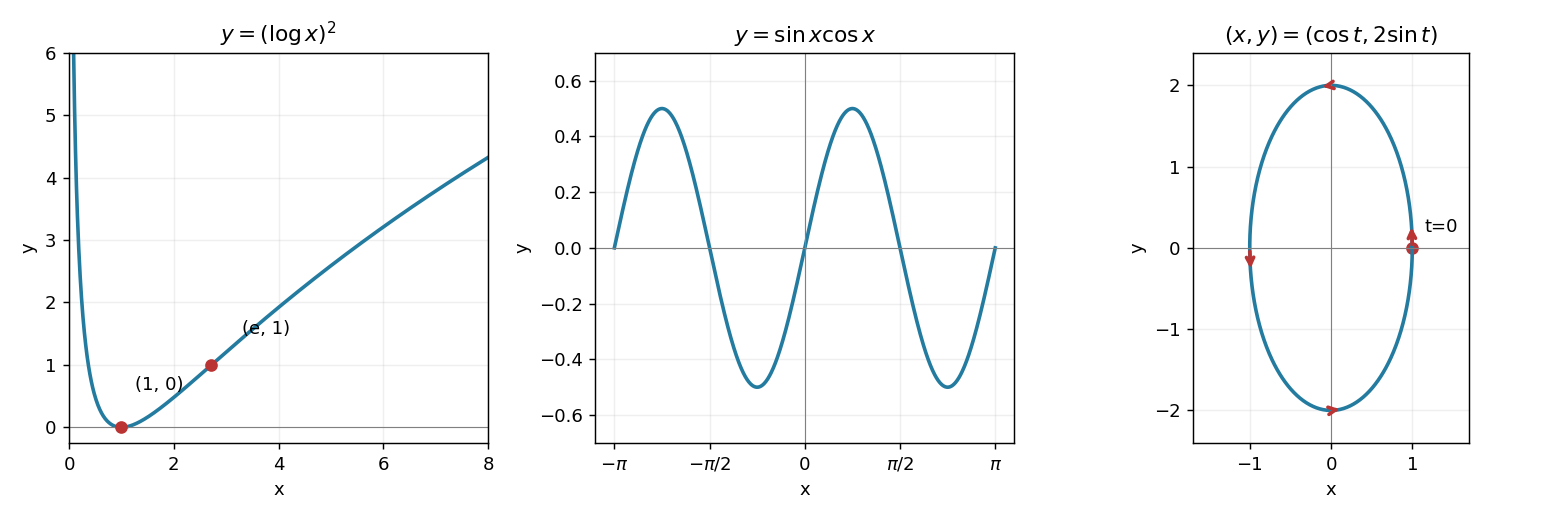
Write . It is an odd function with amplitude and period . Its zeros on the specified interval are . The maxima are at and the minima at , with values and . The middle panel of the preceding figure shows the two full oscillations.
The line has equation , with normal vector . The distance from a point to a line is the absolute value of the normal component of the displacement:The perpendicular foot is , which lies on the line and realizes this shortest distance.
Eliminating the parameter gives , an ellipse centered at the origin with horizontal semiaxis one and vertical semiaxis two. At the particle is at with velocity , so it travels counterclockwise, reaching successively and returning after . The right panel of the graph figure shows this direction.
For a parametric curve with , the chain rule givesThe specified point has , hence in the given traversal. Therefore
Differentiate the numerator and denominator using the product rule and quotient rule:The numerator simplifies to , giving
For the real inverse hyperbolic tangent, take and . Its logarithmic expression givesThe same derivative holds on a differentiable complex branch away from its singularities.
First take and , and put , . Then . The chain rule givesConsequentlywhich proves the identity on the open domain of differentiability. The squared inverse sine is unchanged when is replaced by , so the identity also holds for negative with . The value is excluded.
An axial section gives similar right triangles. At height above the base, the cone's remaining height is , so the cylinder's radius is . Therefore its volume isAssume and for a nondegenerate cone. The geometry and the dimensionless optimization curves are illustrated below.
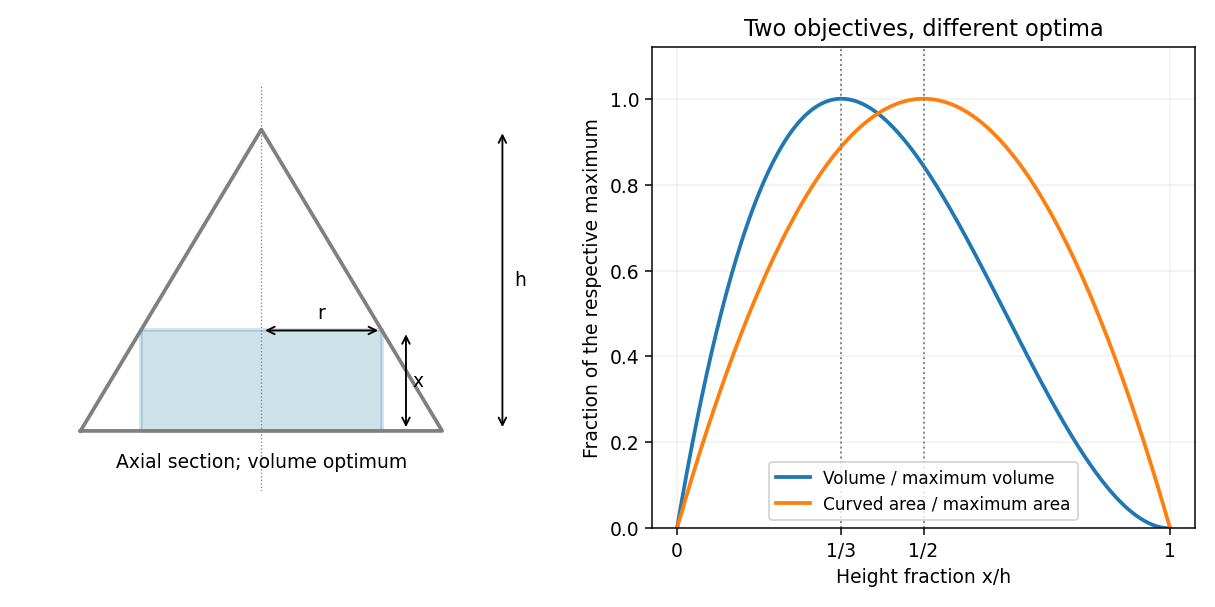


At fixed , the derivative is . It is positive for and negative for . The endpoint volumes are zero. Thus the unique positive-volume global maximum is atIts value is , whereas the cone volume is . HenceThis is the volume case of the optimal cylinder inscribed in a cone.
The curved surface area excludes the two end disks, so . Completing the square givesThusIt differs from the volume optimum because the objective contains one power of the radius rather than two.
Neither biscuit type can run out in this case. Treat each freely made choice as an independent Bernoulli trial, with success meaning chocolate. The number taken after choices has a binomial distribution, soThe binomial coefficient counts the possible success positions, and every such arrangement has the same probability. Independence of successive choices is the probabilistic model implicit in the question; identical marginal preferences alone would not imply it.
Write the chocolate count as with independent Bernoulli random variables. Each has expected value and variance . By linearity of expected value and additivity of variance for independent variables,
For the last chocolate to be taken on choice , the first choices must include exactly chocolate choices, and choice must take chocolate. Before that final success there is still chocolate available, so no forced plain choice has yet occurred. The negative binomial stopping argument givesThis is the all-trials convention of the negative binomial distribution. The finite examination scenario also has a remaining probability that the tray still contains chocolate after all choices; the displayed probabilities need not sum to one over . At the last chocolate is never taken, and at it is taken on choice .
A forced plain choice occurs exactly when the last chocolate is taken before the final Fellow is served: if it is taken by choice , choice has no chocolate available, whatever that person's preference would have been. Exhaustion precisely on choice forces nobody. The distinct possible exhaustion times are disjoint events, henceEquivalently, imagine independent preferred choices even after stock is exhausted. The event is that at least preferred chocolate choices occur among the first people, so the binomial distribution gives . The success-count and waiting-time duality explains equality of these two sums. Plain-biscuit depletion cannot interfere because .
The characteristic polynomial isThus the eigenvalues and corresponding eigenvectors over areAll nonzero scalar multiples of these vectors are also eigenvectors. Distinct eigenvalues make them linearly independent. Put them in the columns ofThe equations are exactly , giving the diagonalizationThere is no diagonalization over , since the matrix has no real eigenvalues.
Expanding the determinant gives . Solving each eigenvalue equation yieldsTheir pairwise inner products are , and . Their squared Euclidean norms are , respectively, so division by gives an orthonormal basis. This also follows from the spectral theorem for real symmetric matrices: symmetry makes eigenvectors for distinct eigenvalues orthogonal.
The values of the complex logarithm at are , . For any such value and any integer ,This is an integer multiple of , so its sine is zero. In particular the result holds with the principal value . The argument does not require treating the multivalued logarithm as a single globally defined function.
Using the principal complex square root, . Its two square roots differ by a sign, givingEquivalently their arguments are and modulo . If instead the right-hand square root is allowed to take both values, the union has four elements , , satisfying . Only the two boxed values square to the principal right-hand side.
Substitute the exponential definitions of hyperbolic cosine and hyperbolic sine. The cross terms cancel:This proves the identity for real arguments, and the same algebra proves it for complex arguments.
The exponential definitions giveThus the double-angle identity follows directly, without any restriction beyond the domain of the exponential.
The scalar triple product is the determinant of the matrix with columns . A cyclic permutation of three columns is a product of two swaps, so its determinant sign is positive. Therefore . This uses the alternating multilinearity of the determinant, and remains true for linearly dependent vectors.
The determinant defining has two equal columns. Interchanging them both leaves it unchanged and reverses its sign, so it is zero. Equivalently, the cross product is orthogonal to , giving .
Three vectors in real three-dimensional space have zero determinant exactly when they are linearly dependent. Their linear span then has dimension at most two, so they lie in a common plane through the origin. Conversely vectors in such a plane span at most two dimensions, so their scalar triple product vanishes. This includes parallel nonzero vectors: they need not determine a unique plane, but they lie in at least one. Even zero vectors satisfy the determinant characterization, though the question excludes them.
By the vector triple product identity,The last inner product vanishes by perpendicularity. Taking the inner product with givesThis is the identity for cross products with a common vector, and holds without nondegeneracy assumptions.
At an intersection, , so . Alternating multilinearity of the scalar triple product then gives , establishing .
For the location, write and take its scalar triple product with and :Under the additional stated assumption , division givesThese are intersection parameters from scalar triple products. The formula presupposes an intersection; the first coplanarity condition by itself also holds for distinct parallel lines. Intersections can exist with the displayed denominator zero, in which case a different auxiliary vector or a component calculation is needed.
For , integration by parts gives the Gamma function recurrence:The endpoint terms vanish because at zero and the exponential dominates the power at infinity. Also . Iterating for nonnegative integers therefore yieldsNegative integers are outside this integral definition and factorial conclusion.
Set , so and . The improper integral becomesThe Gamma function recurrence givesThe exponential-transformed integrand also proves convergence at the logarithmically singular endpoint.
In the Gamma function integral at , use , , with . Then , soThe substitution can first be made on finite positive intervals and then extended by monotone limits, justifying the endpoint passage.
The integrand in the preceding expression is nonnegative. Tonelli's theorem permits squaring as a quadrant integral; then polar coordinates giveThe defining integral is positive, fixing the sign of the square root. ThereforeThis is the positive-quadrant proof of the Gaussian integral.
The homogeneous first-order differential equation suggests , so . Wherever the original equation is defined,Thus the implicit solution is . The printed initial values force .
There is no classical solution through the printed initial point. There , so the tangent on the right is undefined. The implicit relation nevertheless has two neighboring real branches on which approach that point continuously:Both tend to as , but their derivatives become unbounded with opposite signs. They solve the equation on the open interval , not at its endpoint. Other inverse-sine periods cannot approach the specified initial value. This is an endpoint obstruction in a homogeneous differential equation. Constant-ratio branches also solve the general equation where , but do not meet the initial data.
Articles were limited to the first 100 out of 133 total.
Articles by others on the same topic
There are currently no matching articles.