Put . In the right half-plane,The last two cancel, so . The possible singular point lies outside the open domain .
For , a level curve of value has . These are rays from the origin, restricted to the right half-plane. For positive , the values increase with angle from on the lower boundary to on the upper boundary. If , the function is identically zero. The left panel of the figure in (c) shows these ray-shaped level curves.
Let . Direct partial differentiation, away from , givesThese are the Cauchy-Riemann equations. Equivalently, with , the analytic mapping is , the inverse Cayley transform between the half-plane and disk.
The supplied harmonicity result can also be checked by the multivariable chain rule. The Cauchy-Riemann equations imply , , and . HenceThis is conformal invariance of harmonicity for the given mapping.
Simplify the real component to . Thus is the unit circle with excluded from the mapping's domain. Its upper semicircle has and its lower semicircle has ; the point maps to . Inside the disk, , so the principal arctangent is unambiguous. Setting givesThe Laplace equation follows from (b). Approaching an open upper boundary arc makes the ratio tend to , giving ; the lower arc gives . This solution is in terms of the harmonic measure of a semicircle in a disk .
The boundary data jump at , so no path-independent continuous boundary value can be imposed at those two junctions. The displayed bounded harmonic function is the solution with the specified limits on the open arcs; those endpoint discontinuities are part of the idealized capacitor geometry.
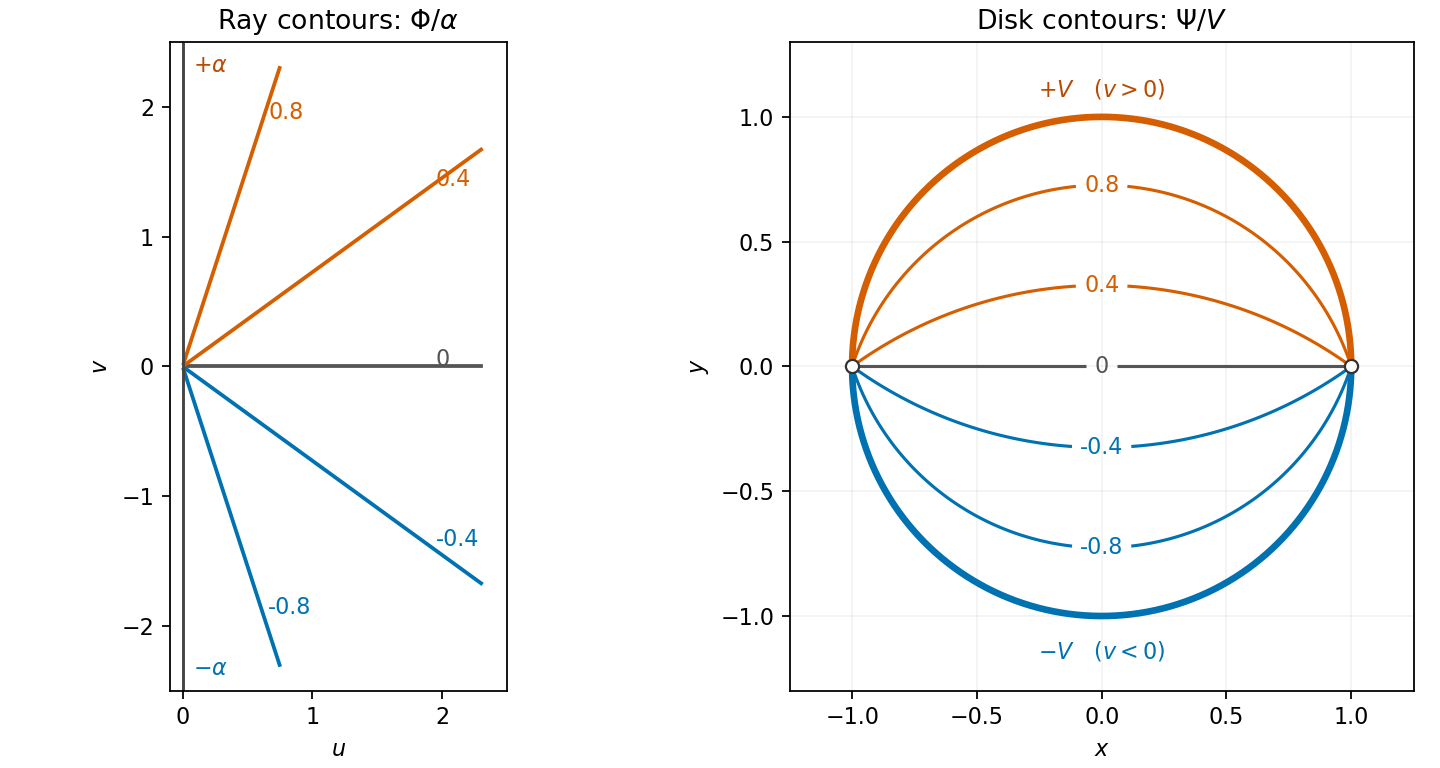
Harmonic ray contours in the right half-plane and the potential in a disk with opposite semicircle boundary values
. Details. 
Articles by others on the same topic
There are currently no matching articles.