Inside the sphere, the electric field has the form , including at the origin. Thus it is a conservative vector field. Outside, use the gradient of a radial function to obtainThis is also an explicit potential of a conservative vector field, single-valued throughout the exterior region. Equivalently, the curl vanishes in both regions: for a radial coefficient , because is radial. The interior formula avoids any apparent issue at the origin. The vector-field potentials here have the opposite sign from the electric potential convention used in (b).
For a radial electric potential, . Comparing radial coefficients givesIntegrating these one-variable derivatives gives the general local expressionsThe two constants are initially independent because these integrations were performed in separate radial regions.
The condition at infinity gives . Matching the electric potential at givesConsequentlyThis function is finite and differentiable at the origin. At the joining radius, both and match, giving and . Thus the electric field is continuous there as well as being conservative on each side. This is the potential of a uniform spherical source, with source coefficient .
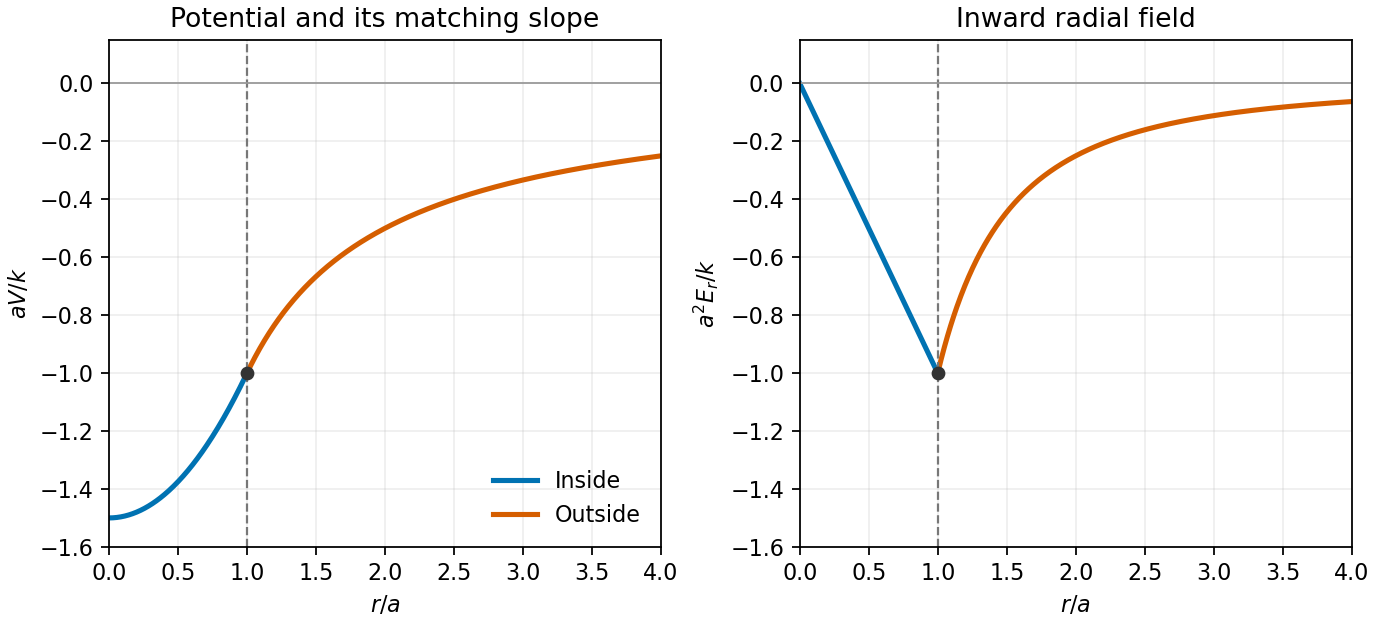
Continuous radial potential and inward electric field, normalized at the sphere boundary
. Details. 
Articles by others on the same topic
There are currently no matching articles.