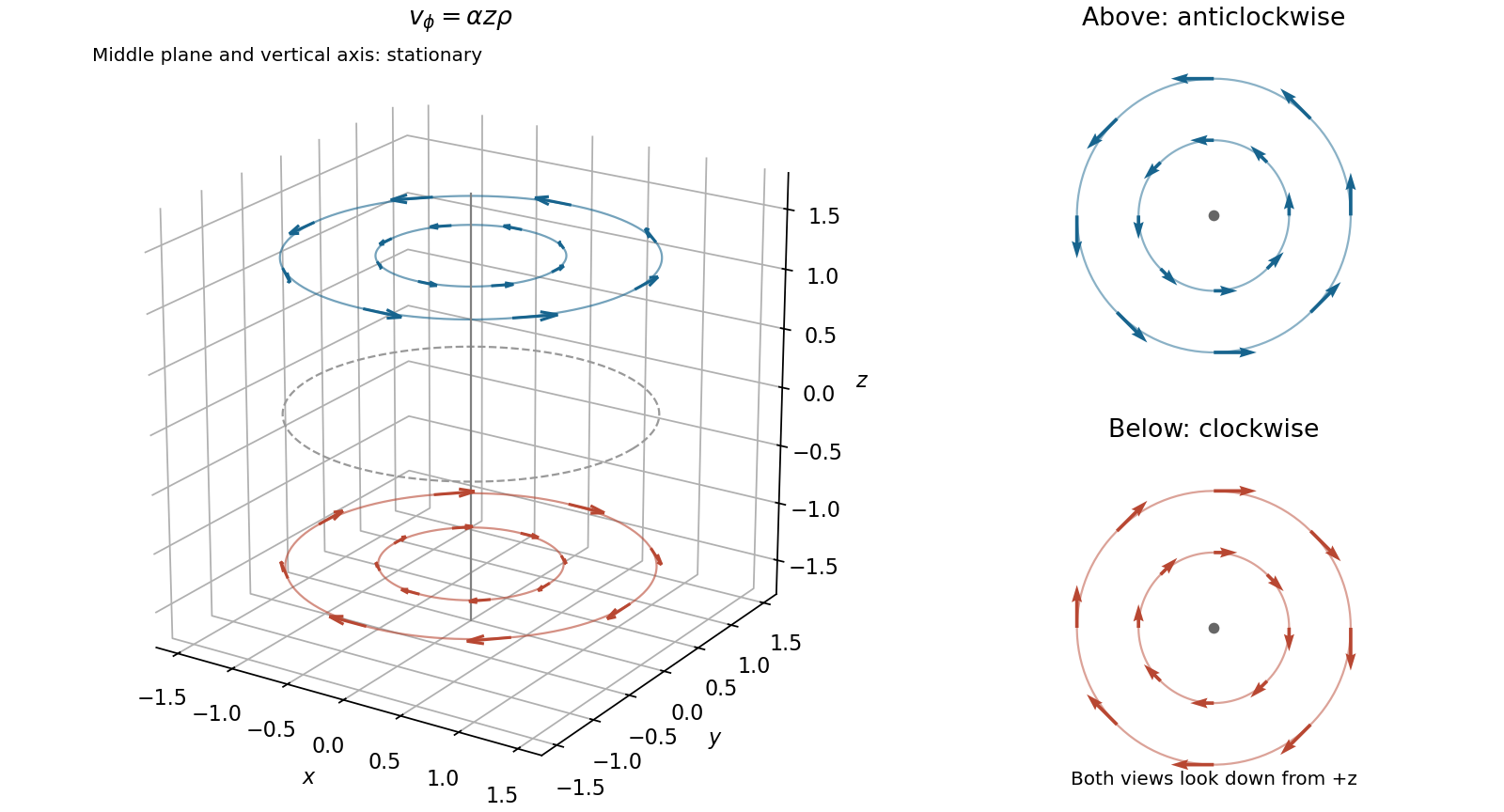
Use cylindrical coordinates , . The velocity field becomesFor each fixed height, particles follow concentric circular streamlines around the vertical axis. At the motion is anticlockwise viewed from above, while at it is clockwise. Within a horizontal plane the angular velocity is , independent of radius, and the speed is . Both the plane and the vertical axis are stationary. The rotation rate varies with height, so the entire liquid is not one rigidly rotating body.

For a sufficiently smooth vector field on a volume and its closed boundary , the divergence theorem stateswith the unit normal directed outwards. HereHence the net volume flux through every closed surface in the liquid is zero. This verifies incompressible flow directly. It does not require the velocity to vanish pointwise on an arbitrary closed surface; inward and outward contributions can cancel.
The curl gives the vorticity:Since , the requested form isAt the axis the radial unit vector is undefined, but its coefficient vanishes and the Cartesian expression remains smooth. The radial vorticity reflects the change in rotation rate with height.
Separate the closed cylinder into its curved side and its two end disks, all with outward normal vectors. On the side, and , soAt the top, and , giving . At the bottom, both and the axial normal vector change sign, so the same positive value results. Each disk therefore contributes . Adding all three surface integrals,This explicit cancellation is consistent with the fact that the divergence of a curl is zero. The two disk contributions add rather than cancel.
For an oriented surface with compatible boundary direction, the Stokes theorem statesLet denote the removed patch and the remaining cylinder. Keep the outward orientation inherited from the closed cylinder. Everywhere on the removed curved patch, the normal curl component is , so its flux is , where is its actual curved area. Part (d) then givesConsequently the circulation around a hole in an oriented surface isThe positive direction here is induced by the remaining outward-oriented surface; locally it runs clockwise around the hole when viewed from outside. If the edge is instead traversed positively around the removed patch, the direction reverses and the answer is . The question does not specify an edge direction, so the sign must be accompanied by this convention. The result depends only on the removed curved area, not on its shape. If the patch has several boundary components, use the sum of their induced line integrals. Since , the result has the units of a velocity line integral, length squared per time.
Articles by others on the same topic
There are currently no matching articles.