An eigenvalue equation has the form , where is an eigenvector and its eigenvalue. It means that the linear map preserves the vector's line and acts there by multiplication by . Nonzero solutions occur precisely when ; the zero vector is excluded because it would satisfy the equation for every .
Each proposed displacement has second derivative . Matching the coefficients of the common time factor in the three equations givesThese algebraic relations hold for the entire oscillation, including the isolated times when the common cosine vanishes.
With , the eigenvalue equation isThe dimensionless matrix is the stiffness matrix divided by ; its eigenvalues determine squared angular frequencies.
Expanding the determinant along the first row givesThe eigenvalues and normalized spatial eigenvectors, in increasing frequency order, areFor each mode both signs of give the same cosine displacement. An arbitrary overall mode amplitude remains free. These vectors are the instances of the sine eigenvectors of the fixed-end spring chain.
The pairwise dot products of the normalized vectors areTheir squared norms are respectively , , and , all one. Hence they form an orthonormal basis. This also follows from the spectral theorem for real symmetric matrices, because is symmetric and its three eigenvalues are distinct.
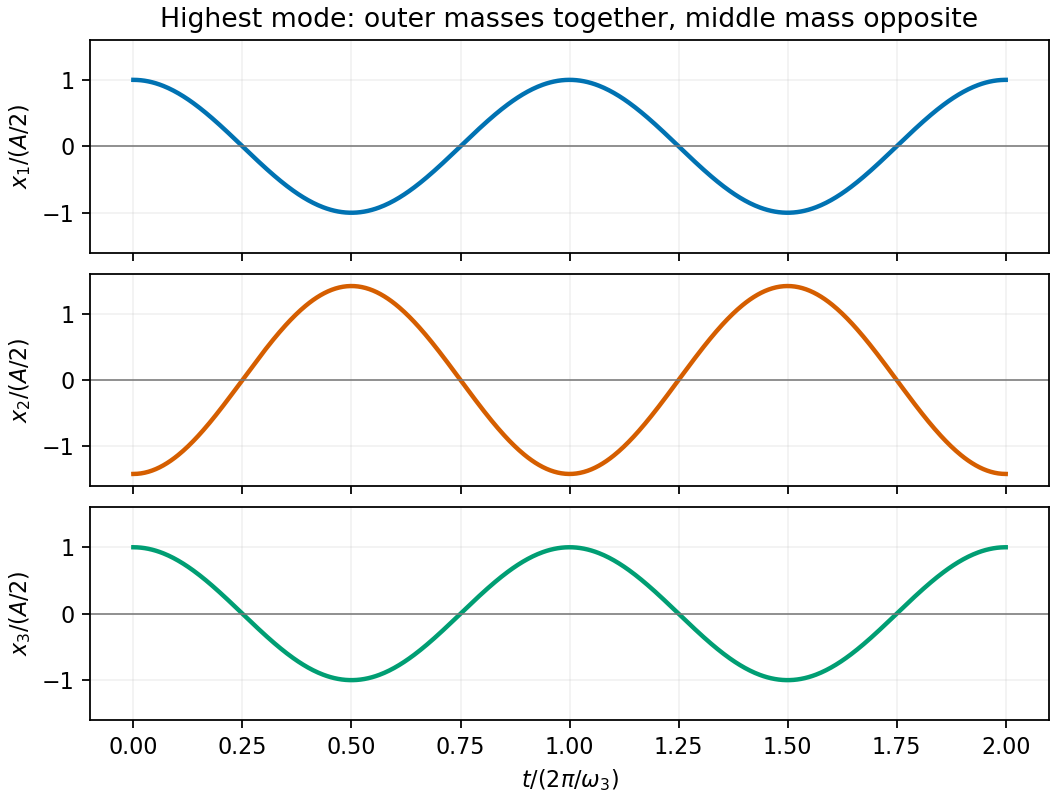
The largest angular-frequency magnitude is . With overall amplitude , the corresponding displacements areThus the two outer masses move together, while the middle mass moves oppositely with times their amplitude. All three have the same period .

Articles by others on the same topic
There are currently no matching articles.