The exponential function is strictly positive, so the zero level set is determined entirely by its prefactor:This is a rectangular hyperbola with branches in the first and third quadrants.
The sign of is the sign of . ThereforeThe positive region includes both coordinate axes, the second and fourth quadrants, and the portions of the first and third quadrants on the origin side of the hyperbola. The two negative regions lie beyond its branches. The left-hand panel shows these regions; its markers locate the stationary points calculated next.
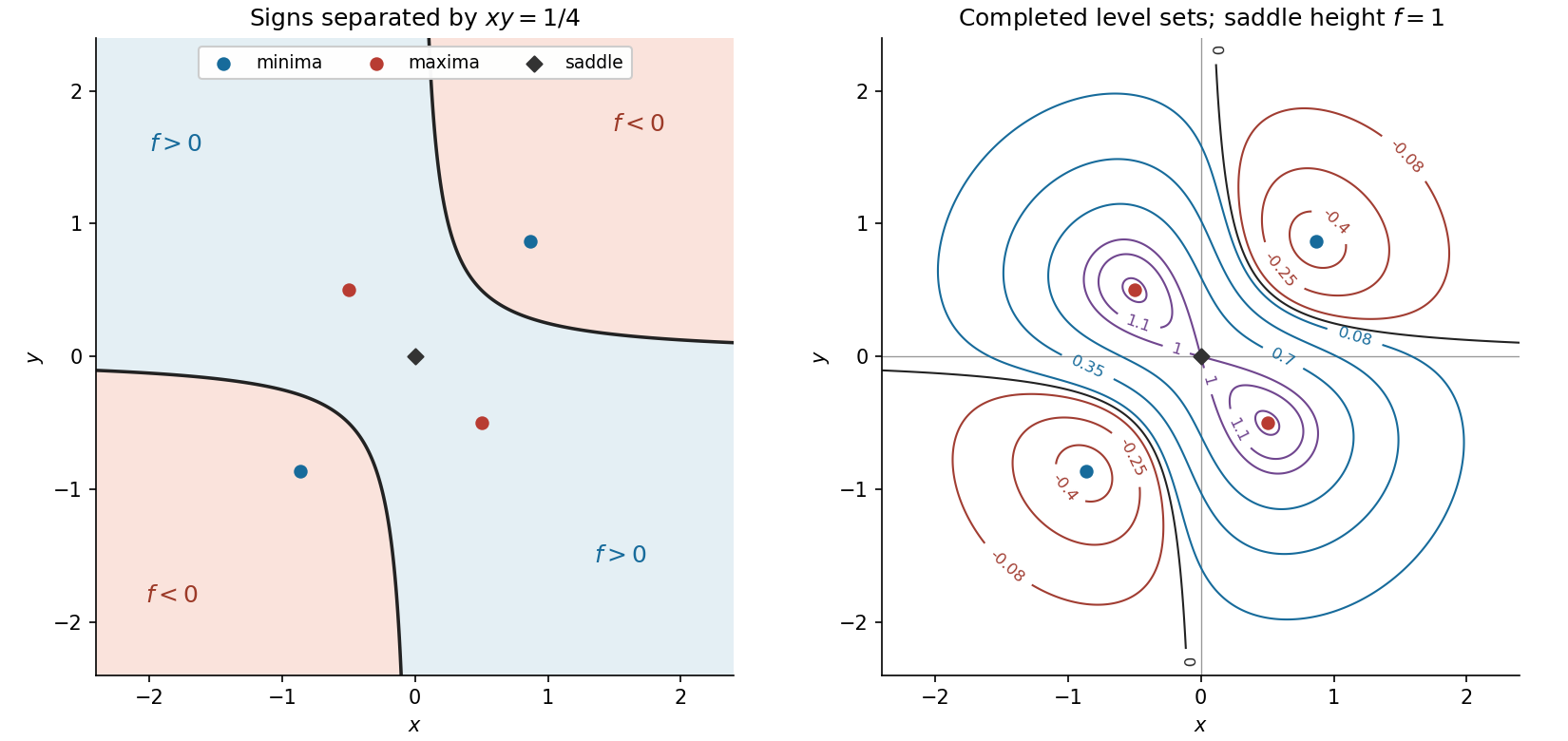

Set both components of the gradient to zero. After dividing out the nonzero exponential, they are equivalent toAdding and subtracting gives and . If , the first equation reduces to , giving the origin and the two diagonal points. If , it reduces to , giving the origin and the two opposite-diagonal points. The alternative simultaneous values and are incompatible, so these cases exhaust the possibilities. Thus the five stationary points areThey are marked in both panels of the figure.
Evaluate the Hessian matrix at the five stationary points. At the origin it iswhose eigenvalues are and , so the origin is a saddle point. At the two points with ,whose eigenvalues are and . Both are positive, so these are strict local minima. At the two points with ,whose eigenvalues are and . Both are negative, so these are strict local maxima. In summary,The quadratic changes along the orthogonal directions and also provide a direct justification of these classifications.
The completed contour plot is shown in the right-hand panel. Its geometry follows from the symmetries and , together with as . For orientation, the two local minima have value , the two local maxima have value , and the saddle point has value one.
Negative level sets between and zero form separate closed curves around the two local minima in the first and third quadrants. Positive level sets below one form a single closed curve enclosing the origin and both local maxima. At level one, a critical level set crosses itself at the origin and surrounds the two local maxima in two lobes. Between one and , the level sets split into separate closed curves around those local maxima. The zero level set remains the two unbounded branches .
Near the origin, the Taylor expansion is . Consequently the crossing directions at the saddle height satisfy , giving the local shape of the critical level set.
Articles by others on the same topic
There are currently no matching articles.