Use the intended model of uniform draws and a replacement decision independent of the first ball's colour, with probability . The marginal specification alone would not determine the experiment if replacement depended on that colour. This independence assumption is used throughout the question.
Write for a non-blue draw and for no replacement. The sample space consists of the eight ordered outcomes obtained by choosing one of , then one of , then one of . The chain rule for probabilities gives their probabilities:For example, the first entry is . The fifth is because one blue ball has been removed. With no replacement after a non-blue first draw, the two remaining colours each have two balls, explaining the last two entries. The first four entries sum to and the last four to , so the full sample space has total probability one. At or , the corresponding impossible outcomes simply have zero probability.
For sampling without replacement, sum the two outcomes with a blue second draw:The marginal blue probability equals the initial blue fraction even though the two draws are dependent.
Condition on whether replacement occurs. Both alternatives have blue second-draw probability , so the law of total probability gives
The event of two blue draws splits into disjoint replacement and no-replacement cases. Their probabilities from the sample space are and . Hence
By the definition of conditional probability, or Bayes' theorem,Its denominator is positive throughout the specified range. Observing two blue balls raises the probability of replacement for , because replacement makes a repeated colour more likely.
Let . Under replacement its joint probability iswhereas without replacement it isIn the latter case the first removed ball is non-blue, so all blue balls remain. Applying Bayes' theorem and cancelling the positive common factors yields the posterior replacement probability after different-colour draws:It does not depend on . To prove the requested bound directly,Equality holds at and , and the inequality is strict between them. Its sketch joins to , stays below the diagonal, and is increasing and convex becauseThe interpretation is that removing a non-blue ball increases the chance of blue on the second draw; seeing the two different colours therefore favours the no-replacement explanation.
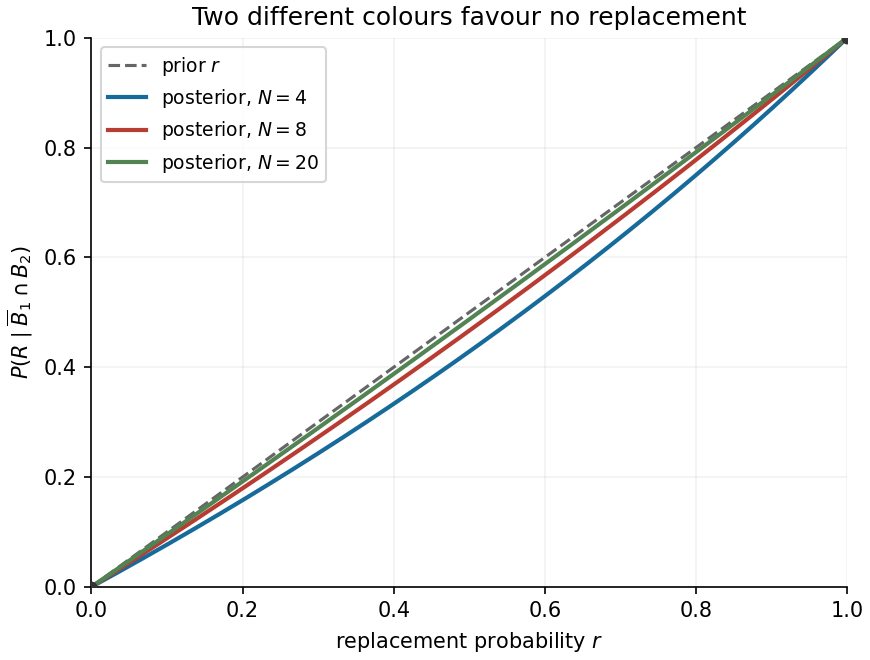
Posterior replacement probability lies below the original replacement probability
. Details. 
Articles by others on the same topic
There are currently no matching articles.