Bring all terms to the left and factor the quadratic polynomial:Its leading coefficient is positive, so it is nonpositive between its two polynomial roots, including the endpoints. Therefore
Complete the squares in the two coordinates:This standard equation of an ellipse is symmetric about and . Its centre is therefore
At a point of tangency, the derivative of the curve equals the slope one of the straight line. The chain rule gives . Since , the unique solution is . The corresponding height is . Substitution in the tangent line gives
The normal vector direction is orthogonal to the tangent line. For finite nonzero slopes, their product is . The tangent has slope one, so the normal line has
The two equal legs meet at the right angle, so the Pythagorean theorem gives , with . Thus . The midpoint condition then yields
The triangle is right-angled at , with and . Another application of the Pythagorean theorem gives . At the angle with vertex , the adjacent side is and the hypotenuse is . Hence
The double-angle formula gives . Setting reduces the equation to . On , the sine is nonnegative, so only is allowed. Therefore
Use integration by parts with and . This gives the antiderivativeEvaluating at the two bounds, with , yields
There are terms in this arithmetic series, starting at and ending at . Pairing the first and last terms, the second and penultimate terms, and so on, givesThe summand in the PDF is , not .
Multiply the partial fraction decomposition by to obtain a polynomial identity:At , this gives . Comparing the coefficients of then gives , soThe remaining coefficients agree: and . The original rational identity is understood away from its poles and .
By Thales's theorem, the two sides meeting on the circular arc are orthogonal, because the opposite side is a diameter. Both vectors point towards that meeting point; reversing both does not change their dot product. Consequently
Let the semicircle have radius , and write , . The right triangle has hypotenuse , so the Pythagorean theorem gives . Its area is , whereas half the area of the semicircle is . Equating these and eliminating givesEquivalently, the relation between the two norms can be writtenThe two possible ratios are reciprocals, corresponding to interchanging the two sides.
Put and . Taking the real part of in De Moivre's theorem givesTaking the imaginary parts of the second and fourth powers gives and . HenceThe mixed powers cancel exactly.
The complex conjugate is . From the complex sine and cosine identities,Divide these expressions and multiply by the complex conjugate of the denominator. Its squared modulus is . The numerator simplifies using and the double-angle formulas. ThusThese expressions apply except at the poles , with integer , where the original tangent function is undefined.
With , the expression inside the modulus is . Squaring its nonnegative modulus therefore givesThe locus is an ellipse in the complex plane, centred at , with horizontal semiaxis and vertical semiaxis . Its vertices are and .
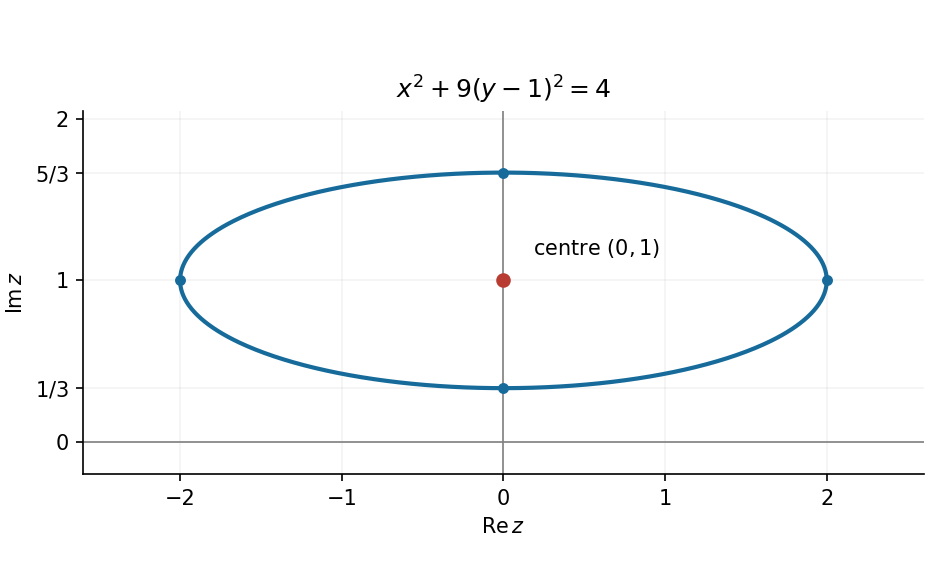
Ellipse obtained from the complex modulus condition
. Details. Take and select a complex argument for . To specify the complex exponentiation, use . Expanding its exponent givesIts complex logarithm therefore has valuesThe continuous logarithm obtained by retaining the displayed exponent uses . If the outer logarithm is the principal logarithm, choose to put the imaginary part in instead; the real part is unchanged. In particular one cannot generally assert without checking its imaginary part.
The condition on the real part gives , so the required logarithmic spiral has polar coordinatesAs increases, it runs from the negative real axis near radius through , and to the negative real axis at radius . The angle increases by one complete turn. Using the conventional principal argument , the inner negative-axis endpoint is excluded and the outer endpoint is included. The convention reverses those endpoint choices. If both limiting arguments are admitted by the paper's wording, both limiting endpoints are drawn; the interior curve is the same. The origin is never included because the complex logarithm is undefined there.
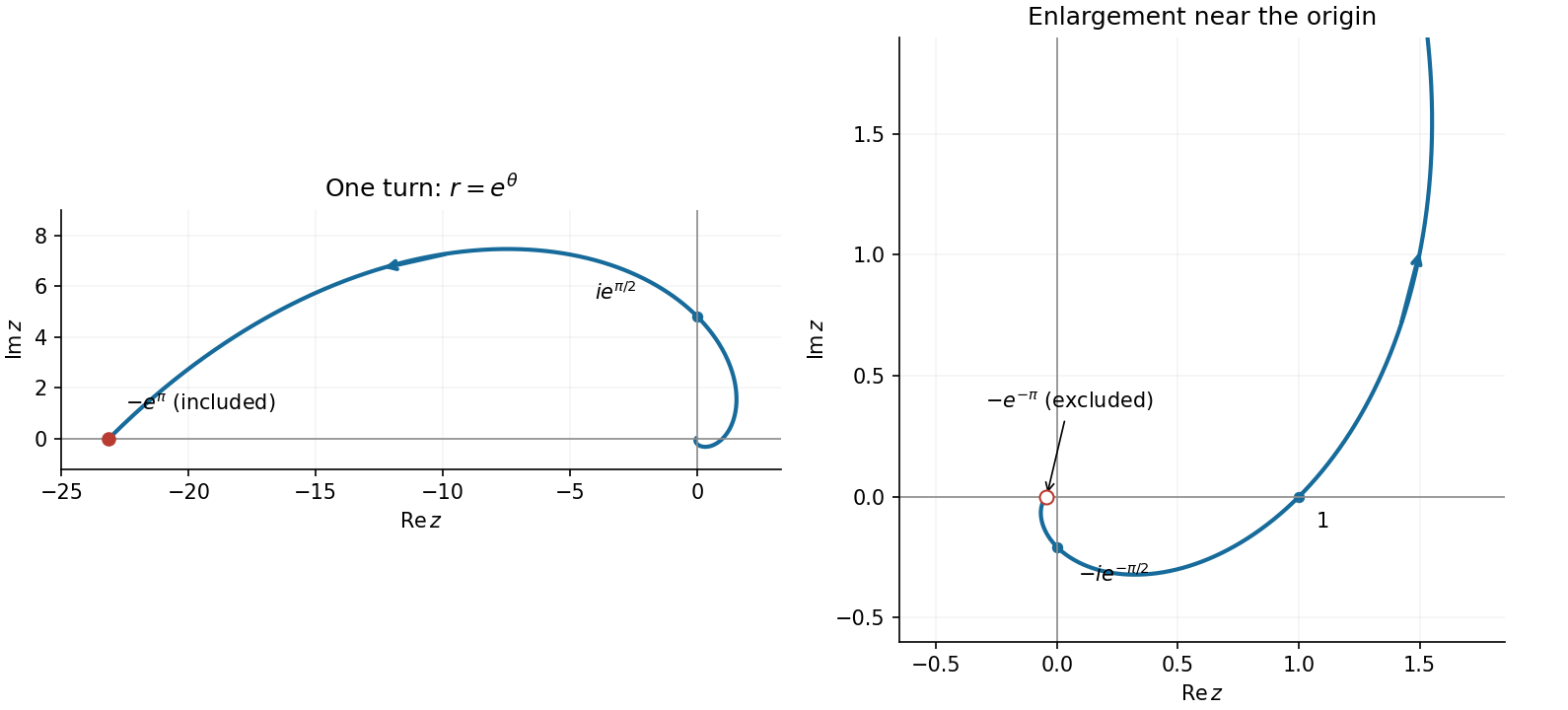
One turn of the logarithmic spiral, with an enlarged view near the origin
. Details. The height is constant along each circular ring, whose area element after angular integration is . The volume integral in cylindrical coordinates is thereforeHere . Using integration by parts, . HenceThe dimensionless coefficient is positive, and the cube root of a volume has the required physical dimension of length.
Integrate by horizontal slices. At a fixed height , the parabolic boundary gives ; the other inequality gives . Thus the cross-section is a rectangle of areaThe volume integral, followed by integration by substitution , isThis has units of volume. As a check on the geometry, the width decreases with height while the length of the horizontal slice increases from zero to .
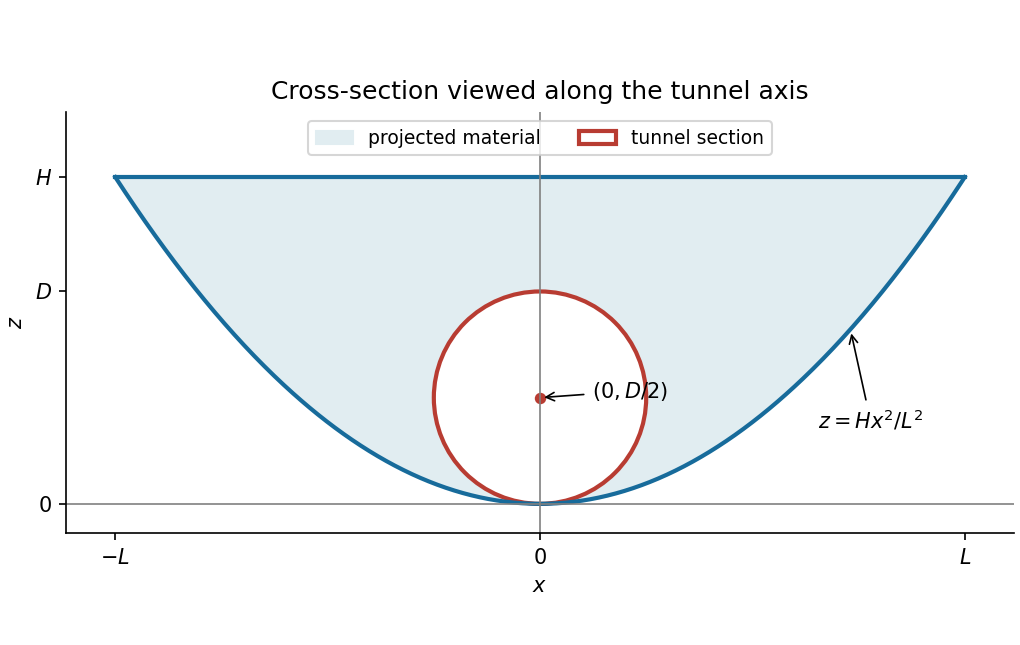
In the plane, the embankment lies above the parabola and below . The bore has circular cross-sectionIt touches the valley floor at the origin. To check that this entire disk lies inside the projected embankment, its equation gives . Since , it follows that , with strict inequality away from the bottom contact. Also . Thus no circular segment needs to be subtracted from the tunnel section.
For each in the disk, the length of bore inside the material is the local width . The required volume integral is thereforeThe disk has area and centroid height , so . Applying the volume of a solid with affine thickness formula givesThe width varies along the circular section; multiplying its area by the top width alone would miss this variation.


Let and . Their cross partial derivatives agree: . On the simply connected plane, this makes the differential form exact. Integrating gives ; matching then requires , so one potential isThe ordinary differential equation states along a solution. Its initial condition fixes the constant to . Hence the solution is specified implicitly byAt the initial point , so the implicit function theorem guarantees a unique local branch through that point.
For , multiply by to obtain the first-order linear ordinary differential equation . Its integrating factor is . The product rule then givesIntegration yields , soThe constant of integration is arbitrary on each connected interval of the original equation's domain. The formula extends smoothly through zero, but the printed equation itself contains and is not defined there.
The real equation has domain . Its integrating factor isThus the linear ordinary differential equation becomes . After integration, . The initial condition gives , hence
Write the scalar field as , where and . Its radial contribution to the Laplacian in spherical coordinates isFor the angular contribution, and , soCombining the radial and angular terms provesThe calculation uses to avoid coordinate singularities. In Cartesian coordinates, , which extends smoothly across the polar axis for . It therefore satisfies Laplace's equation there as well. The origin is a genuine singularity and is excluded.
Take the total differential of the logarithm of the relativistic energy, with the speed of light fixed:Using the chain rule,Every term is a dimensionless fractional change. The differential relation is exact; applying it to finite small changes is a first-order Taylor expansion.
Equal energies mean in the linear approximation. Evaluate the coefficients at particle , where , and use . The fractional rest mass change isConsequentlyAs a check beyond the requested first-order approximation, exact equality of relativistic energy gives , consistent with the sign and approximate size of the difference.
Work on an open domain with and , where the displayed square root is real and differentiable. Split with and . For the first term, the chain rule givesso .
For the second term, set . Its first partial derivatives areThey show , the degree-one case of Euler theorem for homogeneous functions. Differentiating that identity with respect to each variable yieldsThe mixed partial derivatives agree here by the chain rule. Multiplying these equations by and , respectively, proves the second derivative identity for a degree-one homogeneous function:Adding the results for and verifies the partial differential equationEquivalently, for positive , so the same proof follows directly from its homogeneous function property. The statement is local to a domain where the given expression is defined; it does not require assigning values on .
The finite form of Taylor's theorem iswhere lies between and when . Sufficient hypotheses are continuous derivatives up to order on the interval joining the endpoints and an th derivative in its interior. The first terms end at degree ; the Taylor remainder uses the th derivative. At the remainder is zero. This finite Taylor polynomial identity does not require convergence of an infinite Taylor series.
Write the sine argument as , with . The sine addition formula gives . Its Maclaurin series is , soThere is no linear term because the outer sine has zero derivative at .
Set , the displacement from the expansion point. The numerator has Taylor series , while the reciprocal denominator has geometric series . Multiplication givesThe local power series converges for , the distance to the denominator's zero at .
Use the Maclaurin series of the logarithm and hyperbolic cosine:To retain terms through degree six, only the constant and quadratic terms of the reciprocal factor can multiply the leading cubic term. ThusThe numerator in the original PDF is ; the cubic power is missing from the local TeX transcription.
Use the intended model of uniform draws and a replacement decision independent of the first ball's colour, with probability . The marginal specification alone would not determine the experiment if replacement depended on that colour. This independence assumption is used throughout the question.
Write for a non-blue draw and for no replacement. The sample space consists of the eight ordered outcomes obtained by choosing one of , then one of , then one of . The chain rule for probabilities gives their probabilities:For example, the first entry is . The fifth is because one blue ball has been removed. With no replacement after a non-blue first draw, the two remaining colours each have two balls, explaining the last two entries. The first four entries sum to and the last four to , so the full sample space has total probability one. At or , the corresponding impossible outcomes simply have zero probability.
For sampling without replacement, sum the two outcomes with a blue second draw:The marginal blue probability equals the initial blue fraction even though the two draws are dependent.
Condition on whether replacement occurs. Both alternatives have blue second-draw probability , so the law of total probability gives
The event of two blue draws splits into disjoint replacement and no-replacement cases. Their probabilities from the sample space are and . Hence
By the definition of conditional probability, or Bayes' theorem,Its denominator is positive throughout the specified range. Observing two blue balls raises the probability of replacement for , because replacement makes a repeated colour more likely.
Let . Under replacement its joint probability iswhereas without replacement it isIn the latter case the first removed ball is non-blue, so all blue balls remain. Applying Bayes' theorem and cancelling the positive common factors yields the posterior replacement probability after different-colour draws:It does not depend on . To prove the requested bound directly,Equality holds at and , and the inequality is strict between them. Its sketch joins to , stays below the diagonal, and is increasing and convex becauseThe interpretation is that removing a non-blue ball increases the chance of blue on the second draw; seeing the two different colours therefore favours the no-replacement explanation.
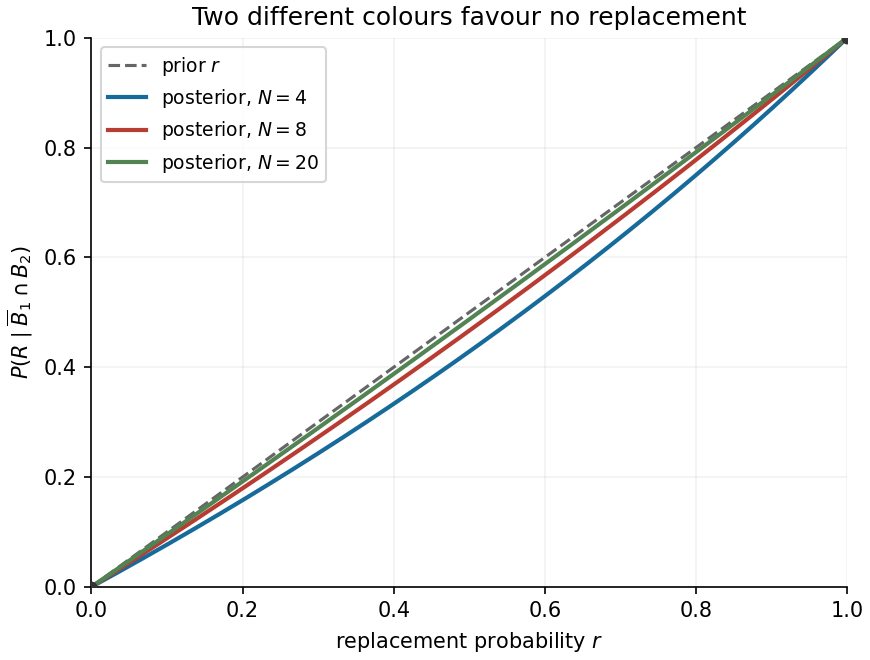
Posterior replacement probability lies below the original replacement probability
. Details. 
Articles were limited to the first 100 out of 137 total.
Articles by others on the same topic
There are currently no matching articles.