The cross product of the direction vectors is . It is nonzero, so a common perpendicular direction exists. Projecting onto its unit vector gives the distance between skew lines:ThusThe numerator is a scalar triple product; movement along either line does not change this perpendicular projection.
Use only the dot product to minimize the squared Euclidean distance from the origin:Completing the square givesThe square is minimized at , yieldingGeometrically this subtracts the squared length of the orthogonal projection parallel to the line. At the minimizing point, , as required for perpendicular distance.
Here , and . ThereforeThe closest point has parameter and position , whose norm gives the same result.
For a point , the magnitude of is the area of a parallelogram. Dividing by its base length gives the perpendicular Euclidean distance to the first line. Explicitly,HenceThis use of the cross product removes any component parallel to the first line automatically.
The graph is the upper branch of the hyperbola . It is symmetric about , positive everywhere, and has its lowest point at . Its derivatives areso it is strictly convex. Sinceits two oblique asymptotes are
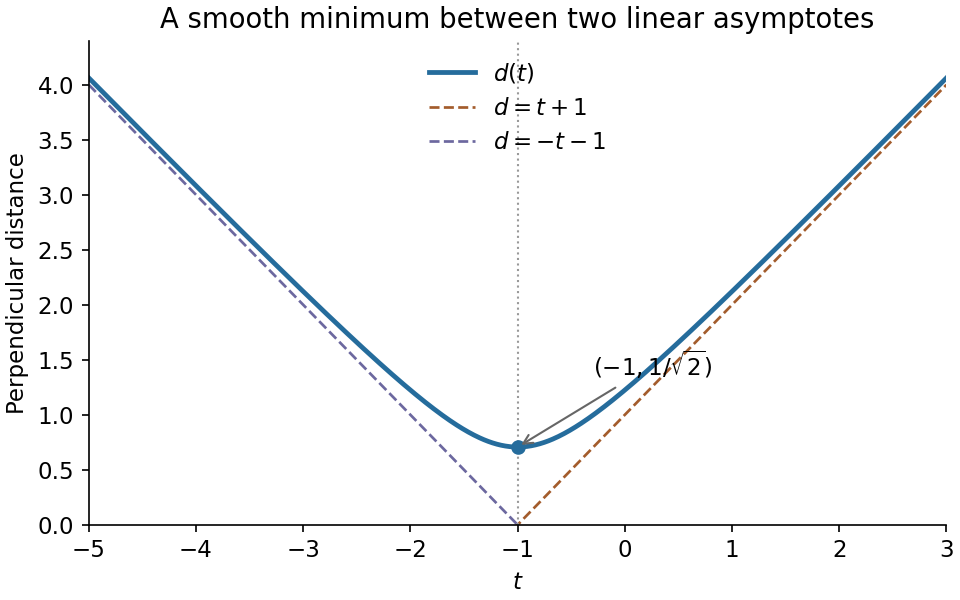

The square is minimized when its first term vanishes. ThereforeThis agrees with the distance between skew lines found in part (b). The corresponding parameter on the first line is its orthogonal projection valueThe closest pair is and ; their connecting vector is perpendicular to both direction vectors.
Articles by others on the same topic
There are currently no matching articles.