At , the gradient is . The position vector has length , so its normalized direction is . Hence the directional derivative is
For a stationary point, the two factors from part (a) must vanish. If , the second equation gives ; if , the first gives . Thus the axis points are .
If both coordinates are nonzero, solve and , giving . These four points complete the list of nine stationary points.
For classification, the Hessian matrix isAt its eigenvalues are , and at the four unit-axis points they are . These five points are saddle points of a scalar function, all with value zero.
At and the eigenvalues are one and two, so both are strict local minima of value . At and they are minus one and minus two, so both are strict local maxima of value . This follows from the second-derivative test. These extrema are local: the polynomial is unbounded above and below on the full plane.
The zero level set is especially simple:The two axes and the unit circle divide the plane into regions where the signs alternate. Inside the circle, has the opposite sign to ; outside it has the same sign. Closed level curves surround the two interior local minima and two interior local maxima; the zero curves cross at the five saddle points of a scalar function. Farther out, the nonzero level curves are open within the displayed square.
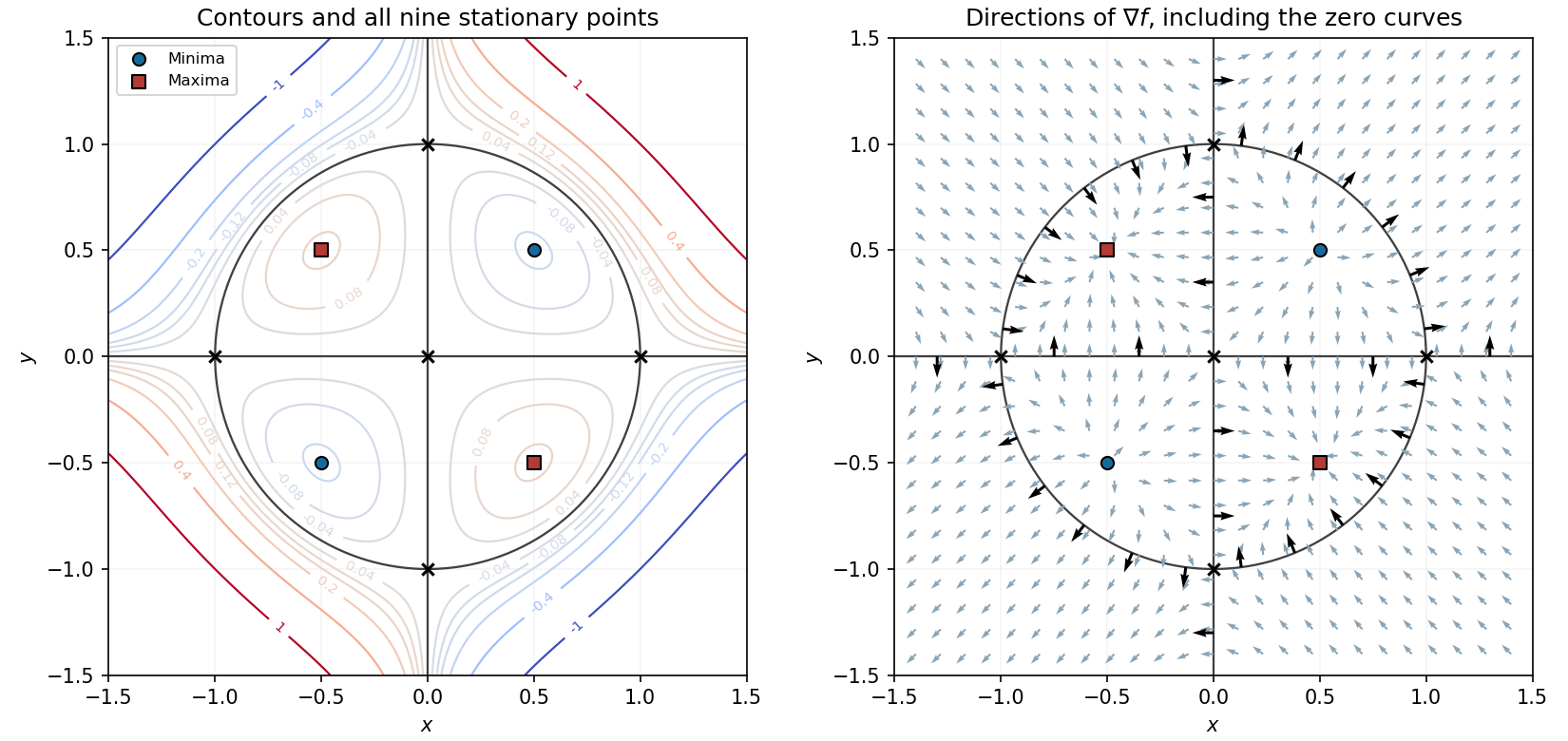

Near each local minimum, the gradient points outward; near each local maximum, it points inward. The five remaining points have saddle directions, determined by their indefinite Hessian matrices.
On the -axis the exact gradient is , and on the -axis it is . Thus arrows are perpendicular to the axes and reverse direction at the origin and the unit-axis stationary points.
On the unit circle, substitute into the gradient to obtainIt is radial outward in quadrants I and III, radial inward in quadrants II and IV, and zero at the four axis intersections. These arrows, together with the nearby saddle and extremum patterns, are shown in the right panel of the contour figure. The gradient is normal to every regular level curve and points toward increasing values of .
Articles by others on the same topic
There are currently no matching articles.