The wave equation is a homogeneous linear partial differential equation. Consequently, if and solve it, every constant linear combination also solves it. This is the superposition principle, because partial differentiation distributes over the linear combination.
The same statement holds for the homogeneous Neumann boundary conditions. Initial conditions combine in the same way; an arbitrary combination need not retain a fixed nonzero initial displacement.
The equation as printed requires ; its sign does not affect the result. Seek separated solutions . Substitution into the wave equation givesThe Neumann boundary conditions impose . Multiplying the spatial equation by and integration by parts gives , so nontrivial spatial eigenfunctions require .
For , is constant and . For , . The first boundary condition gives , and the second gives . Thus is a positive integer and the spatial eigenfunctions are . Their time dependence is . By superposition,The zero initial velocity sets . The trigonometric identity gives the initial profile , so only the constant mode and the first cosine mode occur. HenceIts spatial derivative is , which vanishes at both boundaries, and its time derivative vanishes initially. Thus it satisfies all the required data.
For the two travelling profiles, the initial conditions implySince , is constant. One may therefore choosewhere the constants cancel in the sum. The D'Alembert formula then givesThis agrees exactly with the restricted-domain solution from part (b). The whole-line cosine profile already has zero spatial derivative at both and for every time, so its restriction satisfies the Neumann boundary conditions without further modification.
The standing wave oscillates about the constant level , with time period . Suitable snapshots areThe nonconstant amplitude shrinks to zero at a quarter-period, reverses sign at half a period, and returns after a full period. The nodes of a standing wave of the oscillatory part, , remain at height .
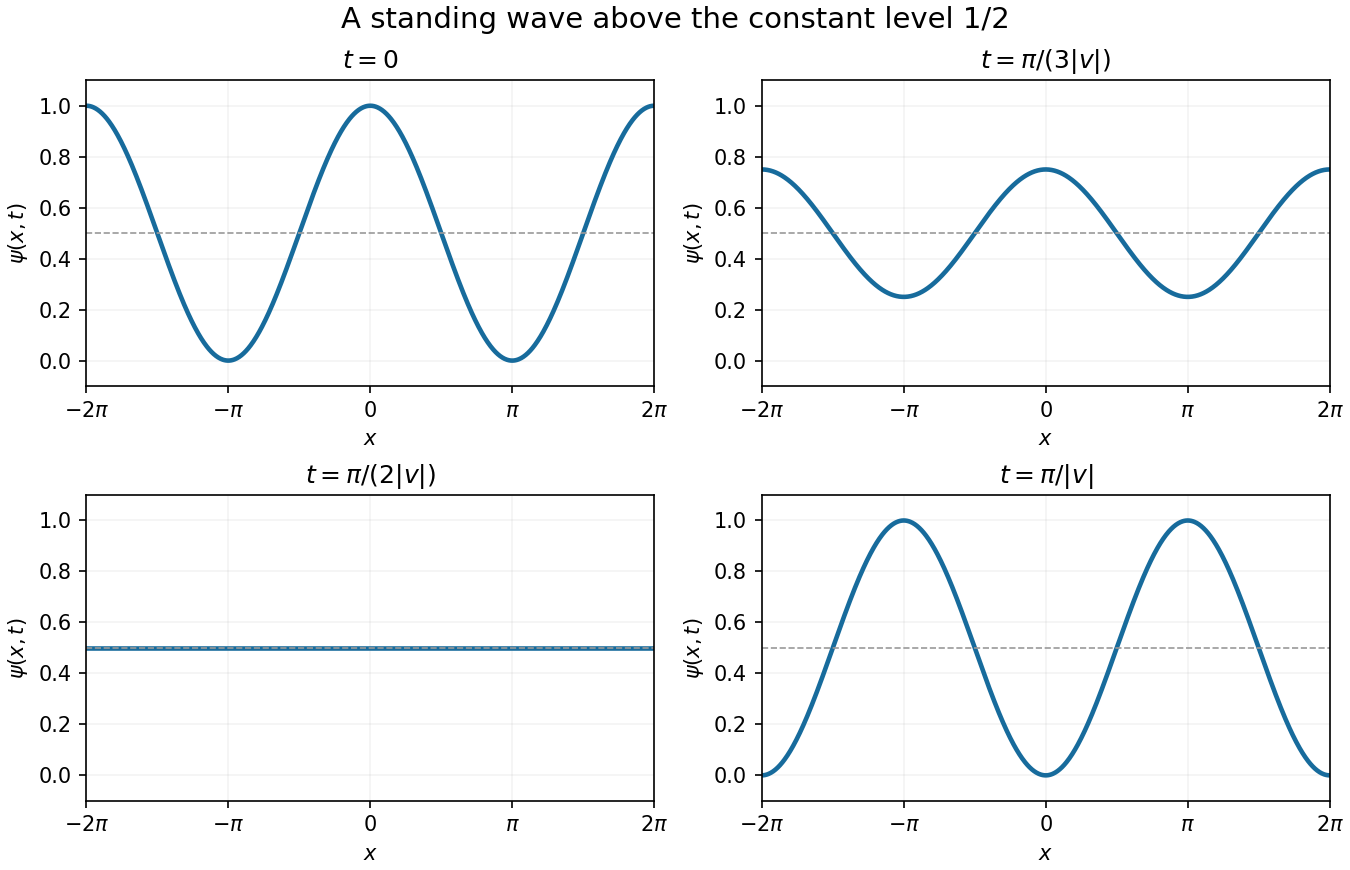
Time evolution of the whole-line Neumann-compatible standing wave
. Snapshots at phases , , and illustrate contraction, flattening and reversal of the cosine profile. A full-period snapshot repeats the initial curve. Details.
Articles by others on the same topic
There are currently no matching articles.